
Creeping Maple. A Discovery. And Questions.
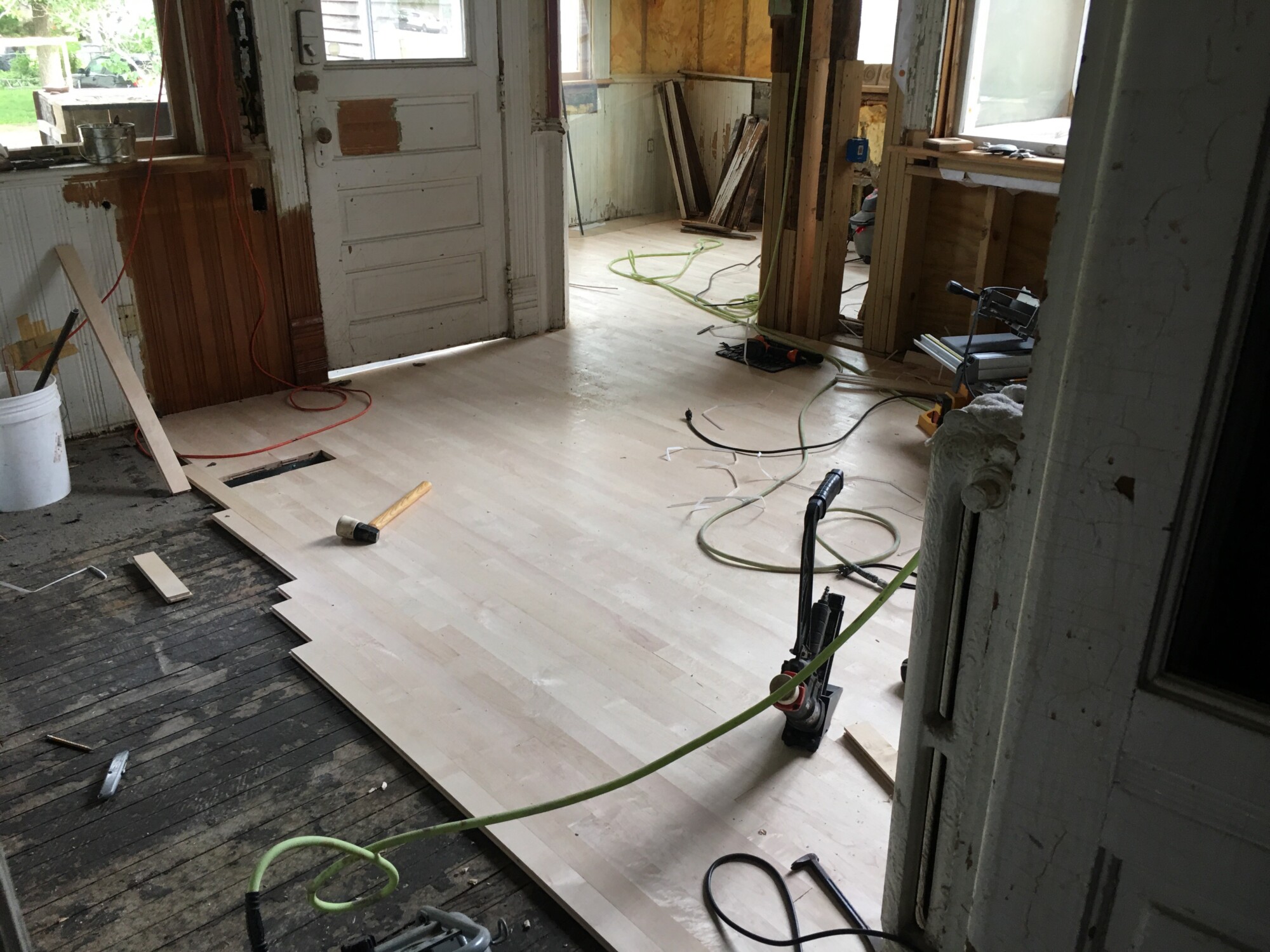
The new maple flooring has now crept into the kitchen!!!!!!!!
For seven years, with immense forbearance, I have overlooked the kitchen flooring, the most damaged in the house. So, you can imagine my thrill at having a good, solid floor! Squee!!!!!!!!
If it were not for Covid, I would schedule a dance party upon the new floor!
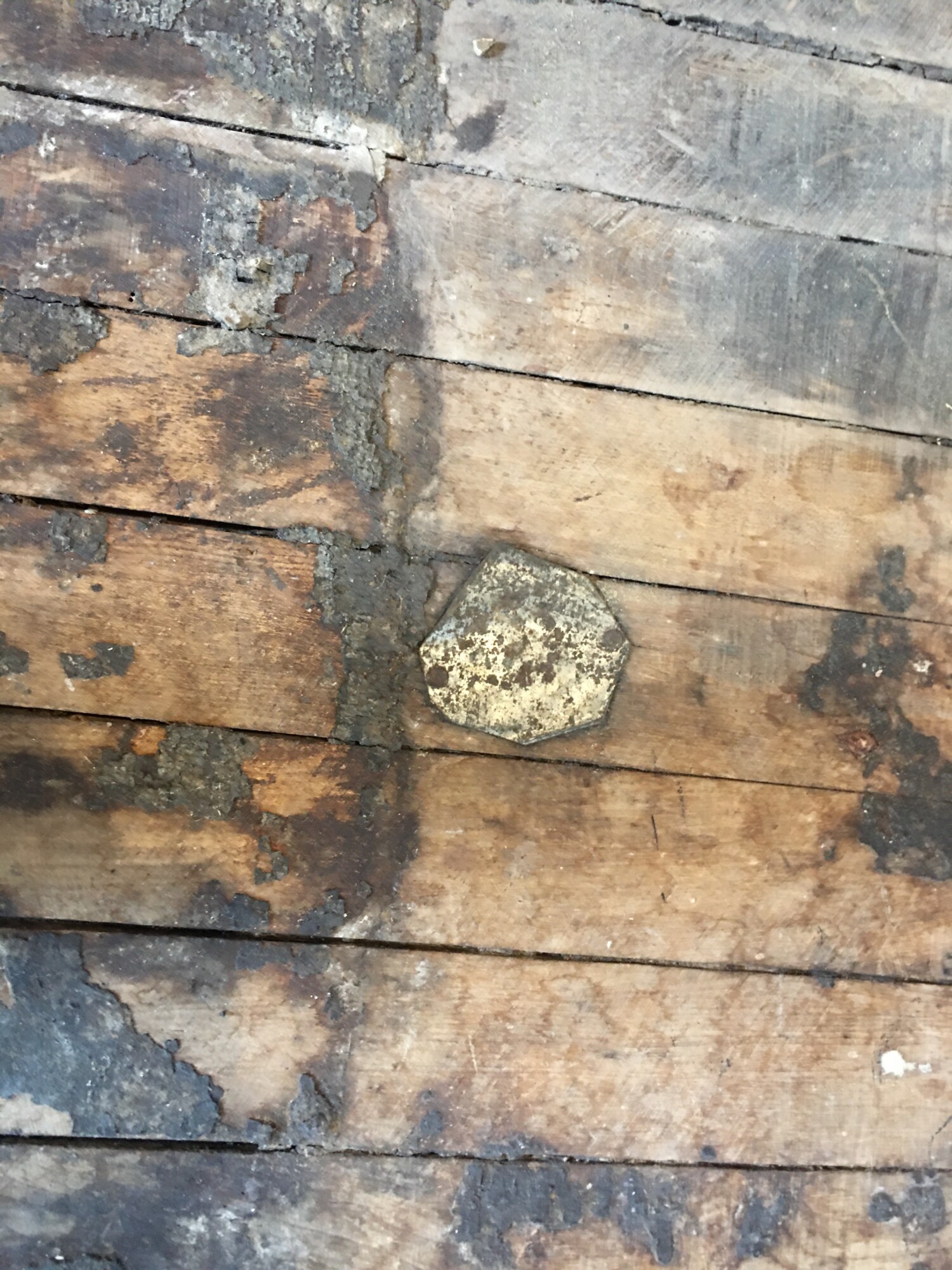
An old patch. This was put in place before the first layer of Linoleum was installed.
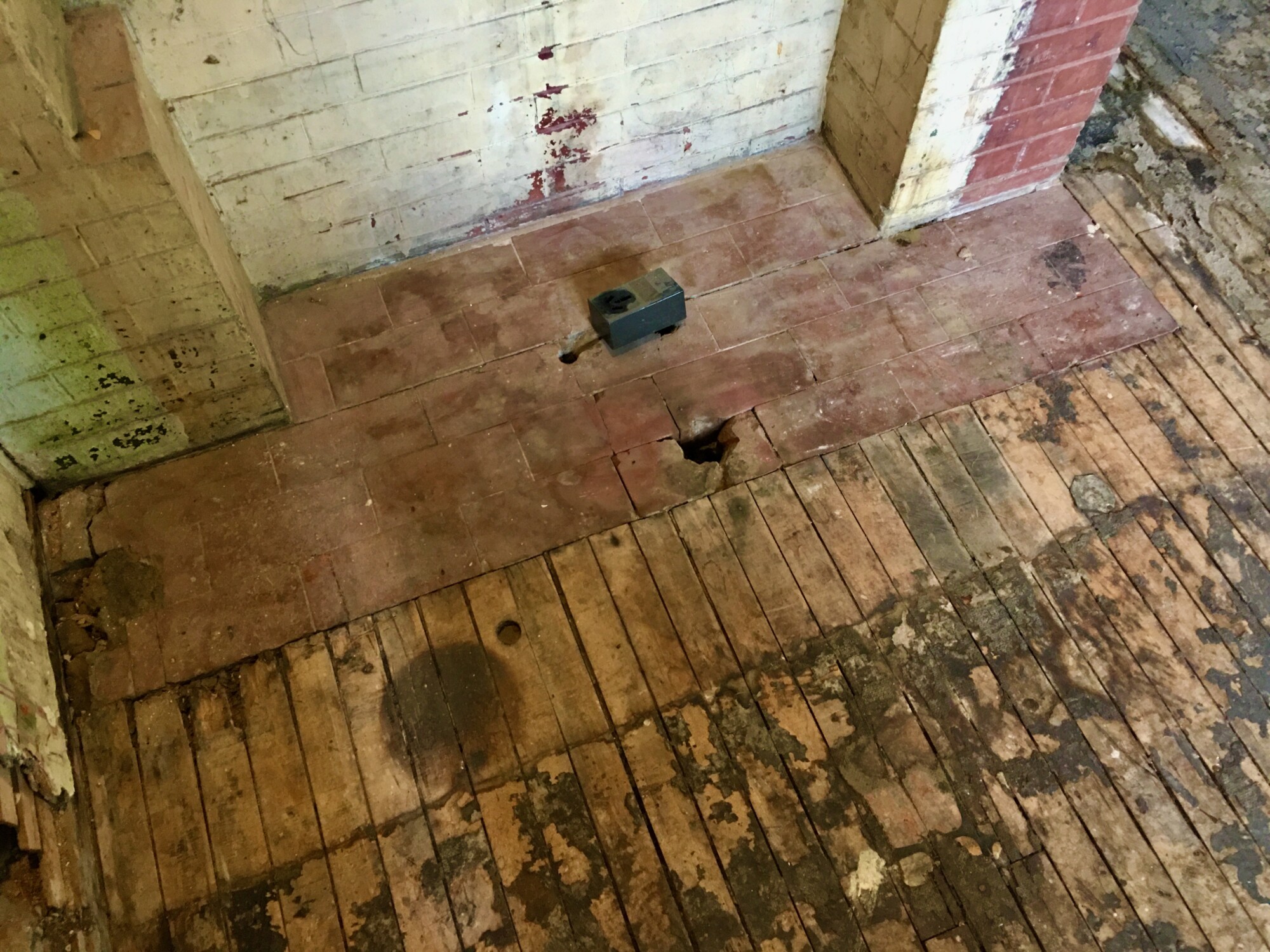
In the NW corner is the brick enclosure for the 1894 coal stove. At a glance, this image only informs about the 1894 brick hearth. But…
…there is a lot more information being revealed in the image.
See the original maple floor adjacent to the hearth? See the black glue? Note how it stops in an even line parallel to the hearth, and short of it?
See, too, the hole in one brick?
See, too, the black box on the brick? That is a 220W electrical outlet I installed way back for the stove. But, I did not drill through the brick to bring in the electrical line, for there were already two small holes through the brick. You can see one; the other is covered by the black outlet.
What does all this mean?
Methinks this evidence shows that while a stove was here in 1894, before a Linoleum floor was laid down, a sink and cabinet were installed in this location. For, the evidence:
- the black glue stops short of the brick hearth, and in a manner indicating a built-in cabinet.
- the large hole in one brick is just where a drain line would be for a sink.
- the two smaller holes in the brick are just where hot/cold lines would be for a sink.
I did not put all this together until today. And I am delighted that the Cross House continues to surprise. The minx!
(Once the new maple flooring reaches the brick hearth, The Other Justin will stop at the hearth and install trim pieces neatly outlining the hearth.
I plan to install a refrigerator into the brick niche, so will place wood ‘runners’ to keep the refrigerator level.)
What fascinates me about this discovery is that, before the house was 40-years-old, the kitchen appears to have been ‘rethought’ and reconfigured.
It seems likely that such work would have been done when Scott Mouse, Sr. purchased the house in the late 1920s. He then proceeded to renovate the second-floor into apartments, while creating a suite of rooms on the main floor as a residence for his family.
This is known.
This, too, is known: At some point, the kitchen dumb-waiter was removed, as was the adjacent laundry chute (the chute is extant on the second-floor) to create a hall from the kitchen to the south hallway.
The following is conjecture:
- I have always presumed that the removal of the kitchen dumb-waiter and laundry chute was done during the 1920s renovation, to allow the Mouse family to privately go from their living room (the original dining room), through the kitchen, into the south hall, and into to their bedroom (the original library). The stairhall would have been a ‘public’ space used by the apartment residents, as was, it seems, the original parlor.
- During the 1920s renovation, the kitchen sink, presumably installed originally in the SW corner (in front of the huge south window), was moved to the NW corner in front of the brick stove niche.
The evidence as revealed by the above image supports #2.
If this is correct though…where was the stove then placed? And the refrigerator? The latter did not exist in 1894.
I am gonna guess that a refrigerator would have been placed along the east wall (as there was no other location possible), and a stove in front of the south window. If not, where might they have been placed?
Another curiosity? See the perfectly round black mark on the maple floor, lower left? What caused that?

22 Comments
Leave a Comment
Your email address will NEVER be made public or shared, and you may use a screen name if you wish.
The black round mark at the edge of the previous linoleum: someone “parked” a heavy, very hot pot on the floor prior to being washed?
That black round mark? I’m not sure how coal stoves work but do you ever have to remove glowing hot coals? I can see that mark being made from a bucket full of glowing hot coals.
It’s also possible that a cast iron dutch oven that was extremely hot was placed there for long enough to scorch the wood.
Yes, a bucket of hot coals might explain the black mark.Thank you!
Some wood/coal stoves had removable lids in the top, which were round and roughly the size of a pot. They could be lifted out using a poker-like tool. If someone dropped one of those, that would easily explain the large round burn mark!
I forget which end of the 1920s decade the apartment conversion was done, but it’s likely that they still did not have a refrigerator in the home at that time, and continued to use the icebox. The classic GE “Monitor” electric refrigerator wasn’t released until 1927, and prior to that, although home refrigerators did exist, they were not affordable or commonplace.
Our circa 1926 home was built with a special nook off the back of the kitchen for an icebox, complete with a door through the outside wall and step below it so the ice delivery man could put ice directly into the icebox without coming inside.
My grandparents didn’t get their first refrigerator until the early 1940s (also when they had their farmhouse first electrified).
To further back up your points, I read somewhere that the modern refrigerator wasn’t invented until the early 1920s and did not become available to the public until the late 1920s. However, they were more expensive than a Model T automobile. It wasn’t until the 1940s that the modern refrigerator became common in American households.
Kerri, the classic General Electric “Monitor-Top” refrigerator was introduced in 1927 and cost $525. This seems cheap, but this translates to a whopping $7,700 in 2021 money! Yes, more than a Model T in 1927! Nonetheless, over a million were sold.
As I mentioned, the late 1920s apartment conversion plans for the Cross House indicate refrigerators in each apartment. So…?
Hi Ross. This is not anything important at all. I just thought it was interesting and might
answer your question as to where the refrigerator was placed in the 1929 renovations. The
main point of the article was that refrigerators did not become commonplace until the 1940s.
With a population of 119 million in 1927, selling 1 million doesn’t seem like a lot to me.
Do the conversion plans actually list refrigerators? Maybe, he was adding brand new ice
boxes. But, again, it’s not important. It just seems like a lot of money for Mr. Mouse to spend
on rentals.
Thanks for the stories, Seth!
I am confident that Scott Mouse would have ordered a new-fangled refrigerator for the kitchen, as the second-floor apartment conversion plans also show refrigerators.
While a hot pot seems likely, there appears to be a small hole in the floor next to the scorch mark. Could this have been a hot water heater next to the sink, with an adjacent gas or water line? We had a hole and pipes from one next to the chimney in our 1915 house.
https://oldapplianceads.com/wp-content/uploads/2014/06/lawson-water-heater-1905.jpg
The placement would be a bit odd so far from the wall, but there was likely more built into the corner at the time.
Colin (pdx)
The tall tank in your example (called a “hot dog”locally) could be hooked not only to a gas heater, as this high-end model was, but also to a coal/wood range with a water jacket in the firebox, or a laundry stove, also with a water jacket around the “belly”. There were over/under water connections in the jacket, plumbed to the hot dog so that heated water from the “over” outlet rose up a pipe to the connection at the top of the tank, which injected it through a dip tube into the bottom of the tank. Colder water from
the tank flowed into the “under” connection in the jacket. No pump, hydronic, don’t you know! I still have the whole setup–glass tops in the ornate stands being used as tables, laundry stove and tank in the basement waiting for the apocalypse.
Hi, Colin! The lack of black glue on the original floor strongly suggests that a built-in cabinet was installed against the brick chimney, and the holes in the brick hearth strongly suggest that the cabinet included a sink. This work was, methinks, part of the late 1920s work on the house, which was extensive.
A hot-water heater (as you link to) was common in the 1890s, and I’ve always assumed one was in the Cross House. But…where? It seems unlikely that it would have been where the round black mark is (too close to the adjacent door, and too close to the original coal stove).
We had a house once with no central heat. Gas stoves had been placed in several of the rooms in the 1920s. Under each was a board covered in metal to deflect the heat off the combustible wood floor and back into the room. Could there have been something similar under your stove? Hence the black linoleum goo line?
An intriguing thought, David. But…I can’t see this. The ‘goo line’ offers strong evidence of a built-in cabinet being installed.
I can’t answer your question, but I did want to say that the floor is beautiful! And I would be happy to be part of your virtual dance party. Working on my moves now!
Ditto here, that kitchen makes me happy just to look at it, even in its current state, so bright and light. Can’t wait to see it all come together.
Ross happy, too, Katie!
Work those moves, Barb!
Hi Ross. If the stove was there, could it be that at some point a hot pot might have been placed on the floor and singed that circle?
It’s possible, Marcia!
Are there any clues on the underside of this floor (in the basement) that would confirm the placement of a sink or other appliance in this space?
Ross, you’ve earned the title of Super Sleuth for all you’ve uncovered and deduced from the clues in the house! I bet you’re right about the sink being installed here, where there was previously a stove. I love the background of “how” people existed in these old homes… and the thought of someone either putting a hot pot or a bucket of coals down and causing that burn mark just brings the previous occupants to life. Keep on, Super Sleuth!