
The Case of the Mysterious Door. RESOLVED!!!!!!!!

This is an original drawing of the Cross House stair elevation. But, I learned long ago that there is often a difference between AS DRAWN and AS BUILT.
The stair, as drawn, had steps spilling to the north, and with curved corner wall (right). So, the whole lower stair was intended to be an L-shape. However, as built, the whole lower stair was a U-shape with the steps spilling down to the east. And the plastered corner, while framed out as a curve, was never finished as such and the corner was squared off.

As built. Ignore the red arrow.
All this, though, is not vital at the moment. What is vital is the door shown to the left. That was the door into the library. The drawing states that the door was 8-feet high. This would have matched…
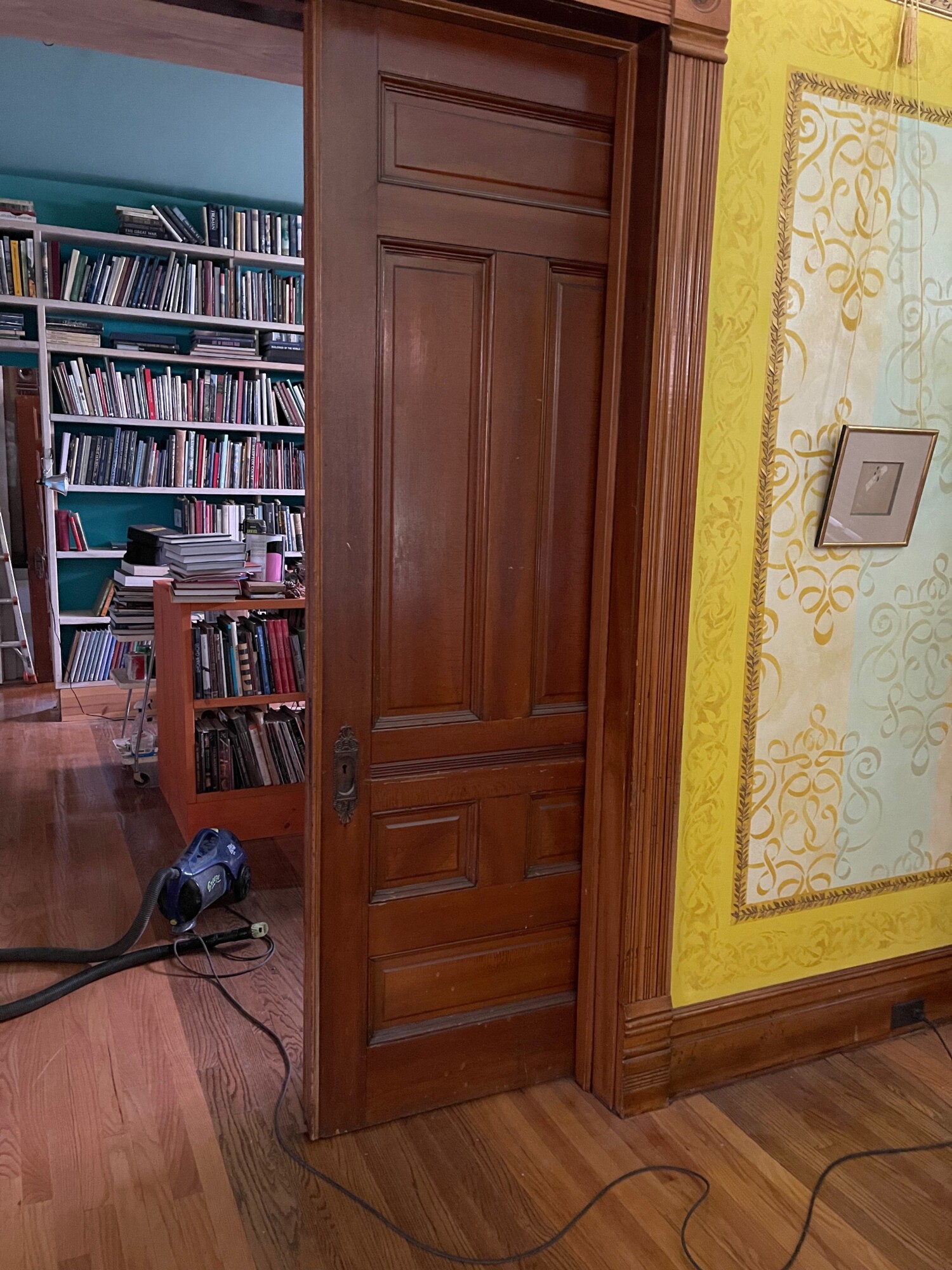
…the pocket door to the library, and…
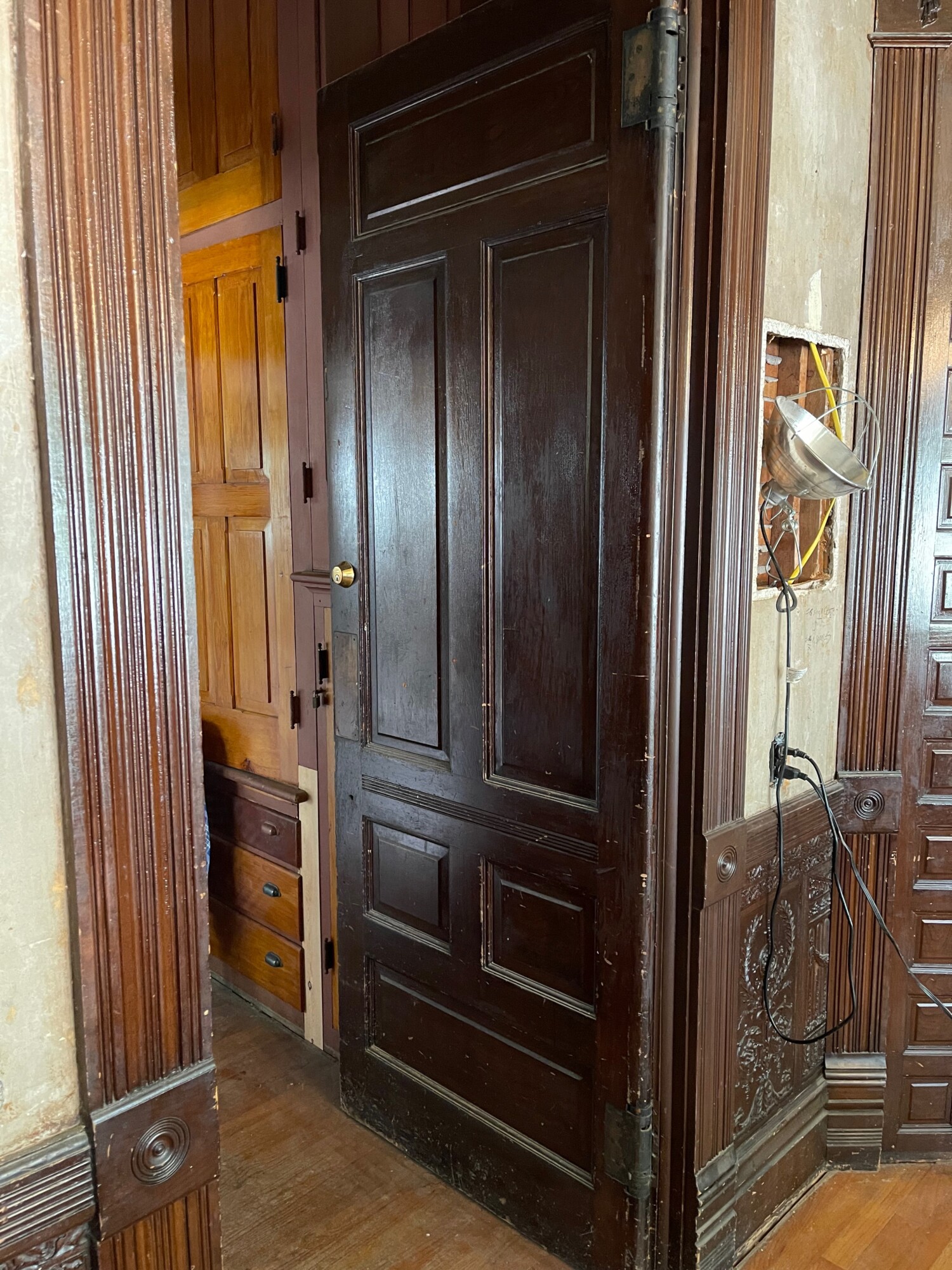
…the only other first-floor interior 8-foot door: the swing door to the butler’s pantry. These tall doors feature a rectangle bottom panel, two square panels above, then two LONG vertical panels, and then a final rectangular panel. See?
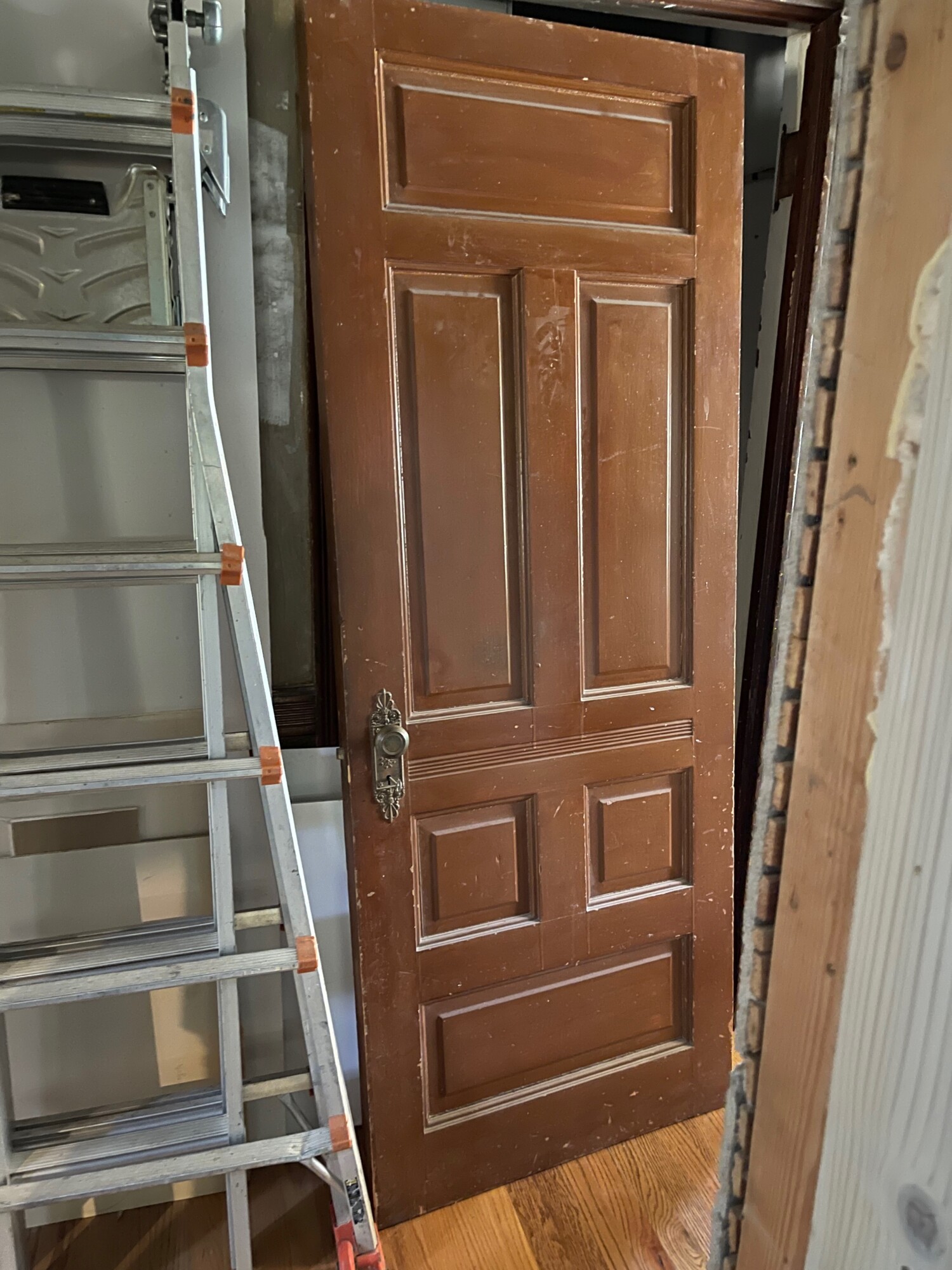
The library door though does not match the 8-foot doors. Note how the vertical rectangular panels are much shorter? This door is 7-feet high. Huh?
I have done two previous post on the library door. Make sure you have some time…and wine…before clicking on these links:
Here.
Here.
In short, I discovered…to my great astonishment…that the library door in situ was originally the door to the basement, in the kitchen.
Huh?
So, how did it end up as the library door????????

For several years I pondered: Was the library door even originally installed under the stair as shown in the 1894 drawing? This image from 2000 confirms that it was. You can see the 1894 blocked-up door to the left of center. Note the dark header. To the right is the relocated door. Was this done in 1929 (when the house was converted into apartments, and the library became the bedroom to the owner’s suite), or in 1950 (when the house was converted into a motel)?

In 2014, I relocated the door to the north end of the east wall (left). It had been on the south end of the east wall (right). I also recreated the diagonal framing. Yes, I am fabulous that way.
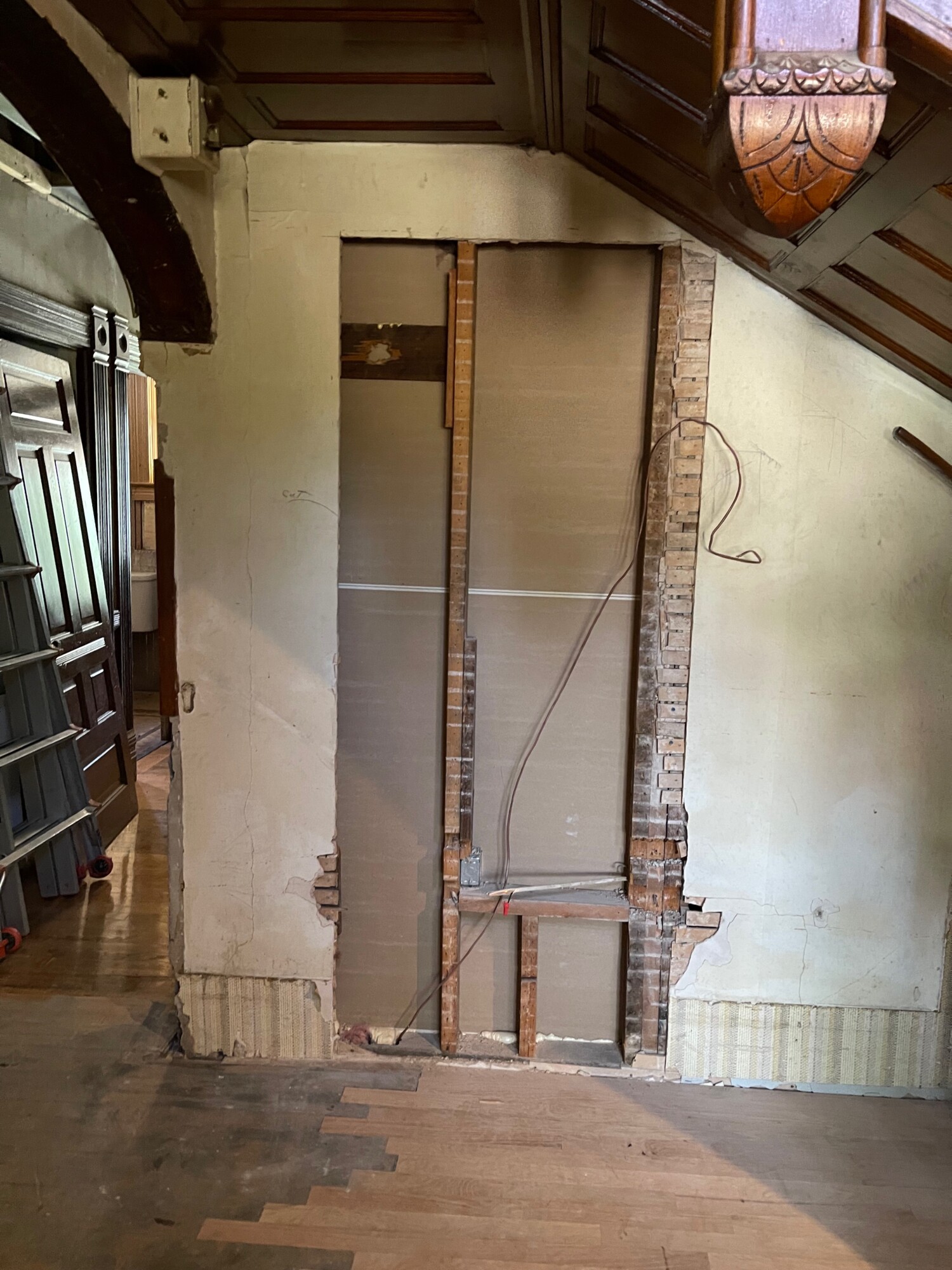
However, because I am crazy, I am in the process of returning the library door to its near-original location, under the stair on the north wall. (See the new oak flooring? I had that installed to cover over the 1950 basement stair I removed in 2014. The stair provided convenient access to five motel rooms in the basement.) Now, to the right of the new opening…
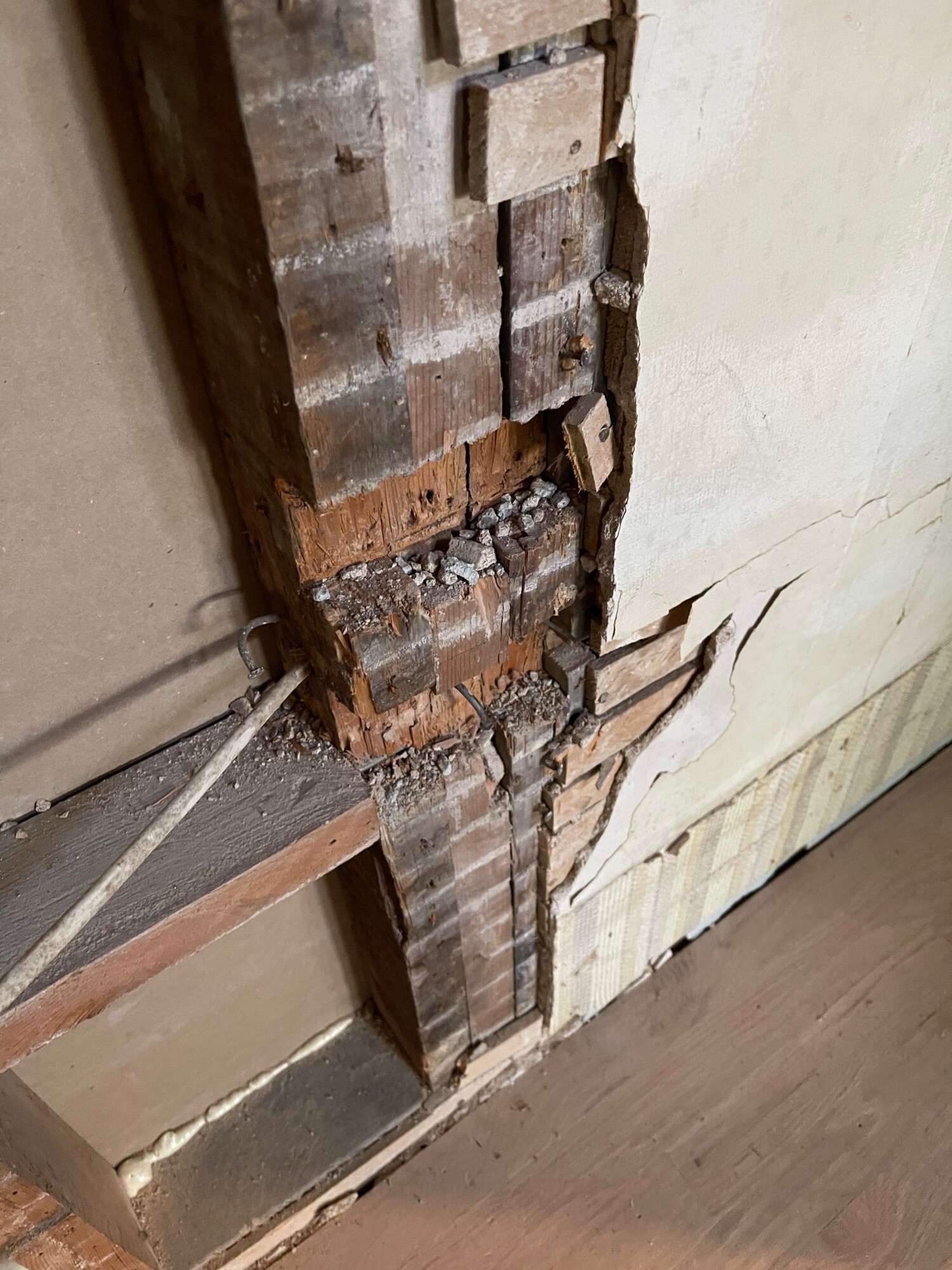
…are three studs. I do not know why they are hacked out. These triple studs are the original west support for the 1894 door header.
While this drawing states that the library door is 8-feet high (click drawing to enlarge), the door is DRAWN at 7-feet high. Huh???????? Note, too, how vague things are: the door is shown with no trim. It seems like the architect was not sure how the door would be finished off.
An 8-foot high door would have been higher than the stair landing. Oh dear.
So, back to What Was Intended. There is no question that what was planned was not actually built. My conjecture is thus: The stair, as drawn, did not have enough stair treads to actually work. As drawn, there are five steps to the lower landing. As built, there are seven treads.
And, remember, the library door in the drawing is stated to be 8-feet high but is drawn 7-feet high.
In short, all this is an 1894 fuck-up.
Yep, a fuck-up.
In my long career as an architectural designer and house restorer I have often had to…on the spot…create solutions to unforeseen fuck-ups.
And this, it seem, is what happened in 1894 at the Cross House.
The library door as drawn and, as dimensioned, do not match. A fuck-up.
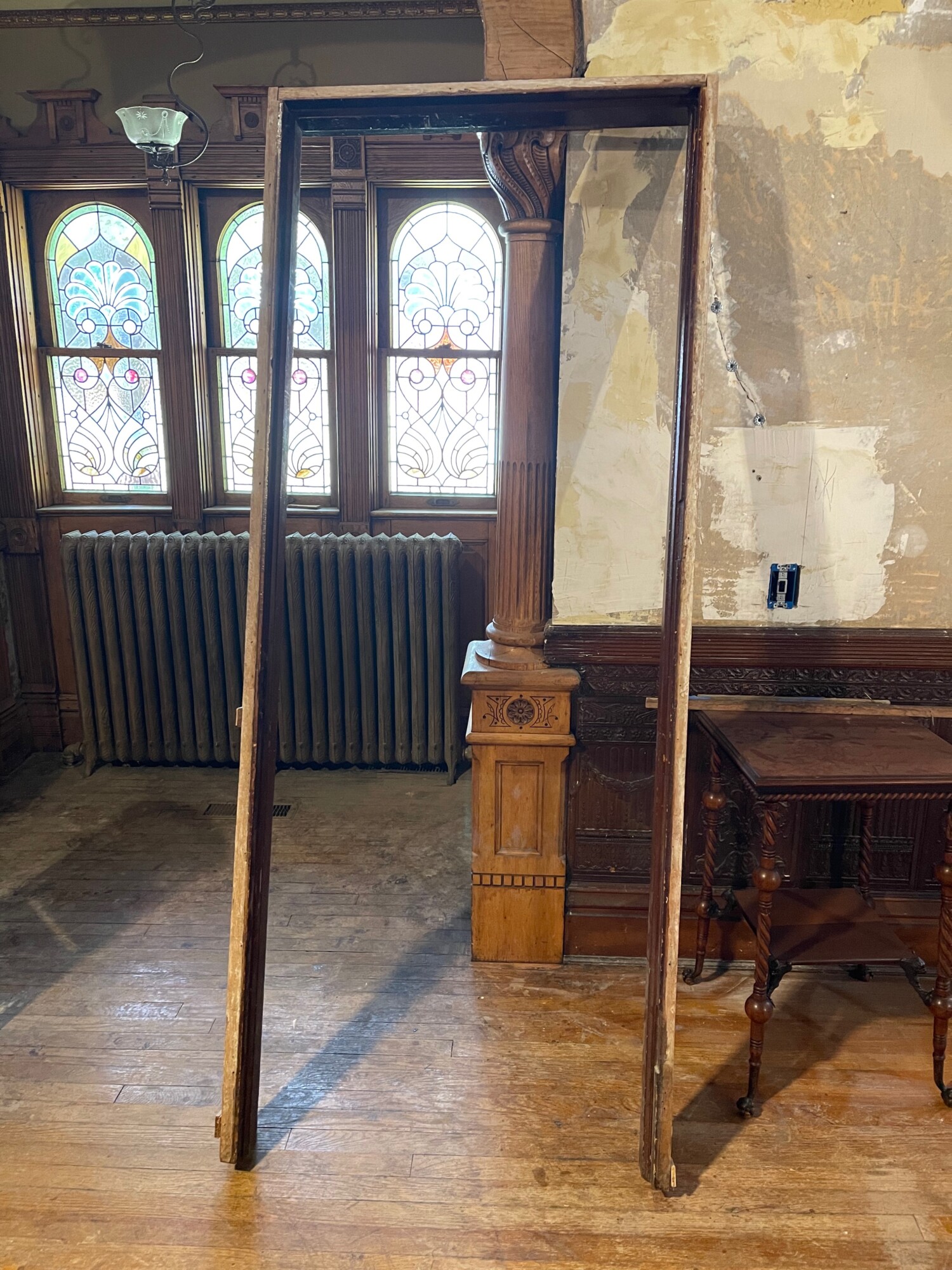
This is the 1894 library door frame. It now fits a 7-foot-high door. However, it originally held an 8-foot-high door. How can I be sure of that?
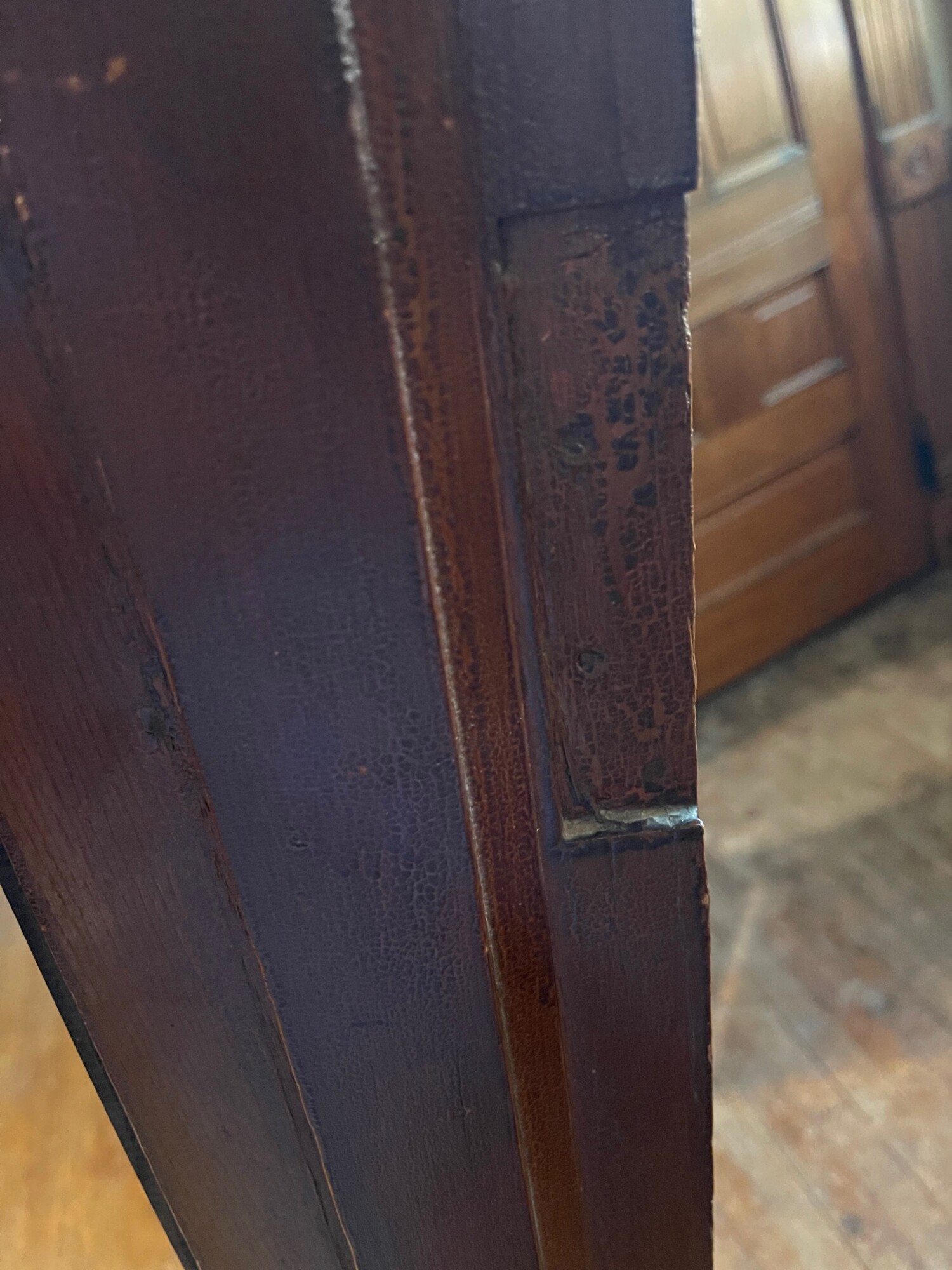
An 8-foot-high door will have three hinges: Top, middle, and bottom. As do the 8-foot entry doors in the house. But this door frame is missing the top hinge pocket. This proved to be a clue: the frame had been cut down.

This image though, after much thought, revealed a lot. See the red arrow?
That is the header for the 1894 door. It is a single 2×6. Huh? It should be THREE 2×6. The header is behind the stair landing. This, too, proved to be a clue.
So, here is what I think happened:
ALL CONJECTURE:
The architect ordered a pair of 8-foot-high pocket doors for the library. These are in situ.
He wanted the single door to the stair hall to match. As would I.
And 8-foot-high door and frame were ordered and delivered.
Then…the stair drama happened, and the stair was radically revised. The final location of the second stair landing (just above the door) proved LOWER than the library door.
Oh dear. What to do? What to do?
The architect, a brave and whimsical man, went ahead and installed the tall door. For, no matter the height of the stair landing, a tall door would fit into the wall. Thus, while in the library, upon opening the 8-foot door, a 7-foot-high aperture would be revealed. And the ugly header would have also been revealed.
“No problem!” stated the architect. He then ordered that the door fame be notched to fit around the header, and he covered the header with an elegant piece of paneling. Quirky, yes, but I have seen this kind of detail before. Indeed:
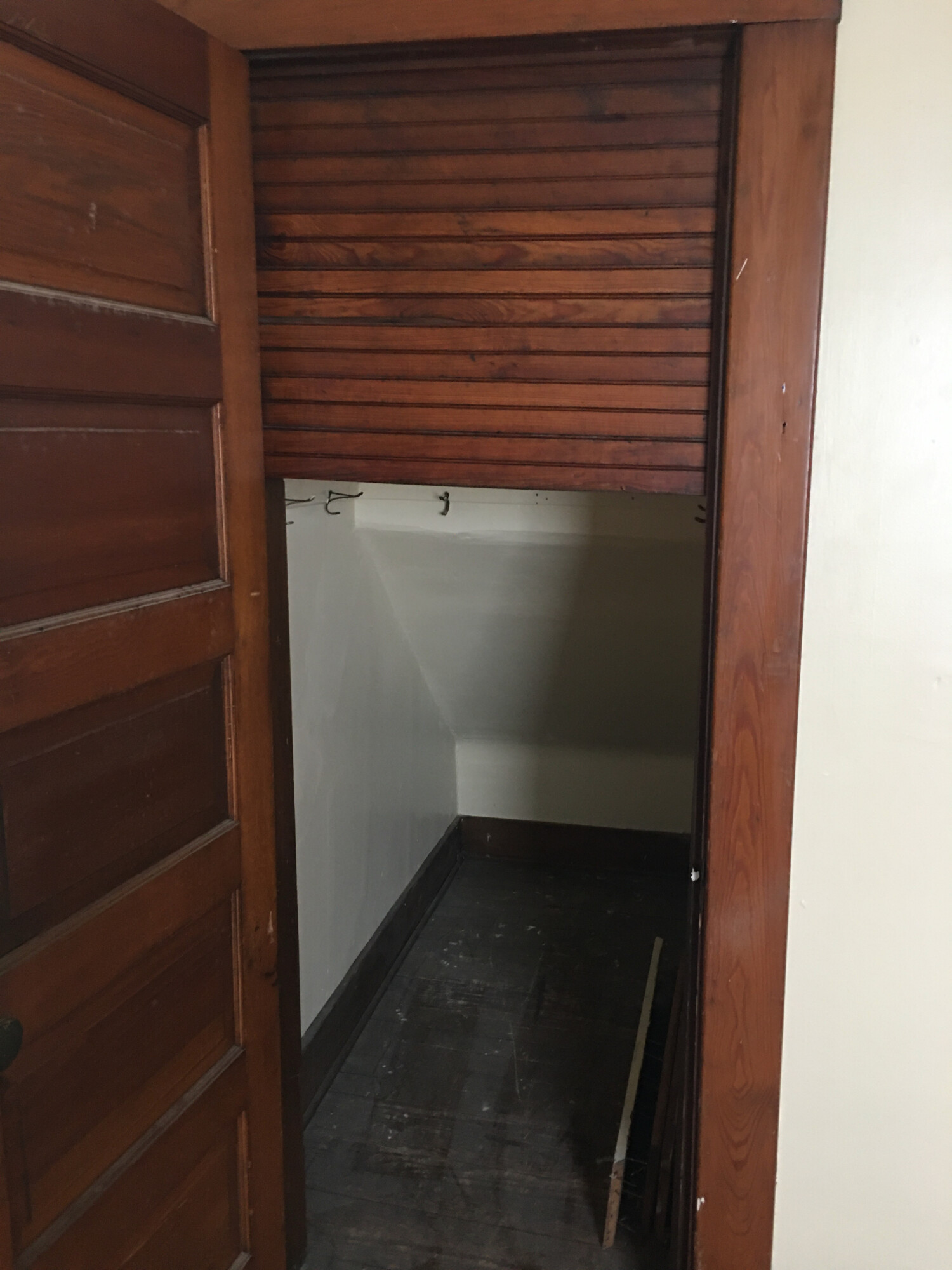
…in the carriage house, the Secret Bedroom closet door opens to a much reduced height. The beadboard is covering the stair landing. So, TALL door, LOWER aperture.
Again, in either 1929 or 1950, the library door on the north wall was removed and relocated to the east library wall. This new location opens into the south hall. The hall already had three doors, all 7-feet high.
An 8-foot-high door would have looked odd. So, the 1894 frame was reduced in height, a 7-foot door from the kitchen (perhaps previously removed and stored away) was installed inside the newly reduced 1894 frame, and new hinge pockets cut out. And the 8-foot door? It is long gone.
All this conjecture is based on the physical evidence.
And it’s soooooooo time for some wine.

10 Comments
Leave a Comment
Your email address will NEVER be made public or shared, and you may use a screen name if you wish.
That door as drawn is also missing the top horizontal box that mirrors the bottom that you see on the eight foot doors. Nothing on top of the two long verticals. No matter what it says, that reflects the size of a seven foot door., at least on the stair side. Or what an 8 foot door would look like through the seven foot opening on the stairway side.
It looks like the location of the door is slightly closer to the stair than the location in the drawing. Perhaps, the measurements were off and the door had to be shifted over, thus no room for trim around it. On the library side the door is right in the corner so no way it could be moved any further away from the stair. The lower header and decorative trim to hide it is pretty genius. At least when the Cross House as built they didn’t have to deal with city inspectors signing off on building permits.
I have blueprints from the 1949 remodel of my house and there are several discrepancies between what is on the blueprints and what was actually built. I have three places were I had to cut the switch plate covers because the electrical boxes were installed too close to the trim. In one case a pocket door was relocated on the opposite side as the blueprints so the light switch had to be relocated to the other side. The original solution was to cut a notch in the 1922 trim. I can’t believe Mrs. Bishop would have approved of that. When I moved in, I got a piece of trim out of the closet and switched it out with the notched one. (No one will see the notch in the closet). Then I cut the switch plate to fit flush against it.
Notches are for plumbing, electrical or to put in a brace or beam. None of that makes sense in that spot. So another mystery waiting to be solved.
I wouldn’t be so sure that door might not turn up. Perhaps the previous owner has it. He’s turned up with other stuff from the house. Maybe give him a call? Or was it relocated to another part of the house or even to the Carriage House? Perhaps it was cut down and reused. Any other odd doors somewhere? Maybe you’ll get lucky and find an 8 foot door matching these doors in local salvage or not too far away. The hunt is on!
This is so confusing!
The blueprints should be the framework and this the project can be built……
However, you have described and instance where the architect became creative with the Cross House construction. He coped with the discrepancies by being creative with the solutions!
This post was just fascinating and very complex!
I am going to reread it several times to get the hang of everything you accomplished!
Daaaamn.
Your mysteries, questionings, ponderings, investigations, solutions, reconsderations, adventures, inspirations and fortuitous findings have had me on the edge of my seat so many times that I have been forced to acquire a seat with an ergonomic edge.
That elevation of the stair has always struck me as tentative, as the line weights are not informative and some of the detailing appears to have been doodled in rather than carefully rendered. That is a peculiar way to document and present such a prominent and important interior feature.
Never a dull moment with you! Which is why I so look forward to your blog. Your mind is amazing! 🙂
The notches in the stud on the foyer right side of your newly reopened door look like they are just the perfect height for sleepers for supporting panel work for the built-in bench that used to be under the stairs. Probably it melded into the door casing and protected the wall from clothes rubbing, umbrellas, boots and shoes scuffing, parcels on the bench falling and generally made for a beautiful contiguous wall.
So does that mean you’re going to reconstruct the stairs as drawn? I mean, if you’re going to go crazy, go all the way!!
Fascinating! Enjoy draining your goblet.
Still a fascinating mystery after all these years! Do the notches align with an old railing or trim from the now-removed 1950 basement stairway?
oooh i love Sleuthing Ross. Nice compilation of evidence!
Wow, fascinating details! So much exciting material to discover and ponder. Thanks for sharing it all with us!