
A Dormer Question Settled?
In 2017 I did an involved post about the exterior of the carriage house. At the time I tentatively wondered if two of the dormers were actually original.

The south dormers. This makes no sense. The dormers kiss each other. No architect or builder would do this.
But…what if the dormers were built at different times? If so, I still do not understand why the ‘new’ dormer was not a continuation of the ‘old’ dormer.
In 2017 I suspected that the small dormer was perhaps original. I was able to confirm that the large dormer dates from the circa-1921 conversion.
Now, I believe that the small dormer IS original. Note its different square-paned sash, and how it sits ON the roof rather than being a continuation of the first-floor wall (which allows for larger windows). I never noticed this until today.
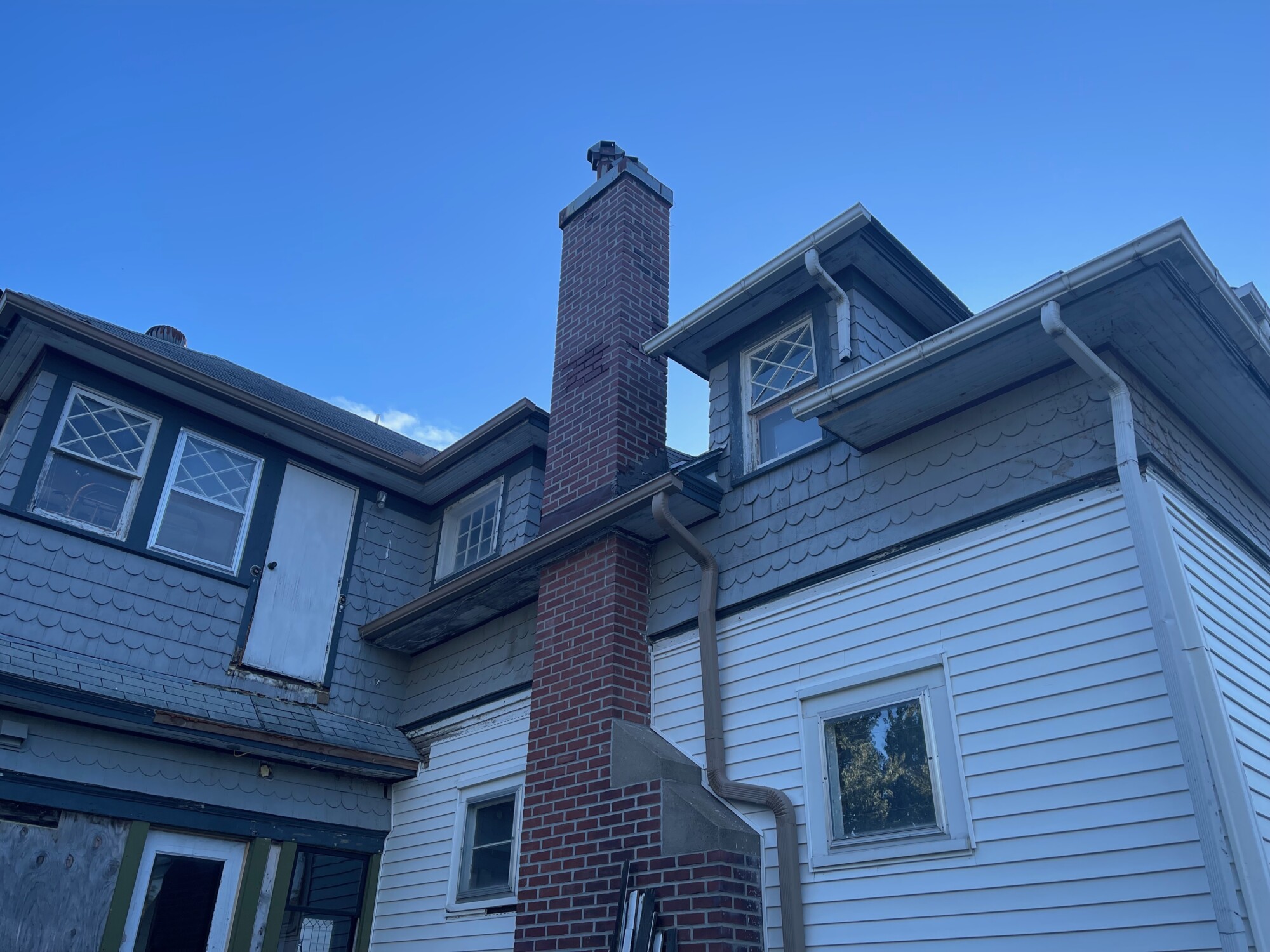
The east dormers. I believe the right dormer is 1921. Note how it is a continuation of the first-floor wall. The dormer to the left has a square-paned sash, and sit ON the roof. The room to the far left is part of the 1921 conversion.
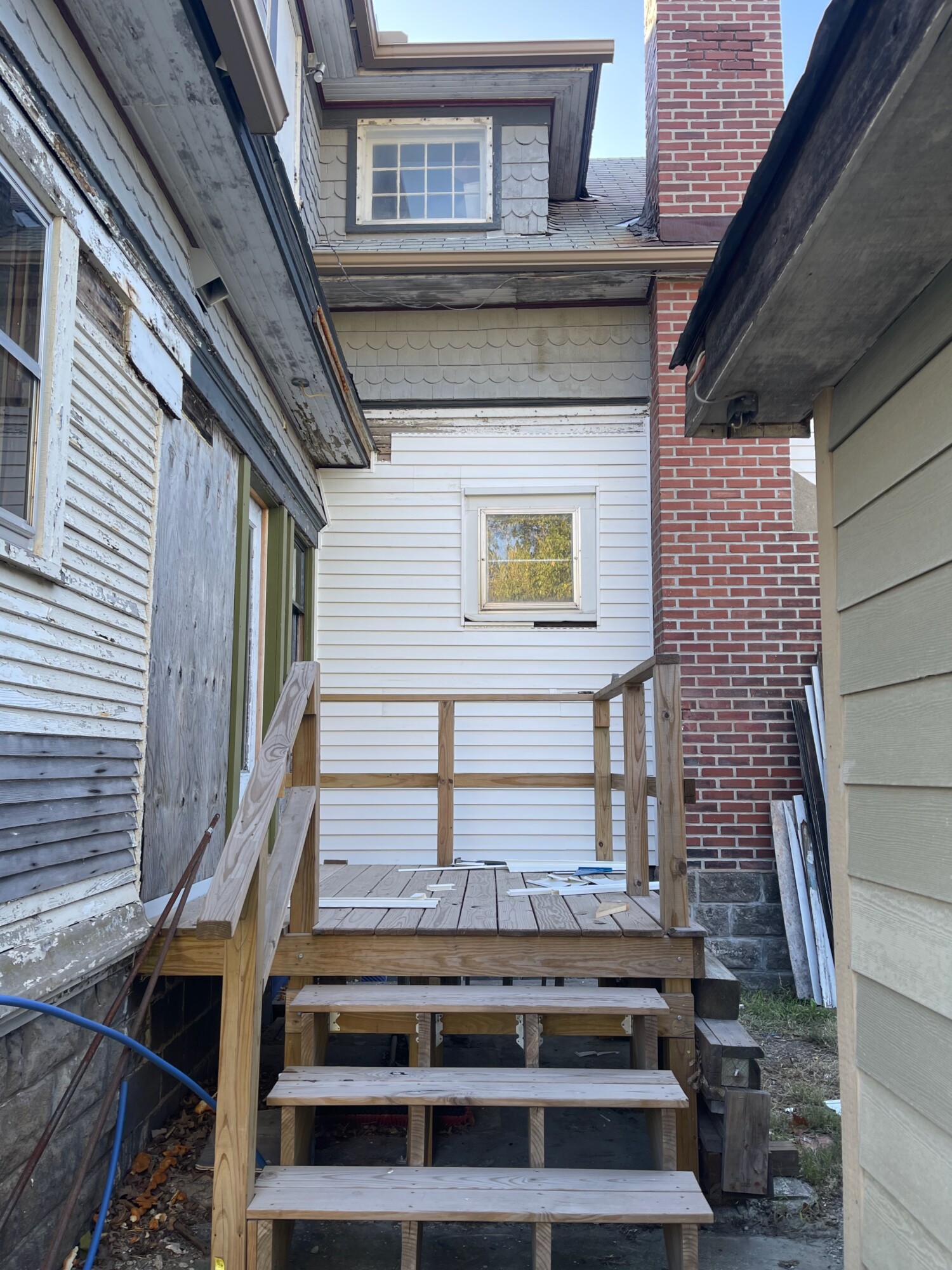
The left dormer. The chimney is from the 1921 conversion.
I now believe that the left dormer is also original.
The second floor was, likely, a hay loft when built. The turret (original) was, perhaps, a groom’s room. And the south and east dormers offered some light and air.
I suspect.

9 Comments
Leave a Comment
Your email address will NEVER be made public or shared, and you may use a screen name if you wish.
Here are a couple of thoughts from a farmer and horsewoman:
It seems more likely to me that the horse(s) were kept in the two story (aka main) section and carriages stored in the one story (aka barn) section. Why? Because in 1894 hay would have been stored (loose) in the hayloft above where the horses were kept so that it could simply be tossed down into a feed manger for each horse stall.
The two dormers that appear to be original likely did serve as part of the ventilation system for the hay loft (second story) and light for the guy who had to climb into the loft to throw hay down for the horses. There was probably also an upper story sliding barn door on the alley side gable (opposite from the side the turret is on) for the purpose of putting hay in the mow.
Another strong possibility is that both horses and carriages shared the main section and the smaller “barn” section served for storage or other purpose. Wooden floors were also common in horse stabling and I suspect there may have been a shallow stone foundation in the original location for the exterior walls of the building.
Exactly, hay lofts like that were common in Europe until very recently, the farm I spent my childhood holidays on built one new in the 1970s, although under an existing roof (basically they replaced the ground floor walls of the cattle barn section while keeping the existing hay loft and roof). The hay was moved up there using a giant blower unit (imagine a fan three feet in diametre pushing air and hay up some big pipes). New ones (back in the 90s) had a funnel that you’d chuck the hay into from above, the old one at that farm simply had a round opening in the front, right where the metal fan was spinning. Once the farmer got the fork in a little too far, the fan caught the fork and snapped the handle in the farmer’s hands. Amazingly no injuries beyond bruises.
While I would have thought the opposite, the windows give it away if that extension above the kitchen is the 1921 addition. If you look at the diamond paned windows, all of the 1921 dormers seem to have those same diamond windows. That means the 12 pane windows are the older, original.
I would still go up in the “attic” if there is one and look at the dormers from the inside and the roof structure and see if I can tell which set of dormers is the older set.
Could it be possible that the smaller 12 pane dormers were newer additions after the 1921 dormers and that there were originally no dormers at all?
If both aren’t original, then you are free to choose which you are going to keep and which you are going to get rid of.
You also have those diamond windows on the ground floor so if you keep the 12 pane you will have a mix of window styles.
The roof is so cluttered some of those dormers have to go.
Hmm. I had another look at that older post.
I think all of the dormers may be later than the original carriage house.
All of the windows in the turret have the diamond panes.
I think it would be easier to take out the dormers with the 12 or 9 square panes that are in the roof and then just repair the roof than to remove all of the 1921 diamond pane dormers that extend up from the lower walls with the soffits cut away and then repair the roof and recreate the wide soffits.
I think I would do some renderings both ways. Removing the multi square pane dormers and leaving the diamond ones and removing the diamond pane dormers and leaving the multi square pane ones and see which are more aesthetically pleasing or functional.
I would also consider which is going to be cheaper and easier from a construction standpoint.
Without photos or blueprints you may never know what is original or when added. I doubt the 1895 carriage house had any dormers. So if you’re using 1921 as your base, then you’ll have to figure out which dormer came first since none of them are original.
I know you mentioned an S-curve in the diamond-pane windows in the big house, and the carriage house excepting the turret windows. What about those two small dormer windows you pointed out? Are they nice S-curves for the muntins, or is their construction closer to the turret muntins, if you catch my drift? In other words, does the muntin thickness of the turret dormer windows and the dormer match?
On the subject of your turret windows. It seems if they do match the construction pattern of the other dormers, could they be original and simply a lower quality of construction? I don’t know much about 1890s window retailers or artisans, but I’m assuming even then there were varying degrees of craftsmanship one could buy. Perhaps because it was “only the barn and carriage house”, they didn’t mind the quality suffering on windows realistically none of the Cross family would be looking at closely. But, to me that still doesn’t explain the frankly insane way those diamonds crash haphazardly into the other side of the window. That made me think-
Could the Crosses have originally ordered windows that were a bit too wide for the carriage house turret sash openings?
Did a workman on site hastily rebuild and reglaze the ends of those windows just to fit?
That is the only explanation I could think of, other than perhaps a clumsy workman made the windows by hand and just messed up the dimensions. It could be also, that the windows are rotated and are supposed to sit 90 degrees the other way, in which case I have seen some diamond-pane windows with sloppy diamond meetups in the middle of sashes.
Those are all my thoughts on the window/dormer debacles. Let me know if any of it makes sense to you!
To add a clarifying comment, when I compare the CH turret to “dormers” in this post I mean the two small suspect-to-be-original dormers that do not poke through the roofline.
Hi, JP!
You wrote: “I know you mentioned an S-curve in the diamond-pane windows in the big house”
To clarify, the diamond-paned windows in the big house have muntins (the narrow strips of wood between the glass panes) with S-curves.
None of the diamond-paned windows in the Carriage House have this feature.
I’ve no explanation for the fucked-up sashes of the turret.
Is it possible the double dormer was the only original dormer but had a door instead of windows and that is how they got hay in the loft? Later it was converted to the two windows?
Everything about the south ‘double’ dormer indicates that it’s from the 1921 conversion.