
A Question. Answered. After Seven Years.
Since buying the Cross House in 2014, I have wondered:
Had the HUGE third-floor room always been huge?
For, the original drawing hinted at it being divided. Any evidence though was masked by two things:
- The flooring was not original.
- The ceiling (sheetrock) was not original.
Drat.
In my previous post, I discovered tantalizing evidence that the room had been divided in 1894. Because, the bead-board ceiling, running north/south mostly, suddenly and inexplicable changed course to east/west.
Huh?
I stared at the bit-o-evidence and could only think of one reason: A wall had originally divided the point of course change. I mean, that made sense. One then would not really register the change of course.
Today though, this question was answered. After seven years.
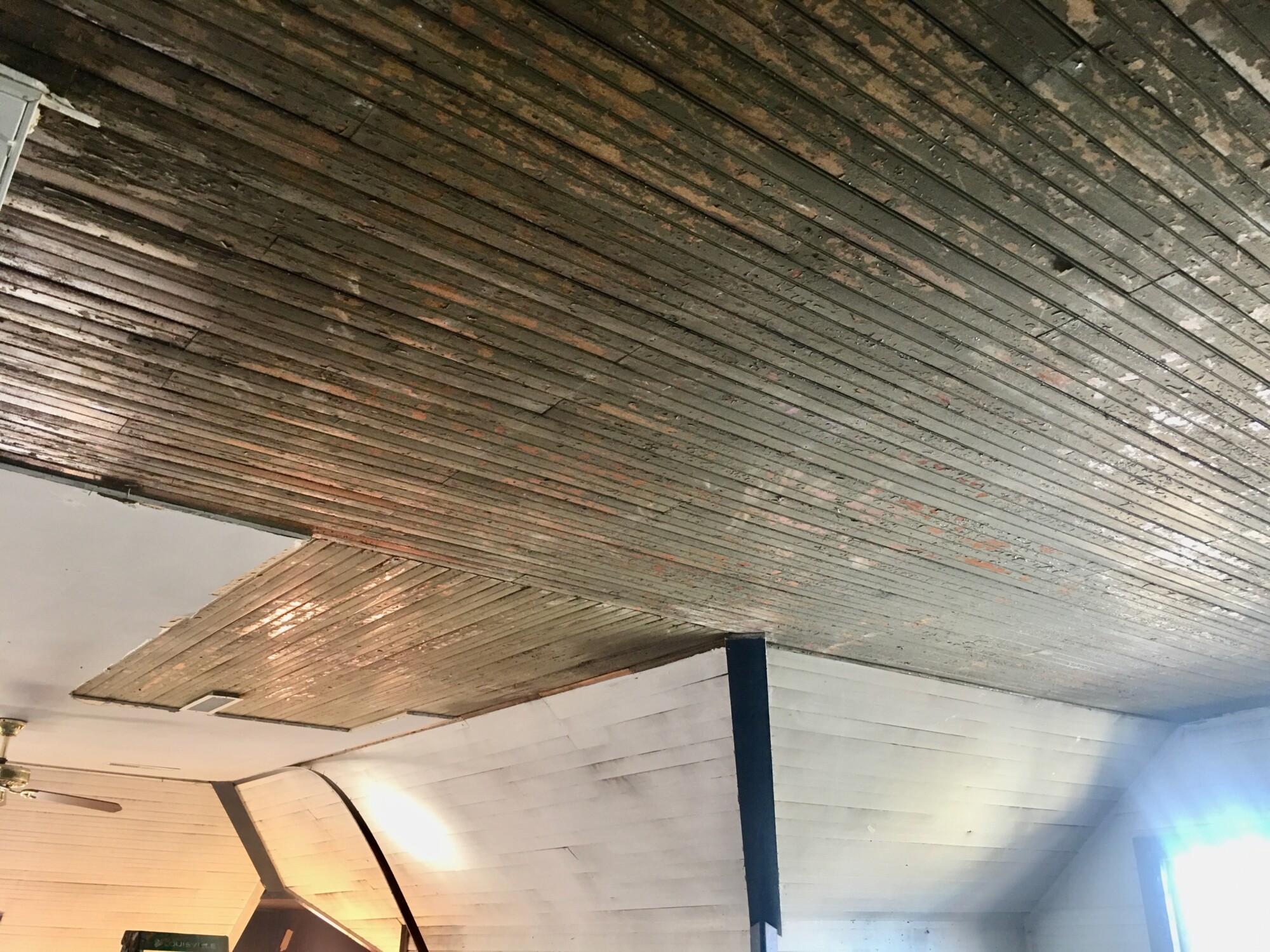
I removed one more piece of sheetrock. In the foreground is the north/south bead-board. And now, you can clearly see the directional change.
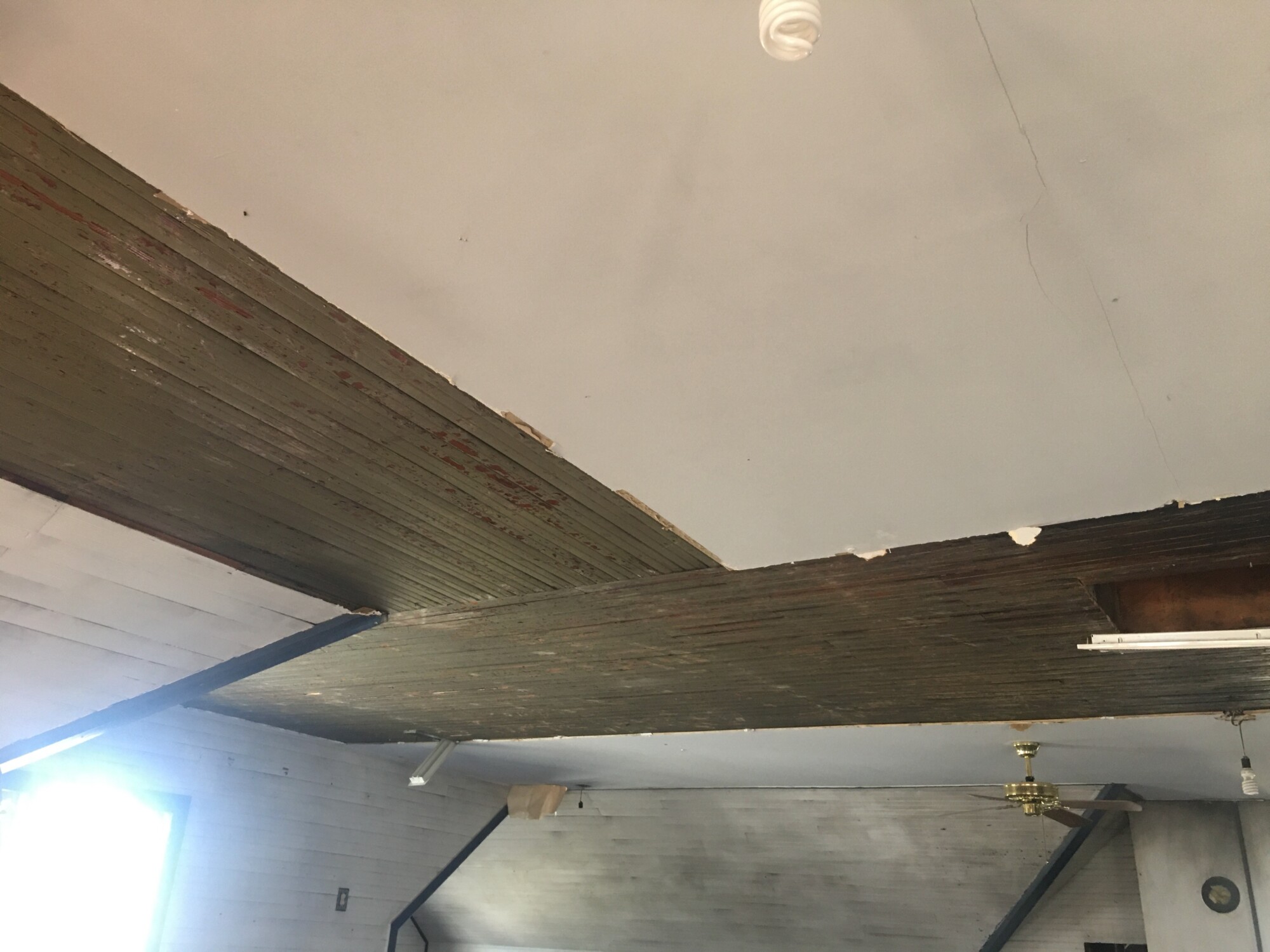
From the other direction.
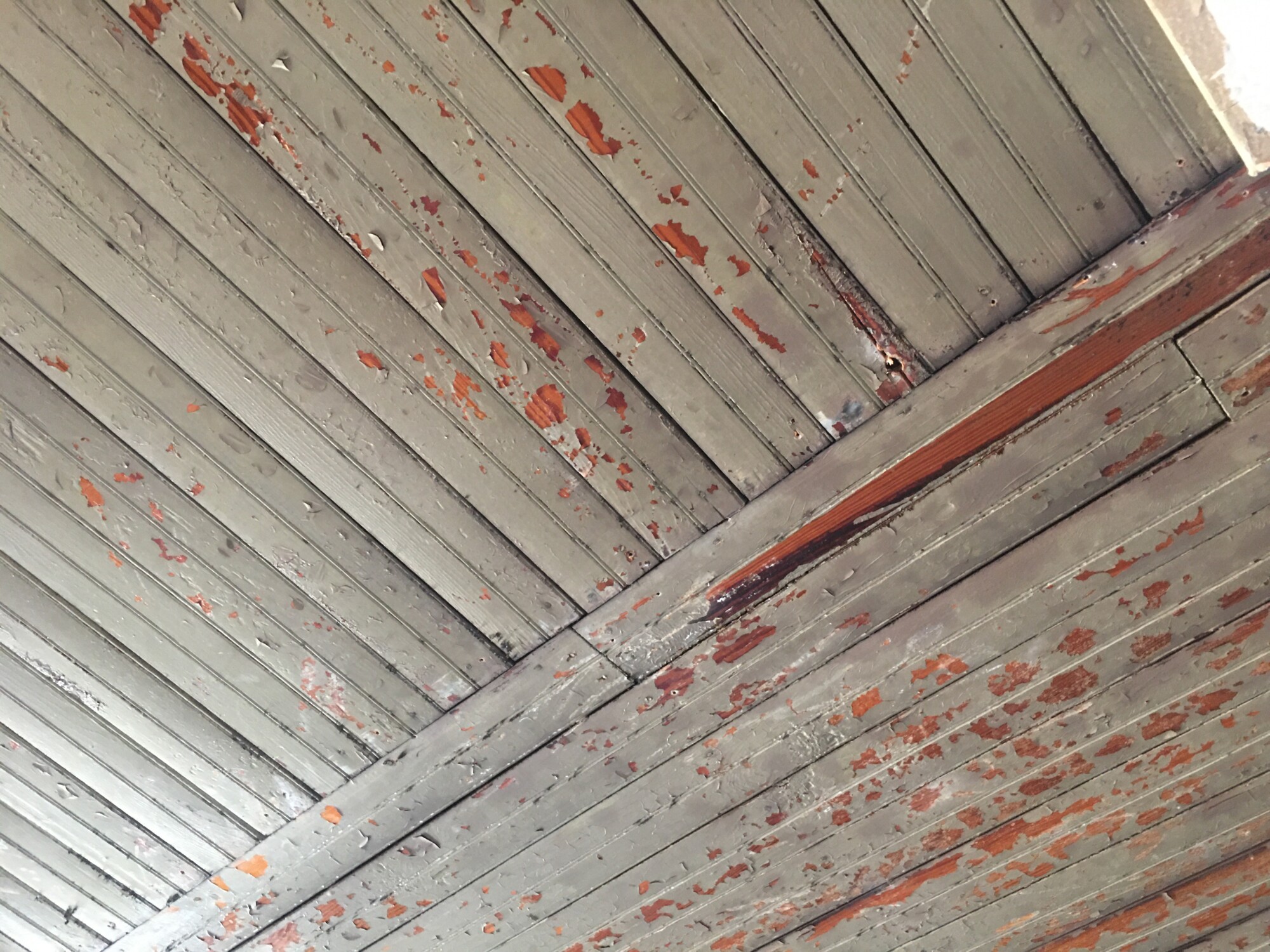
And where the twain meets? ZERO evidence of a former wall.
So why the inexplicable directional change? It makes no sense.
But…but…the original drawing offers a clue. As previously posted, the north/south wall drawn on the plans, which would have aligned with the directional change, was shown as a dashed line. Meaning that it was not yet carved in stone. Walls intended to be build are drawn as solid lines. Not-quite-confirmed walls are shown as dashed.
So…maybe…the ceiling boards were installed with the idea that a wall would mask the directional change. Then, once the ceiling was finished, it was decided to leave the room impressively huge. “Wow! This space is incredible!” says every single person upon first seeing the massive space.
Or, maybe a decision was simply never made. Harrison Cross died soon after moving into the house in early 1894. Perhaps everything unfinished was just tabled at that point?
I doubt there will ever be a full answer for this peculiarity.
But we do now have one answer: There was no dividing wall.
And this is just one of the things I love about old houses. There are mysteries to solve!
Justin will soon be returning to the Cross House to resume work on the cat fence, and he will have his young assistant with him, Brock. I will ask if Brock can continue taking down all the sheetrock.
I am keenly interested in seeing how much fire damage there is. My plan is to then remove all the damaged bead-board, and feather in new wood. Then the ceiling will be whole again, something which will thrill me. That it will then take several years to fully restore the ceiling is something I can be patient about. But I am quite impatient about FIXING THE DAMAGE.

8 Comments
Leave a Comment
Your email address will NEVER be made public or shared, and you may use a screen name if you wish.
In general, unless there is some sheathing or special nailers or furring strips installed, t&g bead board is nailed on perpendicular to the joists/rafters. For this reason, unless all the roof framing was planned specifically for wall locations, then the changes in direction of the bead board may more likely simply reflect changes in direction of the roof framing itself.
I just made this mistake myself in applying a t&g ceiling in my kitchen remodel over plywood, where I ran the t&g on the angled pitches of the ceiling the wrong way relative to how they would have been if the plywood sheathing was not there, and I had to take them down and do them over the right way. Much better.
I don’t have the plans in front of me, but could the dotted lines represent beams or other structural transitions above in the ceiling framing? Is there a framing plan for the roof in the drawings? Dotted lines in drawings more typically represent things above the floor than “maybe” walls in my experience.
Bo!
An excellent thought! I will go into the attic and check out the joist directions! I had not thought about this.
Also, there’s no question that the dashed lines I reference on the 1894 drawing refer to wall locations. See previous post.
Ah, knowing your stardard for restoration, Ross… the finished product will be spectacular (even in areas hidden from sight).
This room is the ultimate “open plan” space! I don’t have words for how much fun it is to stand in it and look around the unobstructed view, or to prowl around and look out the windows in the octagon and turret. You might not start decorating it for a long while. But I can’t wait to see your design process when you do
When you open up the space, you will find no beams where the dashed lines appear on the drawings. Those are future walls. What you will find will be the rafters and ceiling joists. The ceiling joists are also acting as collar ties, keeping the structure together……important not to remove them! Where the rafters change direction on the intersecting gables, the ceiling joists also change direction, running the same way. The beadboard is nailed across the ceiling joists, the reason you see the direction change, as Bo noted.
I think when you get up in the attic with the paint stripper you will most likely find no evidence of any interior walls being there, on the ceiling or the floor. (both areas would leave behind clues if walls were there, just as the fire left evidence it was there) It would be foolish to cut up that beautiful attic space and I know you aren’t foolish when it comes to decisions on the house.
Michael,
Yes, Bo is correct.
The mystery of the directional change of the bead-board is explained by a directional change of the ceiling joists!
And, I’ve no intention of chopping the room up. Oh, the horror!
Good to have an answer on that. If I’d had a space like this as a child you’d known there were no walls at the time because there would be an unbroken worn ring on the floor from hundreds of hours of roller skating.
Ha! MJ – I lived in a house like that, for a time! The third floor was the children’s playroom. We could ride trikes or rollerskate around – whatever we liked. In the corners of the room were built-in bookcases, containing books, puzzles, tinkertoys, art supplies, boardgames, etc.,.
A house this large looks to the future! I’m glad the Cross House has had so many lives! 💜