
A Refrigeration Curiosity
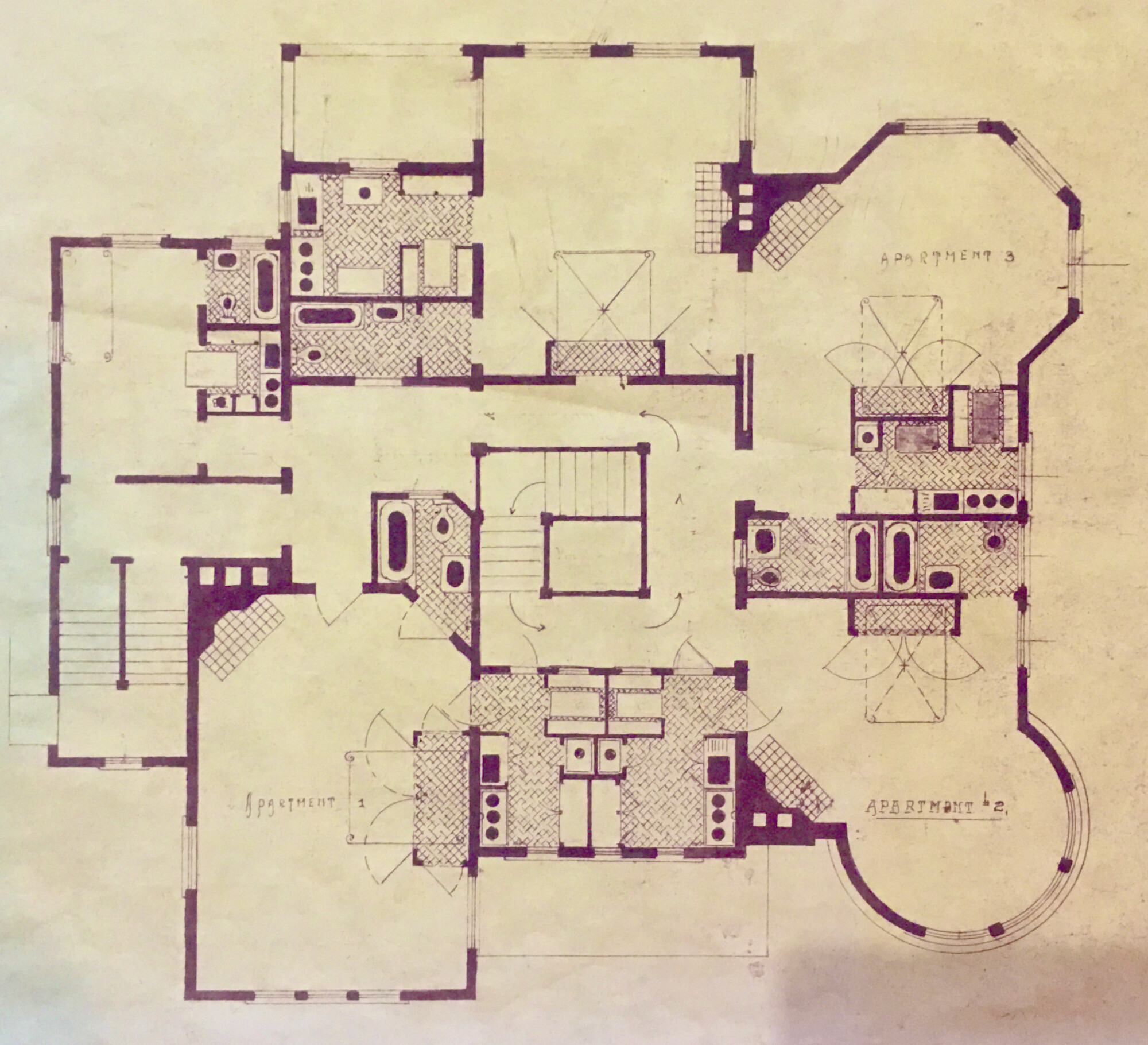
In the late 1920s, the second floor to the Cross House was converted to apartments, and four kitchens were created. Or, at least this is what was intended, as it is not possible to know with any certainty what was actually built. For example, I suspect that the kitchen top, left was never installed.
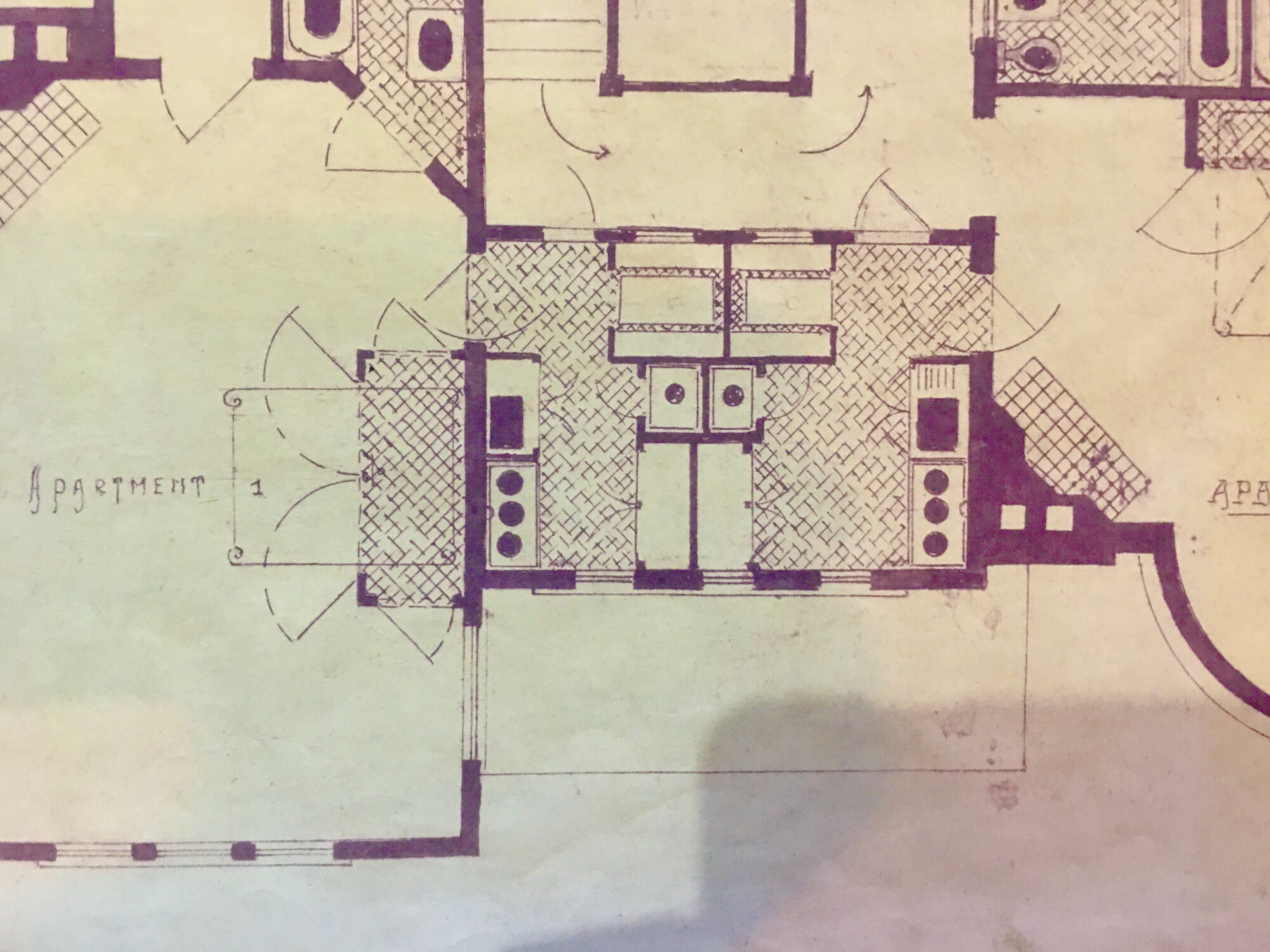
Along the north side of the house were two back-to-back kitchens servicing the adjacent Long Bedroom (left) and Round Bedroom (right). In each kitchen is shown a sink with drainboard, a stove (the rectangles with the three dark circles), and what I have always assumed was a monitor-topped refrigerator (the rectangles with the single dark circle, in the center of the image). You know…

…like this.
But…but…Kerri brought up the fact that such refrigerators were crazy expensive at the time, more than a Model T.
I thought: Oh, that can’t be true.
It is!
The classic General Electric “Monitor-Top” refrigerator was introduced in 1927 and cost $525. This seems cheap, today, but this translates to a whopping $7,700 in 2021 money!
So, Kerri was quite right! And I had no idea.
Obviously then, what I have always assumed were monitor-topped refrigerators shown on the 1920s apartment conversion plan were almost certainly not.
But what were the rectangles with the single dark circle???????? I am assuming ice chests but why the dark circle?
But then…then…GADZOOKS!
While writing this post I recalled that I had a newspaper article about the apartment conversion.
And…there it was: “All utilities, including electricity for the Kelvinators, are furnished by the landlord…”
So, the apartments DID have refrigerators!
But then…then…I Googled 1920s Kelvinator refrigerators and none had the classic monitor top.
In pondering this I would guess that whoever did the drawing simply used a generic refrigerator symbol?

24 Comments
Leave a Reply Cancel Reply
Your email address will NEVER be made public or shared, and you may use a screen name if you wish.
There are people that collect, restore and use these old refrigerators. I found a forum.
Also came across this: https://evolutionhomeappliances.weebly.com/refrigerators-1900s-1920s-early-electric-refrigeration.html
And there is this guy. He has a 1918 “conversion) which he thinks is the oldest working refrigerator.
https://www.youtube.com/watch?v=dr_KkzXvO2k
I am seriously considering a skin for the new Kitchenaid when it comes as I am so not thrilled with the stainless steel.
According to the article, some people just bought the compressor for their ice boxes and converted them with the noisy compressor being in a different room.
I think it would be possible to recreate something similar with a bottom freezer drawer and French Door refrigerator on top with a faux ice box façade.
Or maybe one of the Jasons can convert yours.
https://www.oldhouseguy.com/wp-content/uploads/2017/12/ConvertYourRefrigeratorToIcebox.pdf
Here’s a nice photo of what one owner did by cladding with wood and then using antique hardware.
https://www.oldhouseonline.com/kitchens-and-baths-articles/kitchen-appliances/hide-kitchen-appliances/
I can only speak as a draftsman and yes, most likely they used a generic symbol, not knowing the actual cost of such a unit. The key is the space that was provided and that most likely would fit several different refrigerator brands at the time!
Oops…..sorry for leading you off on a tangent! Perhaps they planned on buying Monitors, but
ended up going with Kelvinators. I found this print ad on ebay…
1929 Super Automatic Refrigerator
priced as low as $185
You could make payments using their “ReDisCo monthly budget plan”
I wouldn’t totally exclude the possibility that “Kelvinator” was a household name for any brand of refrigerator in the 1920s, like “Frigidaire” in 1960s Canada. My late aunt, who spent her late teens and early 20s in Toronto, used that term her whole life, even when speaking German – she moved back to Austria in the late 60s I think.
Ragnar, I’ve never known anybody to use the word Kelvinator in a generic way in America.
My grandparents did use the word, but that always referred to their actual Kelvinator! They never used the word refrigerator! “Go get the salad from the Kelvinator!”
I’m Austrian, born in 1955, and I can confirm that “Frigidaire” was used in German by some old folks, when I was a kid. So, older people probably understood what your aunt meant. The term was more common before WWII and was then replaced by the German words “Eiskasten” or “Kühlschrank” both for political reasons (“Wir sprechen Deutsch”/”We speak German”) and because refrigerators became more common.
Both “Eiskasten” and “Kühlschrank” could also mean the predecessors, i.e. a cabinet for storing food that was cooled with blocks of ice, so people used the English term for the new, electric devices but later switched to the old terms again, when no misunderstanding could happen because the old ice-boxes hat come out of use.
Thanks for the “monitor top” refrigerator and Kelvinator. I had to google both and I learned something new.
I thought that there is a wood refrigerator in the house. a cooling unit can be installed it would be so cool.
Harlan, the Cross House has an intact 1894 built-in ice chest.
And, yes, a cooling unit could be added to it, and I thought about that. But…the wood door expands in the humid summer and sticks shut tight!
Once the interior space is consistently cool and the house environment is controlled better year round, would the expansion and contraction of the doors be minimized enough to function?
But the 1929 apartment only provided for the electricity. The renter would supply the fridge.
Hi, Sherrill! The 1927 article states that the landlord would provide electricity FOR the Kelvinators.
Thus, the Kelvinators were part of the package.
Good point. How about this…. Our 1911 house had an icebox accessed from the kitchen from what was a space framed out like a closet. The box itself extended into the service porch where the iceman could deliver the ice. The first link supplied by mlaiuppa shows a unit that could have been retrofitted in our icebox or installed into a new build insulated closet.
The refrigerator spot seems to be enclosed like a closet. How on earth would anyone expect to insert a heavy 1920s refrigerator through a narrower door? But the drawing does suggest that whatever is inserted in that space is not built it. The symbol for the octagon bedroom seems smaller and the one for the sewing room kitchen is free standing. Curious.
Could it have been for a hot water boiler?
Ooo. I like that idea. Especially since they appear to be in closets. Ross??
We know each apartment came with a Kelvinator. And the rectangles with the dark circles must be the Kelvintaors.
Although why they are shown in closest is curious. Also, remember, what is DRAWN is often different from what was BUILT.
If they were closed in, maybe they were “closeted” for noise control? Still doesn’t make a lot sense. I bet you’ll find some vestiges on the floors that will let you know if the closets were ever built. To Brita’s suggestion: Do you know if they provided hot water to all the apartments from a central boiler? Again, holes-in-floors will tell the story. Another thing to investigate!
David, it appears that the flooring was redone during the 1950 motel conversion. So, there’s no evidence of holes or anything.
In the Octagon Bedroom, along the north wall, there are pipes sticking out of the base molding proving that a sink and gas stove were once along that wall, corresponding with what is shown on the drawing.
That’s called builder’s license. It still happens today but was common back then.
Michael. Oh, yes. Builder’s license. I have the 1949 blueprints for the remodel of my 1922 house and what the house ended up being is not exactly what was on the plans. For one the pocket door and light switch going in to the kitchen are completely opposite to what the blueprints show.
I’ve been meaning to get the blueprints mounted and framed. I should probably work on that this year.
Those apartments would have been top notch in 1929, and then as now, some landlords (myself included!) would make expensive investments that pay off over time, and all the while attract better tenants and better rents.
P.S. Here in the PNW, a ton of old apartments have their original kitchens from the teens and 20s. Plenty have their original icebox cabinets, a few have these now long defunct kits that turned them into refrigerators after the fact.
In 1927, a Kelvinator would have had a small belt driven compressor under the refrigeration compartment of the cabinet. The GE monitor top was introduced in 1927 and was a sealed unit. They did have smaller models, like a DRA2, 4 cu ft of space.
Ross, I had to research a monitor top refrigerator for a project I was working on at the Park District I work at. We were creating a 1930’s historical farmhouse. One of “my” volunteers had a 1929 Monitor top GE. she was able to sell us. After some research, I found out these were sold on installment plans. These units were built TO LAST. The refrigerant is no longer available and you’ll need a HVAC person to retrofit appropriate coolant, but ours does “hummm” when plugged in, it just won’t cool. Also, here’s the trivia behind the name “monitor top”….Remember the famous Civil War skirmish between the two ironclad vessels? The Monitor and the Merimac? The Monitor had an ironclad round turret on its deck which looked much like the round steel case covering the motor of the 1920’s GE refrigerators. The top-mounted motors didn’t last long (the thought process was the heat from the motor would rise out of the top) until an engineer developed a bottom -rear motor. The Coldspot from Sears overtook sales for many years.