
Beast to Beauty. Eventually.
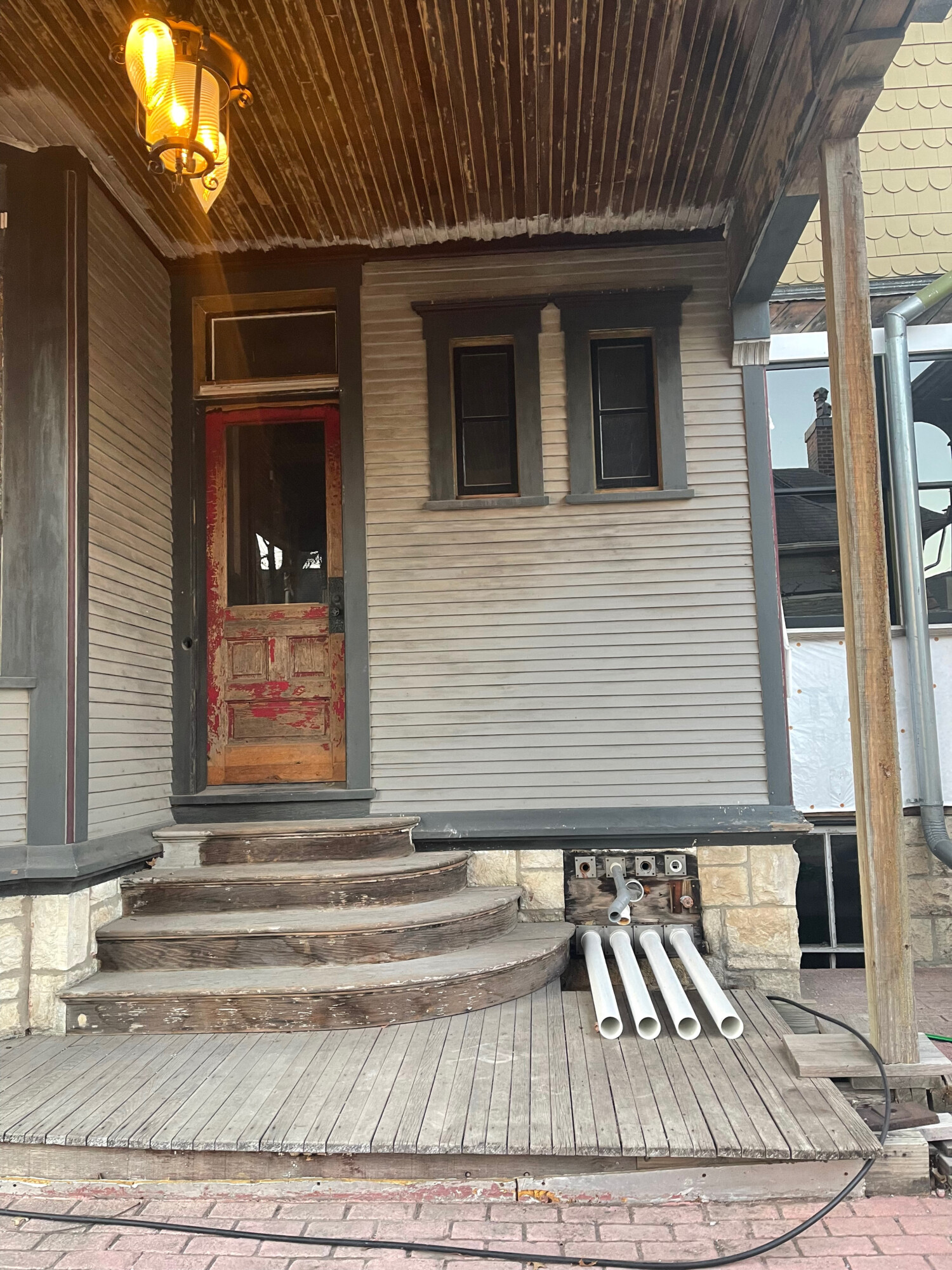
The south entrance, Cross House. The red door had been located. A few years ago I returned it to its original location, here. The delicious curved steps appear to be original. The decking also appears to be original. The red “bricks” are not original and will be removed. And see the piping mess, lower right?
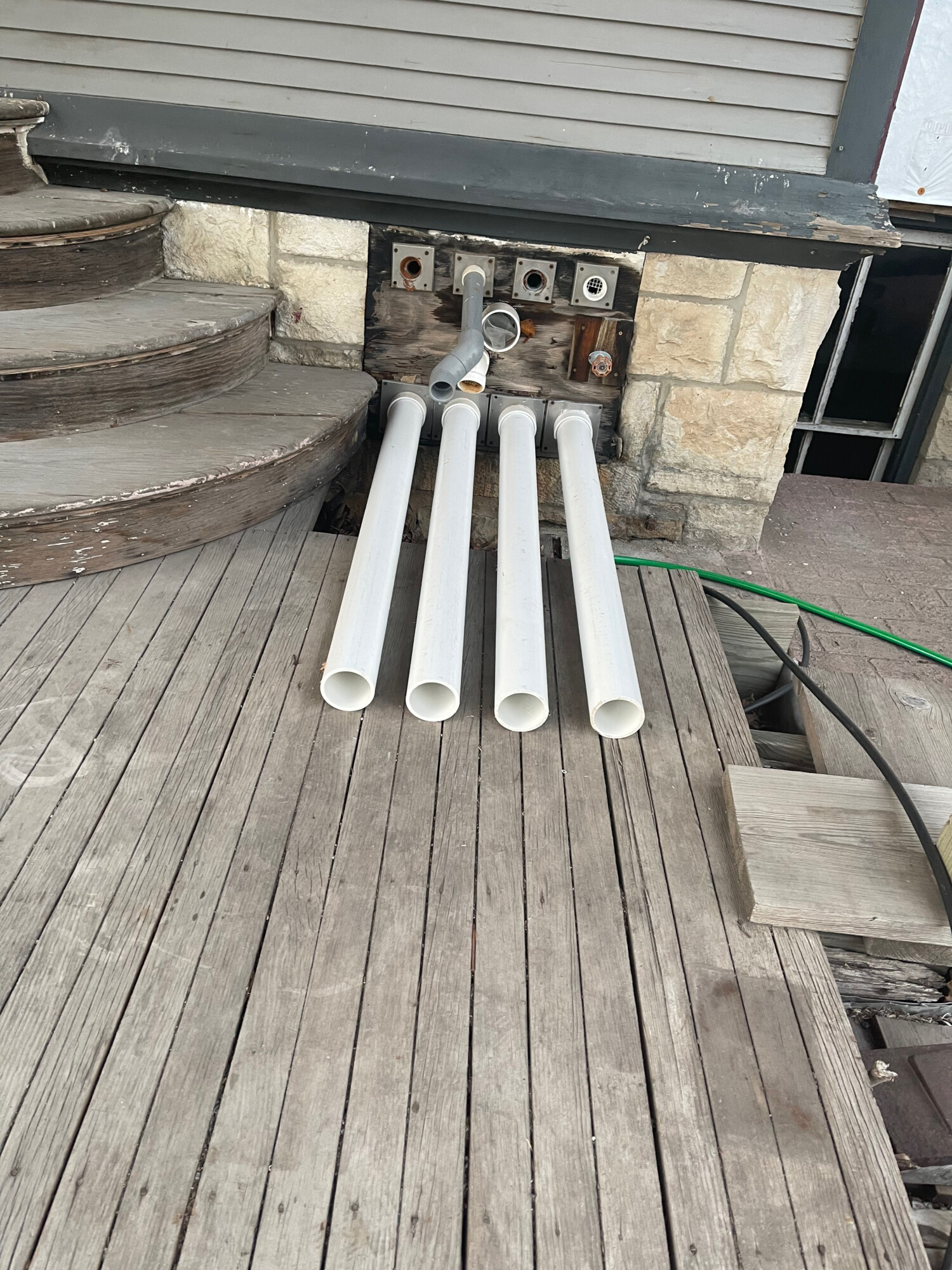
Oh, the horror. This was a window. The sash is extant and in the basement. It was removed to create this ugly ugly ugly mess of venting pipes. The long white PVC extension pipes I just installed. These are the air intake vents for the boilers. They need to be far apart from the boiler exhaust pipes, above. In the middle are vents for the hot water heater. The long pipes fix a problem I have struggled with for seven winters: separate the intake from the exhaust.
What a figgin’ mess.
The plan is to relocate all this venting to UNDER the decking. Thus, the vent pipes will vanish from view, and I can then restore the basement window and reinstall it.
And a beast will become a beauty.

19 Comments
Leave a Reply Cancel Reply
Your email address will NEVER be made public or shared, and you may use a screen name if you wish.
Thank goodness you have a plan to install the basement window.
The relocated door is where it needs to be; above those lovely curved stairs!
Lovely work Ross!
Thank you, Sandra!
Oh but Ross, think about those wonderful pVC pipes and all the architectural interesahahahah I couldn’t get through that without laughing. The south entrance will look gorgeous when they take their talents elsewhere.
Little steps. Look how far you’ve come. Look how much you’ve accomplished this year.
That will be a huge undertaking. Can’t wait to see it finished.
Hey Ross,
Are the intakes going to be visible in the base of the porch?
I think you will need access to the openings not just for airflow, but also for maintenance. They look awfully inviting to little critters!
Hi, Blair!
The intakes/exhausts will be a series of circular holes along the east side of the the deck base trim.
The current white pipes now have screening over their openings.
It appears to me that the original porch deck would have been on the same level as the house. Rebuilding it at that height would negate the need to change the window, the pipes, and you might even be able to leave the steps under it.
Hi, Stewart!
I’m confused by your comment. What evidence do you see that the original deck was at the height of the door?
I haven’t ever seen a roofed porch on a Victorian house before to which one needed to step down. Just call it instinct, which I am sure is wrong this time because you have the original plans that show what was there originally.
Stewart!
It’s not a roofed porch, really.
It’s a porte-cochère. So, maybe that makes a difference?
I’m glad you know what you’re doing – I’d be clueless. 🙂
Knowing your analytical mind, I would bet that you will come up with several possible solutions before you are finished here. Adapting a 19th century structure to accommodate our 21st century needs can be a challenge. It doesn’t look like you have very much clearance beneath the decking, so I wonder if maybe there might be an unused chimney close by that could take some of the exhaust duties from the PVC pipes? We have our gas boiler and water heater vented into a chimney that originally served the wood burning kitchen range and two upstairs heat stoves; of course your system may be very different from ours, which dates back to the late 1980s and does not require an outdoor fresh air supply.
This is perhaps the easy way out, but could you conceal it all behind a period-appropriate screen sash with bronze or copper screen?
Follow-up thought: Is the sash a hopper window? Perhaps if slightly ajar, it could give you the combustion air you need?
Ross,
The commitment you’ve shown for this house over the years has me closer and closer to justifying the 19-hour pilgrimage it would be for me to see this place in person. Only someone like you would take the time to lovingly restore a window like that.
I also have a possible(?) solution? You may not be privy to it as it involves NOT completely restoring the window, but was something interesting I noticed in my apartment building.
They left the original basement window in situ, and popped out one of the glass panes- replaced it with what looks like some form of plywood or thin cardboard, to serve as an exhaust vent for a dryer, leaving the window in actual working order and unmolested, save for the poor glass pane. It seems that you have too many pipes to handle for this to be a viable solution for you, but it’s interesting the state and modification of basement windows to accommodate newfangled ventilation requirements over the years, huh?
Come on, down!
A few years ago I went to an enormous amount of trouble and expense to remove (and bury) the HVAC lines which had been punched through a basement window in the NE corner. See here.
It was worth all the trouble. Today, I smile whenever I look at the restored window.
The issue to resolve here will be vastly easier and not much money. The intake/exhaust lines will simply be lowered, and then fitted under the deck top. Then the window can be restored.
I’m living for the day.
I was going through the search term “windows” last night to see the lavish restorations you have given your windows. I also remember a while ago you mentioning that you had insulated them such that many of them do not open- and I actually had a question.
Are they double-hung or single-hung windows? Do any of them have sash cords/weights in situ? I was looking at the amazing pictures of the sashes and the thought never occurred to me to ask, like ever!
and Ross, had I not taken a winter class this winter I would have seriously considered it, despite the insanity of such a prospect and the protesting my car would make if it could talk. Maybe next summer- I looked at the route, and it would take me through many other cities I’ve been yearning to see.
Ross, I’ve been thinking about this; I am concerned that the intakes and exhaust might be an issue if they terminate in the deck faceplate the way way you describe. Most of these systems have safety switches that will kill the system if either the intake or exhaust are blocked or even partially obstructed; what will keep snow, leaves, etc from collecting and piling up at the edge of the deck? My wife owned a business for many years and the gas furnace vent went out through the sill plate, approximately 18″ from the ground, then turned up and was capped by a 180* double-el. This worked well for several winters until we got a major winter storm which blew a 3′ drift against the building. Might there be a chimney near the boilers that could be used for the exhaust? Or could a small chase be put in somewhere in the laundry chute and the pipes ran up, over the top of the bathroom, and out that way? A lot of work to regain a window, but probably not as much as burying the HVAC lines, LOL… I just would hate to have snow blow over your air pipes and shut down your heat system.
The item that catches my eye the most in the first photo is how awesome the newly installed light fixture looks right now. It will look spectacular once you are done working your magic on the siding, door, steps, and decking.
As you implement the solution to the input/output pipes will you be addressing a solution to the pole holding up the roof? I can’t recall the solutions you were contemplating for a replacement post but if there’s a lot of digging involved for the pipes or the post it would seem logical to address them both at the same time so as not to disrupt one while fixing the other.