
Collecting My Thoughts. At Length!
ADVISORY: This is a long post. Wine may be required.

The Cross House 1894 parlor as of yesterday.
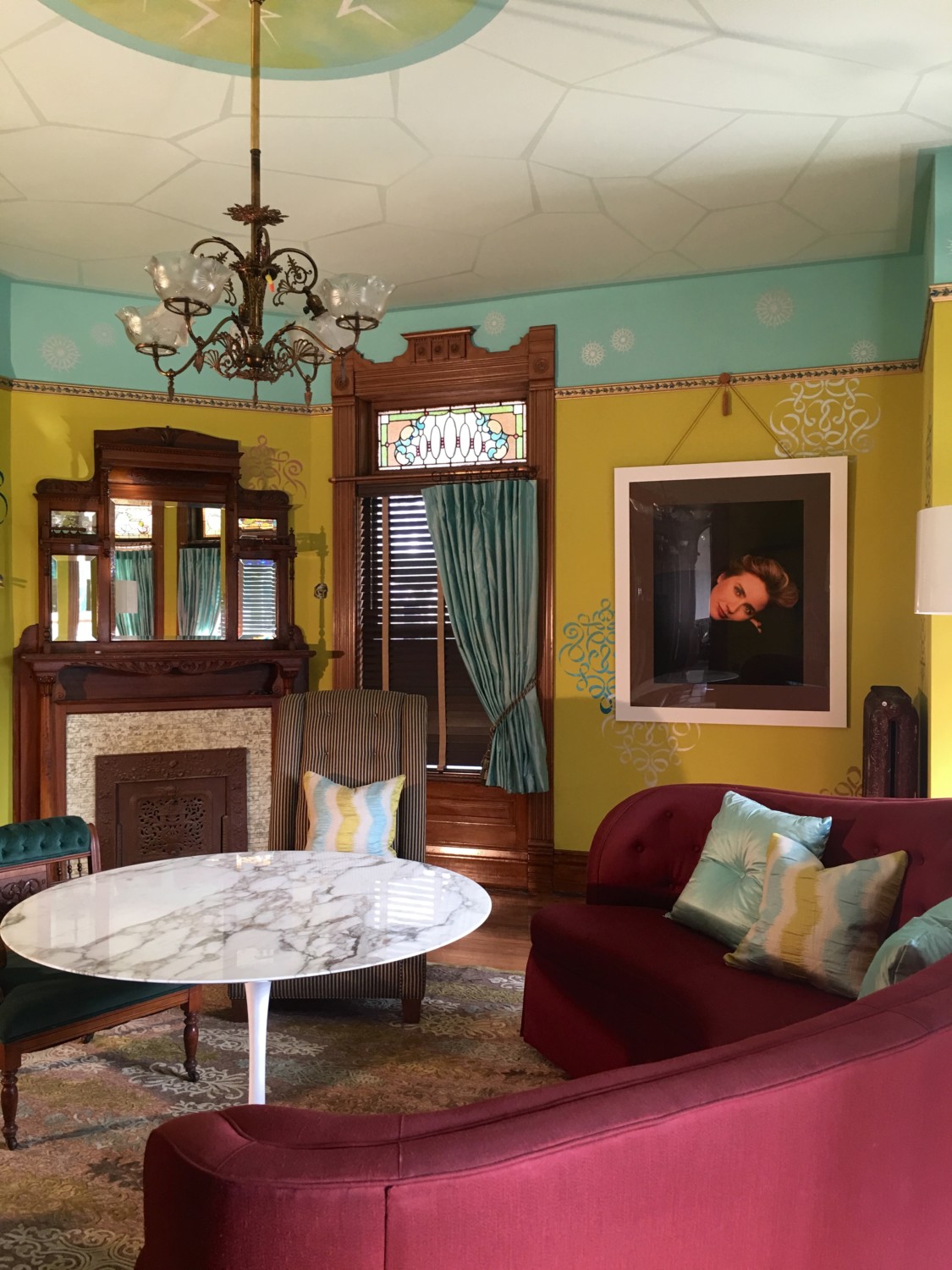
The Cross House 1894 parlor as of yesterday.
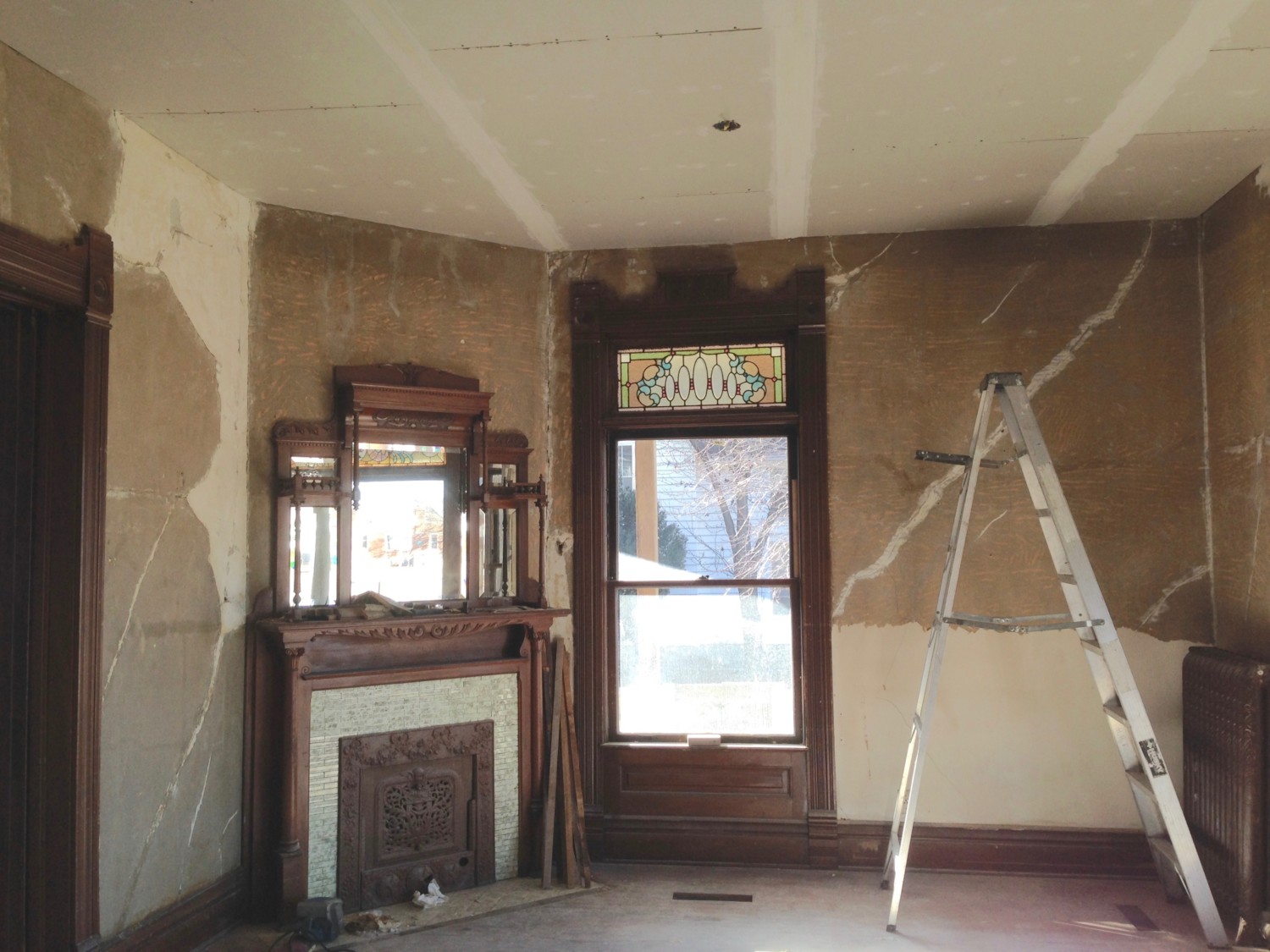
And what I started with.
When I purchased the Cross House in March, 2014, I had very little idea of how a parlor in the Victorian-era was decorated. So, I began to research. I also worked to understand the Cross House and uncover whatever secrets it had. A lot of people, and HGTV, think the way to approach an old house is to send in a demolition crew, tear out all the old plaster, and do a total gut job. This is not how I think an old house should be treated. Mercy no.
In the unrestored image above, the room looks quite forlorn. It was also, as I discovered, unbalanced as it was missing its picture rail, which was about 20-inches below the ceiling.
I also discovered the original damask pattern wallpaper behind the radiators. And I learned that the parlor almost certainly had not only wallpaper, but a paper frieze, too (above the picture rail), and a ceiling paper. In the 2-story stair-hall, I discovered fragments of all three such papers, a significant discovery.
From having little idea of how to decorate my 1894 parlor, in fits and starts, I began to develop some ideas:
- Reinstate the picture rail.
- Reinstate the period-correct concept of patterns on the walls, frieze, and ceiling.
- The stained-glass windows (the glory of the house) were never intended to be enjoyed in splendid isolation but rather were intended to be part of an ensemble. Thus, my every decision would need to complement the windows but not be, well, afraid of them.
- The Cross House originally had wall-to-wall carpeting throughout, and this would certainly have been patterned. This was replaced with plain oak flooring in 1929. So, a visually dynamic original element — patterned floors — was replaced by something quite plain. I realized that I had to do something to make the floor contribute to the ensemble.
While pouring over archival images of Victorian-era parlors I realized right away that a road block confronted me: While I very much wanted to recreate a decorative scheme appropriate to my 1894 parlor, actual Victorian-era interiors…

…overwhelmed me. This is NOT what I wanted.
As the months passed into years I continued my learning curve and slowly realized that I could respect the original intent of my 1894 parlor while nonetheless infusing it with a more modern sensibility.
This however would prove a highly delicate walk upon a tightrope. One wrong choice and the result might well prove…ugly.
During the actual process these past few months of decorating the parlor I fell off the tightrope occasionally (just say NO to antique white!) so I had to climb back up and readjust the delicate aesthetic gyroscope.
As part of this tightrope walk, every decision ALSO had to factor in the adjacent library, which is highly visible from the parlor though a pair of large pocket doors. The library is about 80% completed and while very different I also wanted the two rooms to complement each other.
INTRODUCING ANOTHER OPTION
On several occasions previously I have noted that there seems but two options regarding old houses:
OPTION #1: Recreate a period-correct decor.
OPTION #2: “Update” the house by painting everything white/taupe, knock down walls to create an open plan, and punch a lot of can lights into the ceilings.
I wondered though. Couldn’t there be a third approach?
OPTION #3: Meticulously restore the architecture. Have fun with the decor.
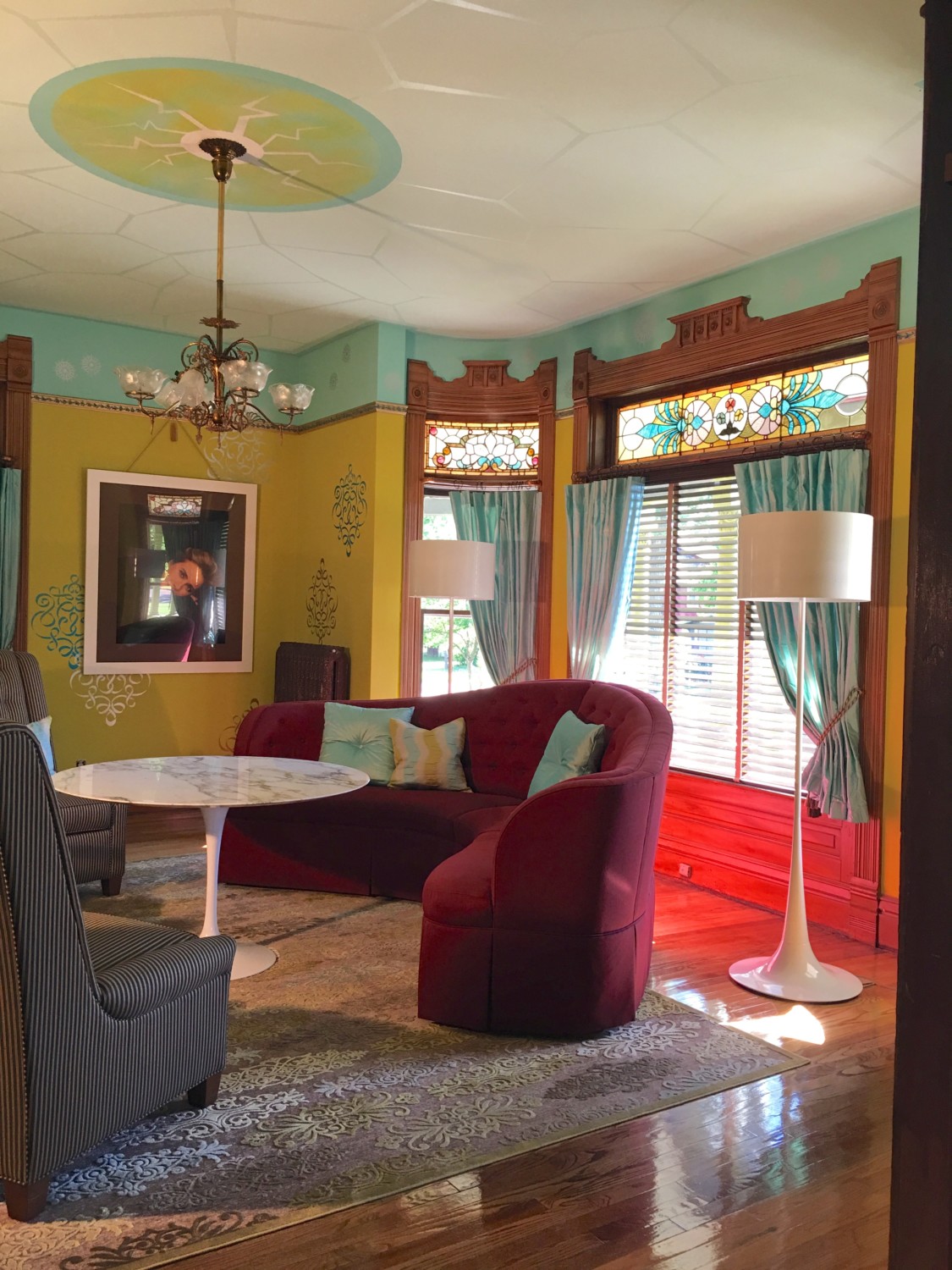
So…OPTION #3, manifested.
The lost picture rail is reinstated. But, as I learned from Bo Sullivan, picture rail in the 1890s did not likely match the trim, as I had supposed. Rather, the rail would have likely been selected to complement the original wallpapers in the room. My end result is a gold painted rail upon which I applied a molded vine picked out in four colors. The end result is more subtle than described!
The parlor originally had a damask wallpaper. My end result is a modern take: a damask ribbon stencil. My age was also a factor in this decision, for I needed to do a pattern which was not physically taxing to do. The chosen stencil could be applied randomly which proved a ton less work than a consistent pattern.
Above the picture rail, the teal paint, which has silver medallions stenciled randomly, recreates the lost frieze, a vital feature in most Victorian-era parlors.
On the ceiling…
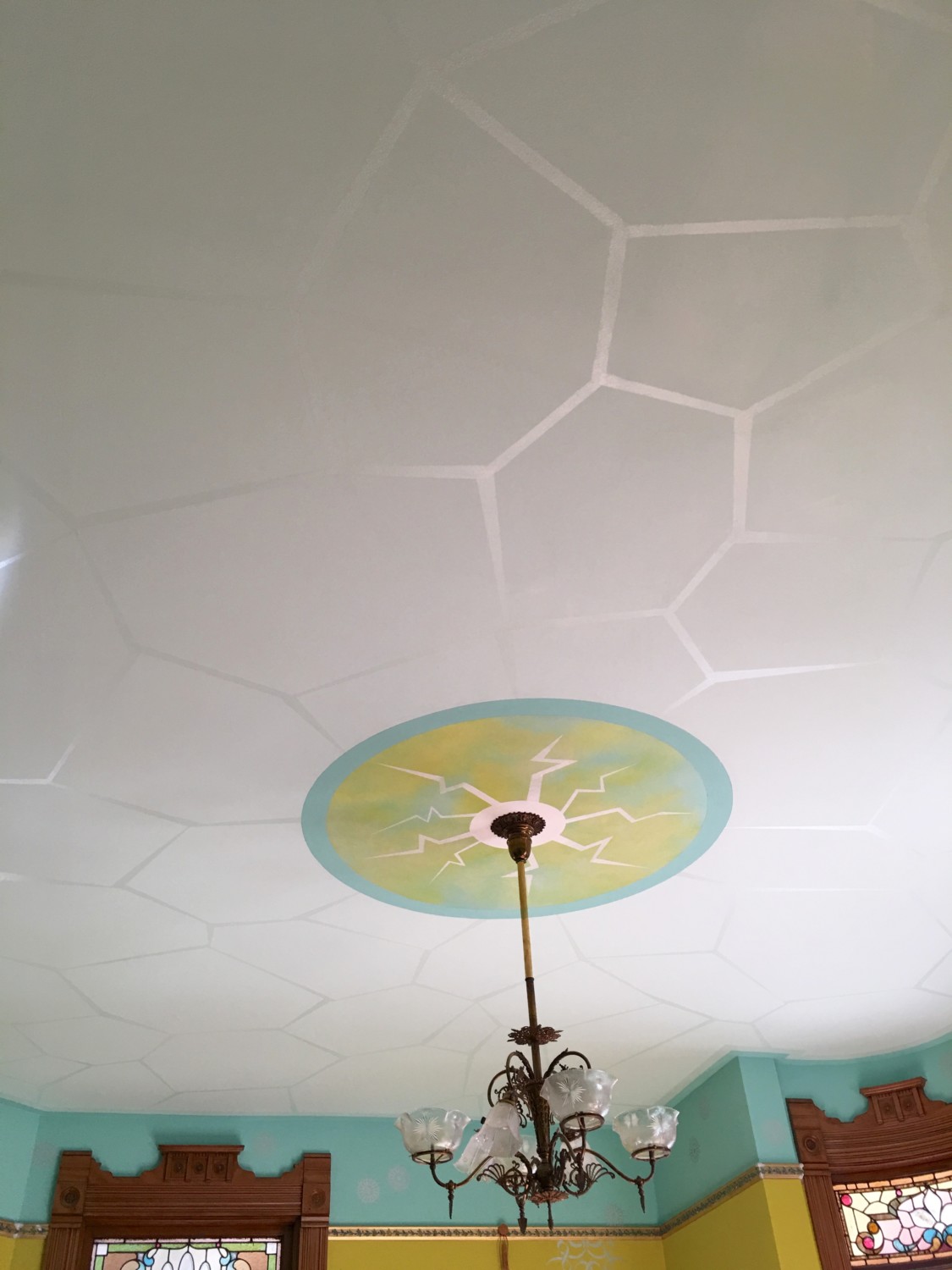
…a “shattered glass” effect was created, and with a dramatic “oculus” featuring lightning bolts. Before the room was furnished this overall effect seemed a bit much. After the furnishings were in place though the ceiling receded to a background element. A kinda cool background element.
So, my 1894 parlor once again has a floor pattern, a wall pattern, a picture rail, a frieze (with pattern), and a ceiling pattern. But I have endeavored to do all this in a fresh, contemporary way.
And I feel really proud about all this!
REGARDING THE FURNISHINGS
.
The furnishings were purchased over a three year period.
SOFA: This is from Thomasville’s Bogart collection. I was MAD for it when the collection came out about fifteen years ago. Right after buying the Cross House one became available within driving distance. I knew right away that I had the perfect place for it. The perfect place! The rooms in the Cross House are all large and with ten-foot ceilings. Most furniture looks silly in the house; like furniture for lilliputians. This sofa is large and with a high back; the tufted back recreates a Victorian-era look, while the sensuous curve fits beautifully in the bay window. The sofa retailed, I think, for like $6,000. I paid around $1,000.
PAIR CHAIRS: Also from the Bogart Collection; a Craig’s List find in Kansas City, never used and but $200. SCORE! Again, note how large/tall they are. Scale, baby, scale!
SINGLE CHAIR: This is the only antique in the room, and is period-correct to the 1894 parlor. I did not want an 1870s or 1880s chair or one from 1904. I also wanted a chair with wheels so it could be easily moved to the center table.
CENTER TABLE. This is a iconic piece designed in 1957, the year I was born. That the table, and me, both turned sixty in 2017 seemed significant, and the purchase of the table was my sixtieth birthday present to myself! Moreover, I wanted a round table because the sofa was designed to accept a round table. I did not want a coffee table and have never liked them (too low). The table was also chosen as it complements the white in the adjacent library. The top is Calacatta marble, which is cream with gold veining. This complements the room much better than the more standard Carrara marble which is white with black veining. Above all though, the table was chosen as it offered a dynamic MCM contrast to the 1890s gas/electric chandelier above. I adore a good historical contrast.
FLOOR LAMPS: It was hard finding TALL floor lamps so I was thrilled to discover these. They were also selected to complemented the center table, and the white-framed picture on the south wall.
RUG: I had a teal-colored rug selected for the parlor but as things progressed I realized it would be too…matchy-matchy. Oh, the horror! So, a different rug was selected which was just a little off. And now I am wondering that I was not brave enough. Would a wholly discordant rug be a better choice? A quite vexing question! For, long ago I learned the value of the “discordant element” in making a room come alive. Because, when everything works together perfectly, a room can come across as kinda…lifeless. But an unexpected element can jolt a room to life. (I had assumed that the sofa, which is a color seen nowhere else in the parlor, would be the all-important Discordant Element. But to my surprise it looks…perfect. Well damn.)
WHAT I DID NOT DO
Above all, I did not impose my will upon the parlor. I did not take my favorite color and apply it to the walls. I did not, because I never do wall patterns or friezes or ceiling patterns, paint the parlor the same way I always paint.
Rather, I spent a lot of time in the empty room and listened to it. What was it saying? And then I spent a lot of time doing research.
Few people take this approach. I see fabulous late 1930s Moderne houses filled with either Victorian-era antiques or Mid-Century pieces. Neither style suits such houses. I see 1950s MCM ranches filled with furnishings and decorative choices wholly at odds with the house. Endlessly, I see expensive new kitchens in old houses which have NOTHING to do with the rest of the house. In each such example, preconceived ideas, popular trends, and this is what I like are imposed upon houses which are stylistically at odds with such choices. This is normal.
I wanted to take an abnormal approach.
The 1894 parlor in the Cross House had a personality; a voice. I just had to listen. The results look like nothing I have ever done before but this is because I have never previously had to decorate a room in a house so old, and with a personality (a strong personality) so different from anything I was used to.
The big trick was to respect the 1894 room while infusing it with a 2017 sensibility. The Cross House has been through a LOT in 123-years and I wanted the finished room to reflect the passage of time.
To repeat:
The big trick was to respect the 1894 room while infusing it with a 2017 sensibility. The Cross House has been through a LOT in 123-years and I wanted the finished room to reflect the passage of time.
ALSO
- No walls were knocked down to create an “updated” look.
- No trim was painted white to create an “updated” look.
- No can lights were punched in the ceiling to create an “updated” look.
YOU GUYS!
The finished parlor did not happen in a vacuum.
My dear friend Patricia was a breathless witness/contributor to almost every decision.
And readers of this blog have shown little compunction about offering advice/criticism. It actually pleases me that y’all feel comfortable in letting your voices be heard, and the end results have been impacted by this global (golly!) participation. Thank you.
As I have endeavored to have the parlor reflect 123-years of history, it is significant that this process has been enabled by a technology which was unimaginable when the Cross House was built: the Internet. I love this!
SUMMATION
The finished parlor is not…subtle.
I never intended that it would be.
But the parlor does reflect its owner. And while the owner has been called many things during the last six decades, subtle has never been one of them.
The owner has a, ah, large personality and the parlor reflects this. But nothing about the newly decorated parlor cannot be easily undone for a new owner. The historic fabric is wholly intact, and lost historic features such as the picture rail have been reinstated. The walls and frieze and ceiling will be repainted eventually and a new owner might love…beige.
The 1957 Knoll table, though, will be buried with me.
As will Hillary.
ADDENDUM: I later made adjustments to the parlor decor.

24 Comments
Leave a Reply Cancel Reply
Your email address will NEVER be made public or shared, and you may use a screen name if you wish.
I love the way you made the parlor look. Everything just looks like it belongs and feels more vibrant and full of life rather than a modern house. I’m glad you came up with a third option when restoring the Cross House, because it brings back both the past and mixes in the present in with it too. I’m also really glad you didn’t go with the second option because it would feel out of place in a house from 1894. I really hope you do something similar, but still different in other rooms in the house. Anyways great job, and keep doing what you’re doing.
Also glad you didn’t do what HGTV does what they usually do it just annoys me that they restore a lot of old houses with the second extremely modern option.
Love love love this long blog! So fun to read about the processing to achieve this beautiful, amazing one of a kind parlor in an amazing house!! It was so wonderful to have you share your thoughts and the decision-making process!!
It looks so very ALIVE! not like a some dead thing that has been arranged for a photographe but vibrant and living! Stunning. You are so far the only person who has taken modern design into the decorating of a victorian house and come out with something I actually like.
P.S. are you still planning on reproducing original papers for the hall? Of course that’s what I want to see but I think anything you do is going to turn put beautifully
The room it just beautiful Ross, great job!
The parlor turned out beautifully! My husband and I are fixing up an 1890s Queen Anne, and I have learned so much since discovering your blog. Very inspiring!
The parlor has turned out beautifully! I’m so glad you went with your instincts, and finished it in “Ross” style. It’s perfect!
I think my dream vacation would be coming down to Kansas and putting in a few weeks of sweat equity, just to be a part of the process!
You are doing a good service to history, Ross! 🙂
You are SO invited!
You should be proud, you did a great job. I hope you feel happy in your parlor. I feel happy looking at photos. I agree with your approach: restore the framework, floorplan (within reason), and woodwork of an old house, but decorate it anyway you like. Decor is personal, but can also be changed easily. I live in a McMansion and would kill for beautiful woodwork and pocket doors like you have. Also the stained glass windows. And vestibules. And porte cochere. And built-ins. And closed off rooms. And dumb waiter and laundry chute. And back stairs. Hmmm, now I can’t remember what I like about my house….
You made me smile!
I love the way you have played with scale, so that it is definitely Victorian, but not fussy.
I think this deserves a more festive and colorful drink. Something like Absinthe, Blue Curaçao and Crème de Menthe jello shooters
I love this. Totally not what I would have done, totally perfect for you, and thoroughly respectful of the house. That is a good trick! You fixed and respected the actual architecture and made it your own. I love OPTION #3: “Meticulously restore the architecture. Have fun with the decor.” I am glad you are championing it, and I wholeheartedly agree! I also love that you know you are not the last owner/decorator of this place. That is really hard to remember. There is a trap in thinking that once you are done, the room will be preserved in amber. I find it hard to get out of that mental trap. When I work on a place, I try and think – what decisions will people be happy that I made in 50-100 years. In my book that always means leaving as much original fabric as possible. Great work! And, also well written!
Thank you, Derek!
And thanks for the compliment on the writing!
I must admit that I am one of the many who didn’t like the chartreuse. However, with the room completed, the chartreuse has faded into the background. The room looks wonderful!
Thanks, Sue!
I agree that the chartreuse was VERY bold during the process. But walking now into the almost finished room the bold color does not grab ones attention.
I love your philosophy regarding this house! Option #3 is by far the best & most exciting!
As for the parlor rug, I think it needs to stand out more-it just kind of disappears. Everything else looks absolutely fabulous! <3<3<3
Hi Shelley!
Yes, I am not 100% sure about the rug and have been back/forth about it.
Then I realized that the two teal pillows may actually be more of an issue than the rug. They are just too matchy-matchy with everything, a particular horror of mine.
So…I am pondering.
Always pondering…….
This is such a beautiful home & she’s the luckiest girl in the world to have you bringing her back to life! <3
I have enjoyed following the progress of this room, both in the physical and in your thought process. I’ve learned not to make a final decision on a room (as far as liking or not liking it) until the final element is in place. Do not judge the room mid-process!
I watched with interest as you decided, tried it, un-decided, and tried something else. I admit to being skeptical as the room progressed. The final product, though, is spectacular and yet understated, and absolutely proves your point about not judging the room mid-process.
Well done, dude.
Thanks so much, Riley!
Back when I had an architecture&design business in NYC, the thing which proved THE hardest was endlessly convincing every client not to freak out until the last 10% was done. This last bit would pull everything together like magic. But it was Hell keeping my clients from freaking out until then. This is the main reason I quit!
I adore this parlour. It alive, it is vibrant, it is interesting and it eccentric. Perfect imperfection.
Thank you, Annette!
I think the best part of this process for me was watching the decor evolve. I tried to not make any judgments, just watch and appreciate the process. The result is spectacular. More importantly, it looks like you’ll be comfortable just relaxing in a room you’ve literally brought back to life.
On to the library!!
Thank you, Arkay! If you fast forward to January/February 2018, you will find that the decor of the parlor…evolved.