
Discovery #1
During the last few days I have made significant and fascinating discoveries in the former servant’s room in the SE corner of the second floor of the Cross House.
This post details one discovery.
The room was originally a servant’s room accessible via a door off the servant’s hall. To the immediate west was (at least as shown on the 1894 plans) a closet for the room, and a blanket closet accessible via the main hall. But were these closets actually built?
In 1929, when the second floor was converted into apartments, it seems that:
- The closet, if built as drawn, was reduced in size.
- The blanket closet, if built as drawn, was removed. This space now became part of the SE room.
- The servant’s hall door was removed, and plastered over. The physical evidence confirms this.
- The main hall blanket door became the entry to the SE room.
- A new oak floor was laid. Or maybe not.

The 1894 plan. South is at the top. The door to the room (lower left) was actually built a bit over to the right. You can see the closet (upper right) and blanket closet (lower right). But, again, were these two closets actually built?
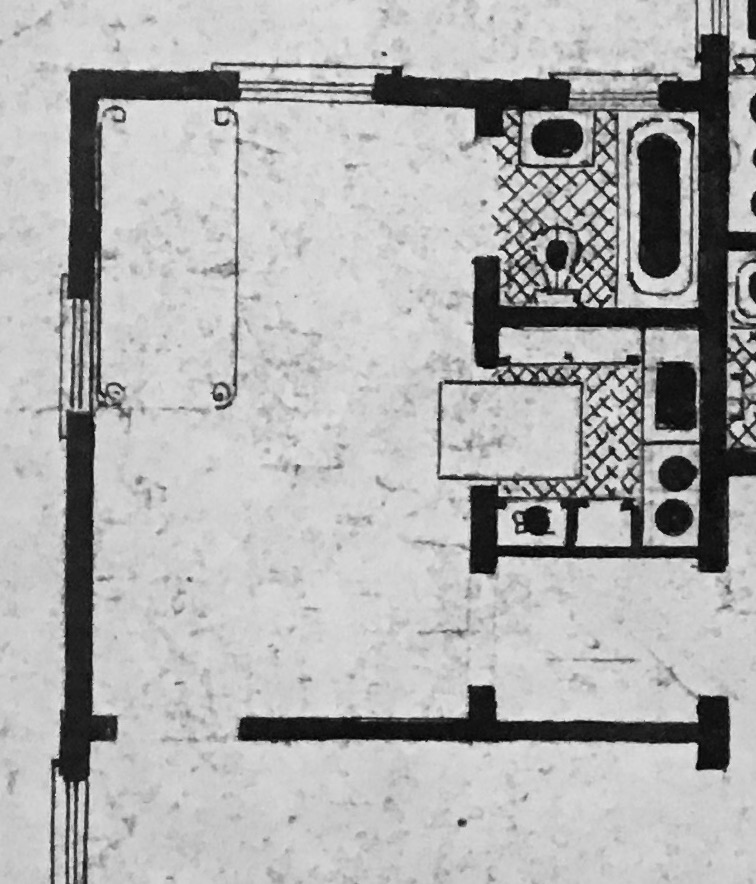
The 1929 apartment plan. While the room was altered, no evidence exists (so far) which proves that this plan was built. It is curious that the room is shown with two entry doors. Also, the windows are MUCH larger than shown. The bathroom window was never installed.
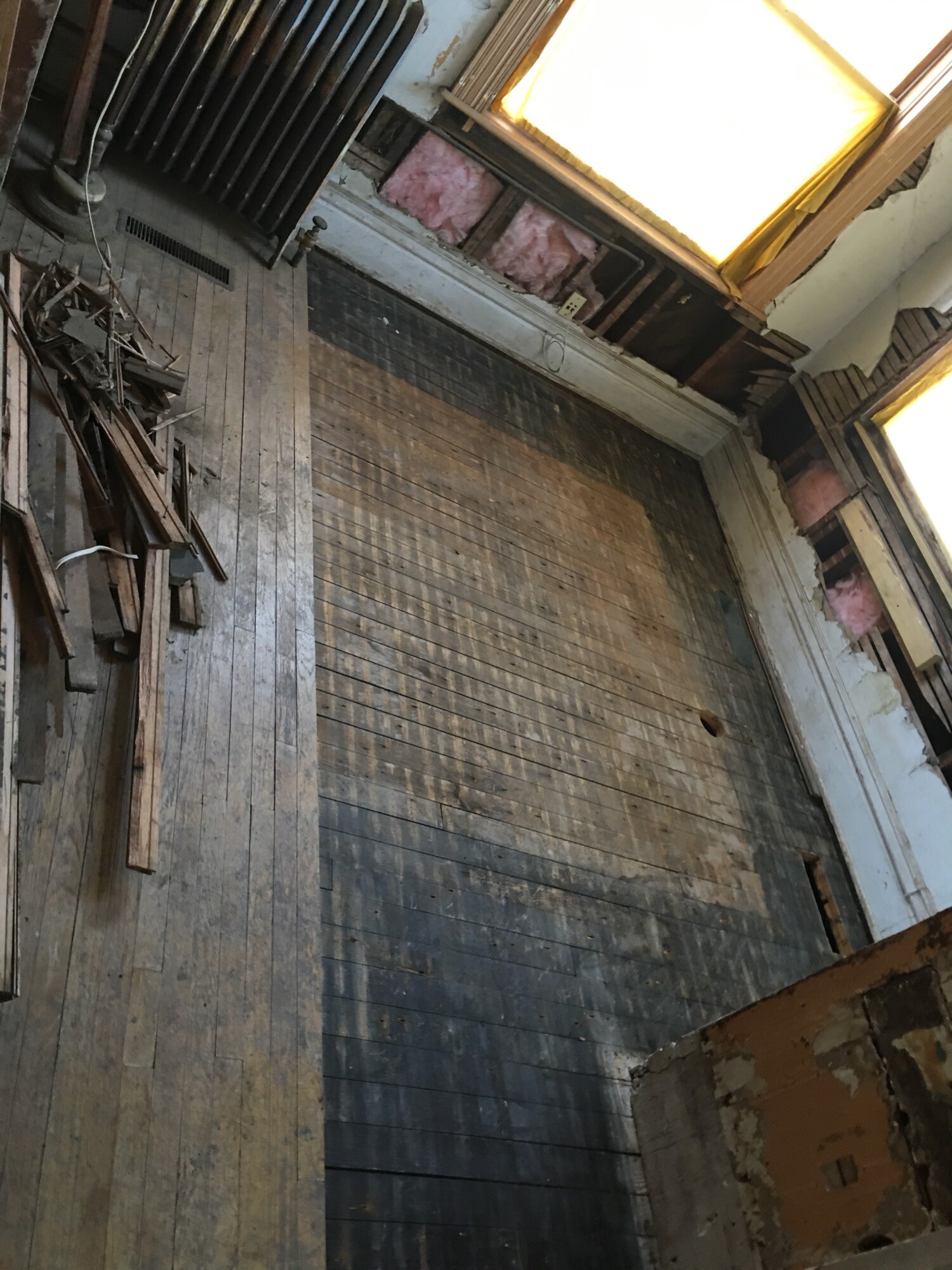
The Other Justin recently removed 2/3 of the presumed 1929 oak flooring, which was too damaged to retain. Under this was revealed the original 1894 flooring. (The first- and second-floors of the house did not originally have “finished” flooring, as both floors had wall-to-wall carpeting.)
The above image reveals something quite fascinating: note the dark border.
In the lower left is the area where the 1894 blanket closet, presumably, was. In the lower right is the, presumably, reduced closet.
The original flooring is painted black or dark brown alongs its perimeter, and a rug was laid down in the center. At least that is what the above image seems to indicate.
But…huh?
Huh?
Ross is now totally confused.
If the oak flooring IS from 1929, then what the above image reveals must pre-date the 1929 conversion. This, then, would indicate that the blanket closet and room closet were not built as shown in the 1894 plan. But is this correct?
However…it is possible that the oak flooring is NOT from 1929, but is rather from the 1950 conversion of the house into the Palace Motel. If so, the above image would make sense.
A plethora of guesses:
- In 1929 the servant’s room was altered,
- its 1894 flooring was painted along its perimeter,
- and a rug laid in the center.
- The room, thus, would not have been made into a studio apartment, but made into, simply, a bedroom or sitting room. (I do know that in the 1960s and 1970s, the room was a kitchen and dining room servicing the rooms for rent.)

In 2015, I did a post which indicated that the oak flooring on the first-floor seemed circa-1950, as the above font is soooooo not 1920s. It now seems though that the oak flooring on the second floor may have also been installed circa-1950.
I am uncertain what to conclude from all this. The evidence indicates circa-1950 oak flooring rather than 1929. And this would explain image #3.
Right?
Or maybe not.
Geez.
Well, in any event, while my uncertainty abounds, I have been having a great deal of fun trying to figure everything out.
What do you think?

18 Comments
Leave a Reply Cancel Reply
Your email address will NEVER be made public or shared, and you may use a screen name if you wish.
Were there any logos stamped on the removed upstairs flooring?
Your opinion regarding the age of the Bruce logo appears to be correct.
A 1930 ad.
A 1931 ad.
A 1942 ad.
I should think that if the flooring had been installed in 1929, then it would have been stamped with something like the logo in the 1930 and 1931 ads, or the would have mentioned a different logo if it were used.
Wow! Cool! Thanks, David!
Yes, the 1942 ad would confirm my guess that the lower level flooring dates from the 1950s motel conversion.
Today, I’m gonna look at some of the flooring removed from the upper level to see if the BRUCE stamp is evident.
David, The Other Justin just confirmed that the oak on the second-floor has the same BRUCE stamp as the first-floor oak had.
Thus, all the oak would date, most likely, from the 1950 motel conversion.
A mystery solved!
Well, damn.
Regarding Jim Wolf’s comment below: I just looked at the 1931 ad again, and that logo is cleverly hidden in plain sight, in the upper left corner. It is pale rather than dark. Once again, I’ve been blinded by my tendency to look for what I think I’m going to find.
I think I will henceforward stick with the hidden-picture puzzles in Highlights for Children. To the doctor’s office!
I think the flooring is from 1950. I think the closets were never built.
It appears the flooring is from 1950…..
I am confused by the other conundrums:-(
However I am so glad “other Justin” could help you and lay the oak flooring.
You are cracking the case!
The E. L. Bruce Company is pretty old. They formed in 1911 (in Kansas City, though by 1921 they had moved their headquarters to Memphis) and ran until they merged (1961) into the Empire National Corporation (who subsequently changed their name to the E. L. Bruce Company lol).
That being said, I found a book for sale, “Design Oak Flooring by Bruce” (there’s no copyright apparent on the listing, HOWEVER, it appears to be 20’s to 30’s). One of the images of the book show a logo strikingly similar to that, above. The font has VERY similar characteristics, and that black “ring” around the lettering is also present, though in print it shows “graining” that make it appear to be the cut end of a log.
Have a gander at the images of the book pages.
I wouldn’t rule out 1929, quite yet. 😉
Regardless, it would be nice if you could save one of the floors and not have to install more wood flooring! 🙂
Are you sure the darkened area was painted? I originally had a bedroom in my house where original flooring had ‘native’ wood areas and darker areas like shown in your picture. However, my bedroom never had carpet. Instead, it was linoleum for a new in 1918 house and out here on a working farm, not in a fancy house in town (some of original stuff still covers my closet floors). The ‘native’ wood areas obviously were locations of heavy furniture (bed, armoire, etc), while the dark areas were open space that got walked on. It was pretty clear that the linoleum backing stained the original pine floor dark brown/black wherever it was mostly walked on.
So here’s my idea for your mystery:
The room starts out as either bare floor or having linoleum, not carpet because: a) it’s intended use was for staff, not family; b) since we are not really certain Mrs. Cross actually had live in staff, it may have not been used as intended. Thus it was not finished with both closets as drawn and possibly was never used while the Cross family lived there. It may have had linoleum installed by the Crosses or a later resident and possibly a housed a bed for guests at some point (which the outline of ‘native wood’ suggests). At some point the linoleum was removed and oak laid down.
My suggestion makes some really loose assumptions so feel free to tear it apart but that dark outline on the original servant’s room floor sure looks like my SE bedroom floor did when I bought my 1918 house. Love a good Cross House mystery!
Hi Ross
That Bruce Flooring label \ logo was used by the company in the 1920s! I found an advertisement in the 1927 National Builder and it included the exact image. I can send you the image if you would like.
So I think it was a 1929 floor.
Gadzooks, Jim!
You are correct!
The 1927 Bruce stamp is identical to the Bruce stamp shown above.
Hi Ross,
Did you look for nail holes for where the walls were nailed into the subfloor? They should still be there if the closets were built.
Maybe call Sherlock Homes? (pun intended, sorry) BTW, the company that has the book on it – Abe Books – is awesome – they are a company that many used book stores use, but sell used and new books, plus many other things. I use them all the time! End of advertising :/ Good luck sleuthing!
Hey Ross,
Another clue as to whether the closets were originally built or not may be the baseboards in the room. Are there seams/splices indicating the baseboards were patched in the locations where the walls may have been removed?
I would restore the original closets, maybe make them into one large closet to support contemporary tastes.
Hindsight is 20/20, so my advice is to document everything that baffles you now, and then a few miles down the road you can take another look at it and hopefully see it more clearly. Several mysteries about my house have solved themselves over time.
I think it’s been too long since we had a good Cross House mystery to solve!
Ross, in your 2015 post, you mention that bathrooms were added to the first floor library area during the c. 1950 hotel conversion (not in 1929). When you had to remove those damaged floors, were they installed AROUND the bathroom walls (as seems likely if the floors and walls were installed simultaneously in 1950), or were the bathroom walls installed on TOP of what might have been an existing oak floor (similar to how you’ve installed the “temporary” wall in the octagon room)? Does that provide any clues as to the age of the matching oak floors upstairs?
Brian, the two library bathroom were installed atop the oak flooring.