
HELP!
This is the story of the never-ending mantel shelf.
I have previously posted about the Octagon Room mantel. It was in very poor condition due to a chronic roof leak above. The finish had flaked off, and the mantel shelf had warped on one end.
Months of leaving the shelf in the sun eventually fixed the warp.
Then the shelf sat inside for many more months.
The over-mantel is now mostly restored. And the Magical Kenny recently refinished the lower mantel. So, it was high time the shelf received some attention!
Taking the shelf down to the workroom, I stripped off what old shellac remained. The top though was blotchy, with the left side having dark stains from decades of water.
I sanded the left side. This made little difference.
I bleached the left side. This made zero difference.
Then I carefully stained the left side. This helped. A bit.
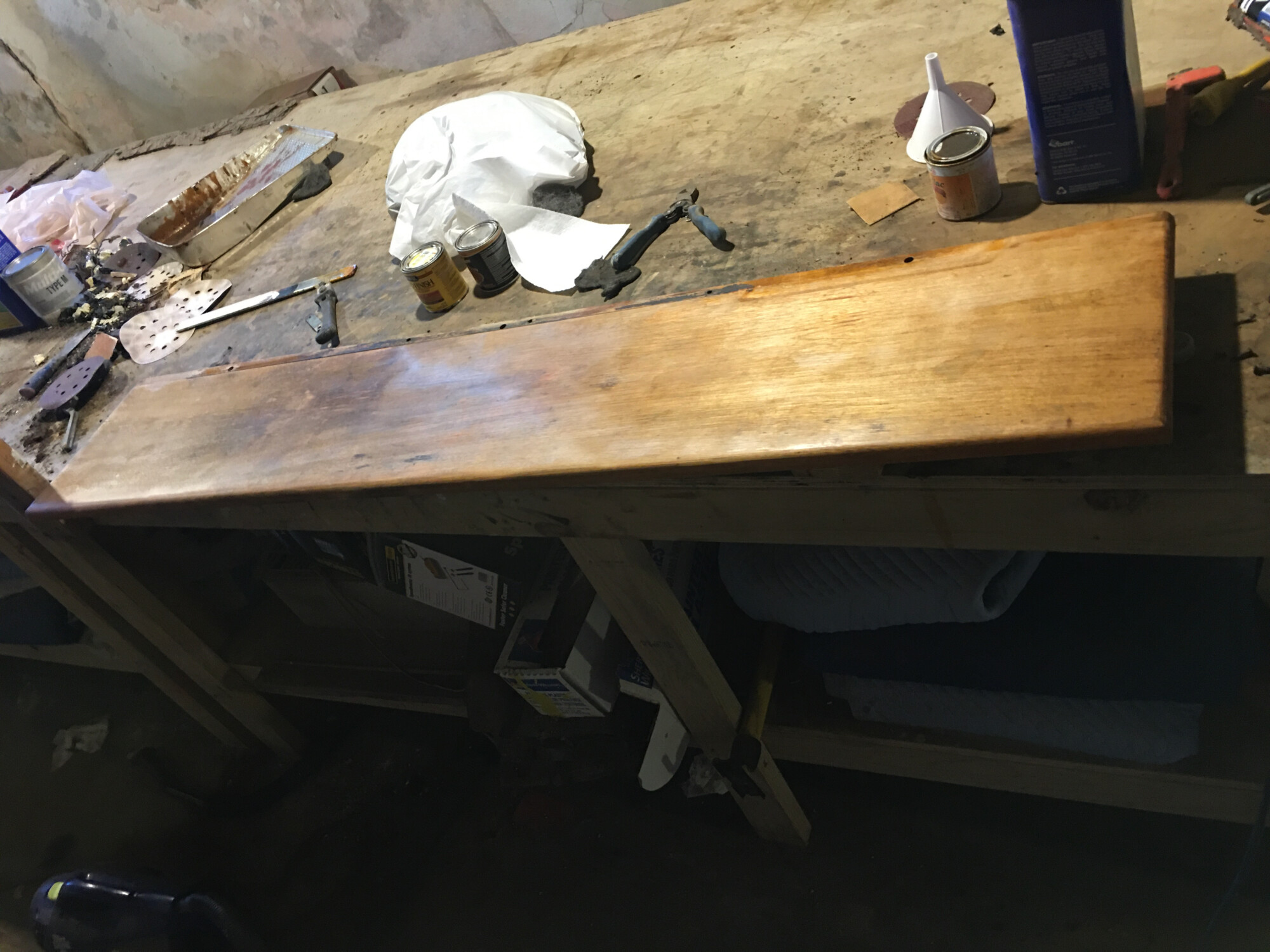
The shelf though still looks like hell.
What can I do? How to fix this?
Or, do I just accept the blotchy shelf as part of its history?
I could also just default to trendy and paint the whole thing black! Problem solved! [Note: Ross is kidding.]

22 Comments
Leave a Comment
Your email address will NEVER be made public or shared, and you may use a screen name if you wish.
Restoring Antique Radios, we see a lot of cheap wood used with the expensive woods and originally it was all blended aka “toned” together to create the effect of a solid walnut case, even though only certain areas received thin walnut veneer….you can try one of Mohawks toners to tone the wood to look like oak again. Another thought, is to see if it can planed down to good wood..
https://www.constantines.com/mohawktonefinishtoners.aspx
My vote is that you leave it as is and let it be a visual testament of the history of the house. I personally would find that far more interesting than if you restored it back to perfection.
I can’t help with the decision. But I can provide wine so you can mull your options. Will be in Emporia on Wednesday, and will leave wine in the usual spot.
Not sure what specifically you used in the bleaching attempt, but it may be worth trying oxalic acid if that wasn’t the previous trial?
Perhaps the person who rebuilt the one interior door has some suggestions. Other than that I can aross this:
Some alternatives to remove watermarks on wood include rubbing either a baking soda mixed with water, a mixture of vinegar and olive oil, dissolved salt on water, or toothpaste (white, non-gel) on the spot in a circular motion until the stain disappears. You should remember to avoid the use of too much water in the mixtures for a more noticeable and successful result.
I have a hunch the most effective might be the toothpaste, not sure why though.
I have some vintage furniture and have had success with removing some water rings with isopropyl alcohol and then reapplying shellac. But that is because I knew they were originally shellacked and the water mark wasn’t down to the bare wood.
I’ve also restored aged pieces the same way, cleaning the entire thing with alcohol and then applying 6 or more thin layers of shellac. When I got done it looked new. No stains or scratches and the grain was beautiful.
For other finishes I have heard of covering them with a cloth and then a warm iron, checking frequently to make sure you aren’t melting the finish or burning the wood. This is supposed to evaporate the moisture as long as it isn’t too deep. Never tried this as all of my furniture is finished with shellac.
I prefer the older furniture because it is easier to repair the finish. With the more modern finishes the only thing you can do is sand down to bare wood and then refinish it. Too much work with middling results. The one thing I do NOT do is paint vintage pieces. To me that is heresy. Okay, I have done it to one piece but it was an old, home-made sideboard of no character or worth whatsoever. It had been used as a tool cupboard. I would not paint any vintage piece of any style or worth. Certainly not one with character.
To me, “shabby chic” is just another name for lazy.
Chlorine bleach won’t help. It’s fine for mildew but that’s not your problem.
You need to treat it like outdoor decking.
Try diluted Sodium Percarbonate first. It is an oxygen based bleach detergent. If that doesn’t work try Oxalic acid or Sodium Hydroxide (lye) diluted. Oxalic acid is good for cedar and redwood. If you use the lye don’t leave it on too long or it will damage the wood.
There are deck cleaners and brighteners available in local stores and online. Thompson and Armstrong both make products.
If it’s a soft wood like pine or cedar you may not be wholly successful but if it’s a hardwood you may have success cleaning, treating and then sanding.
If you do you these products and power wash or scrub, etc. be sure to leave them 2-3 days to thoroughly dry before applying any sort of stain or finish.
Uh…oops.
Doilies, of xourse.
Ha! That is what I might do!
I’m dating myself a little but I love doilies!!!! 🙂
Ross, don’t over think this. Make it presentable and that’s it. It’s the history of the house. No more, no less.
I agree that oxalic acid would be a good option. Thomas Johnson Antique furniture restoration on YouTube would be a good resource to see it in action.
My cousin has a saying that may help in this situation: “Done is beautiful!” I think it is the character of the house and is just fine. And if it bugs you, you’ve always got the doilies to fall back on. 😁
No advice, sorry. But can’t wait to hear what you do! 🙂
I was gonna say use a planer judiciously.
Have it faux grained with the rest of the woodwork?
A tantalizing idea, Steven!
What does the other side look like? Can you flip it over and finish that side instead?
Alas, Trudi, no. The bottom is notched to fit to the lower mantel.
You will be sitting some pretties on this shelf, right? Usually a mantle shelf is at such a height that the top surface is not that visible and if there are pretties (even doilies) placed appropriately, who will know? And like Dan said, it’s part of the house’s history!
I’m not sure it will help now, considering what you have already done, but I have had VERY good luck scrubbing raw wood with straight vinegar and a horsehair brush. Boar bristle will work as well. The brush I have has short bristles, and scrubs beautifully without scratching up the grain of the wood.
It looks like this:
https://stubbennorthamerica.com/product/5201-natur-wood-back-brush/
I read about vinegar vs bleach a couple years ago, when I was scrubbing many big planks to reuse in my house. Apparently vinegar is much better for mold, and though I didn’t have any mold on the planks, I was amazed at how clean they were after being scrubbed, rinsed, and dried in the sun.
Something to keep in mind for the future.
Isn’t it just amazing what vinegar can do? Thx for the info! 🙂