
IT’S OFFICIAL: The Carriage House RESUMES!
NOTE: The carriage house is a tale of two houses. It was built in 1894. The main structure was a carriage house with, likely, a hayloft above. The north wing was the barn. Circa-1921, the whole was converted into a house, and the north wing was relocated to the east and became a kitchen. All this has been detailed in numerous previous posts. So, the structure is today mostly a 1921 creation. The entire interior dates from 1921. The turret is original; most of the many dormers date from the 1921 conversion.
In 2014, after purchasing the Cross House, a lot of work was done on the carriage house. And more work in 2015.
Then it all stopped.
When I first saw the house, it did not look too bad. The previous owner had just installed a new kitchen, a new second-floor bathroom, and painted all the rooms.
He had not fully finished the work however when I made an offer on the property. I then asked that he stop all the work.
Why?
Because I knew I would tear all this work out. I mean, can you imagine me with a Home Depot kitchen? I know, it boggles the mind.
Also, in getting to know the structure, something alarming was discovered. The second-floor bathroom was sinking down into the living room by a terrifying 5-inches. This droop was not new but was obviously the result of many decades of gravity.
The droop was also, I knew, progressive. Meaning that gravity would continue its inexorable force and the bathroom would, one day, collapse into the living room.
And, thus, I abandoned the project.
Until…today.
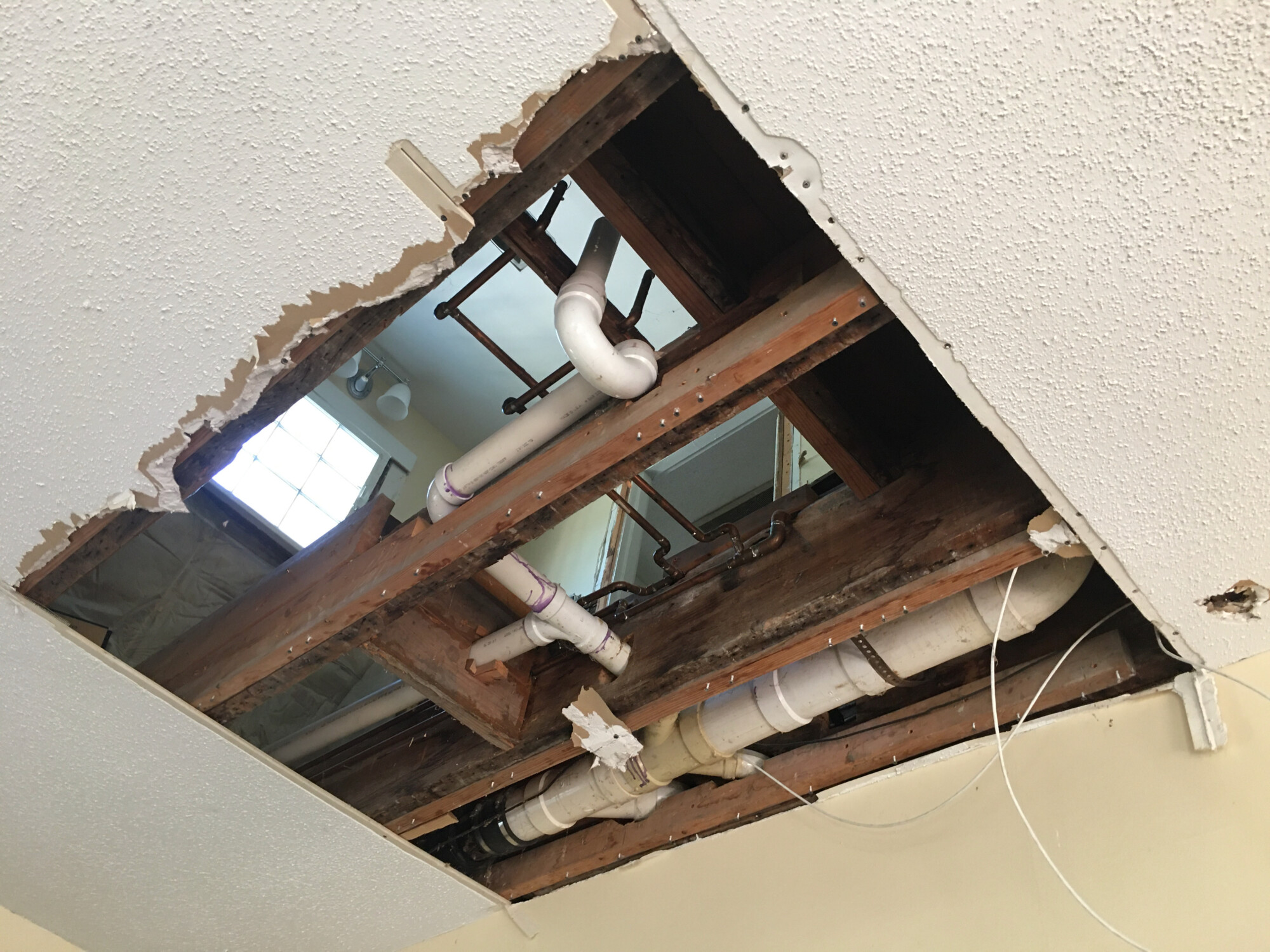
The 2×12 ceiling joists in the living room are like 20-feet long. That is LONG. But, in the SE corner of the room, atop the joists, sits a bathroom. And over the years it was renovated and renovated again. In the process, the LONG 2×12 joists were cut through repeatedly. THIS IS BAD. By 2014, the 2×12 joists were acting as 2×4 joists. THIS IS VERY VERY VERY BAD.
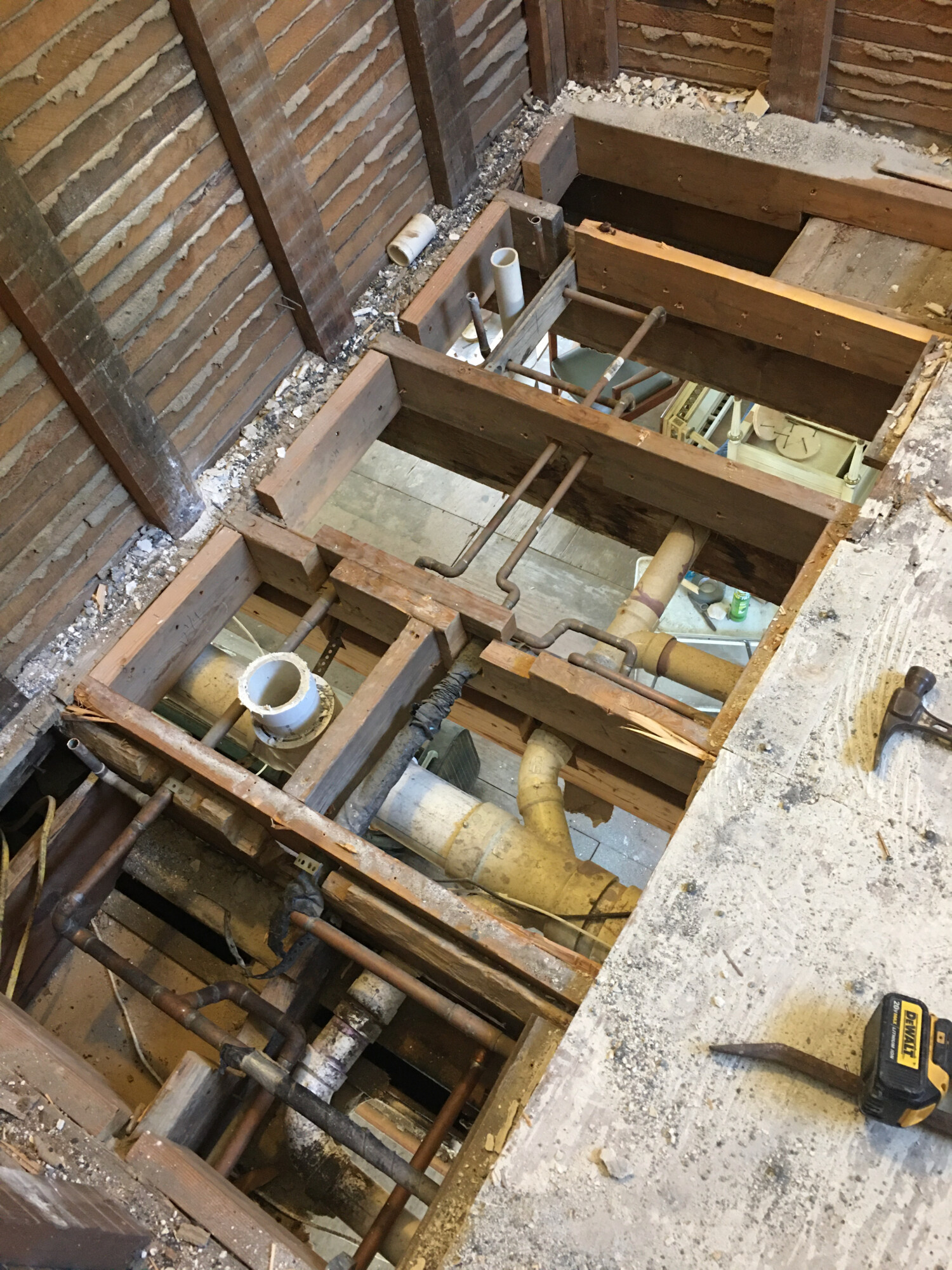
Just yikes. You are looking down into the living room. To compensate for the sagging joists, new lumber was tacked on to create a level floor…
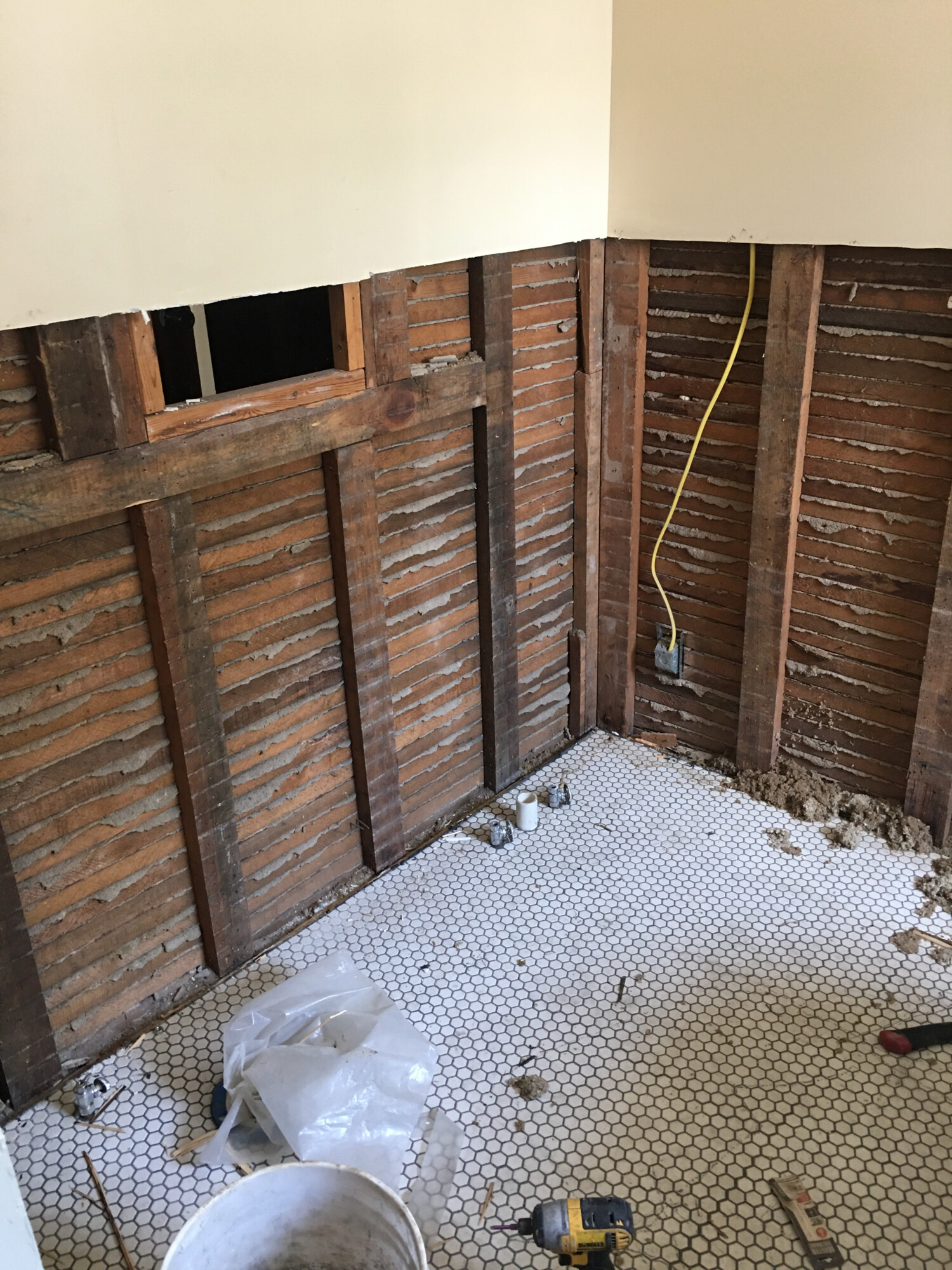
…which was then tiled. The lower walls were covered with plywood, which then had bead-board nailed on. And this is how things were in 2014.
What all this did was to ‘lock’ the 5-inch sag in place. There would be no way to jack the joists back to level with the sag locked in place.
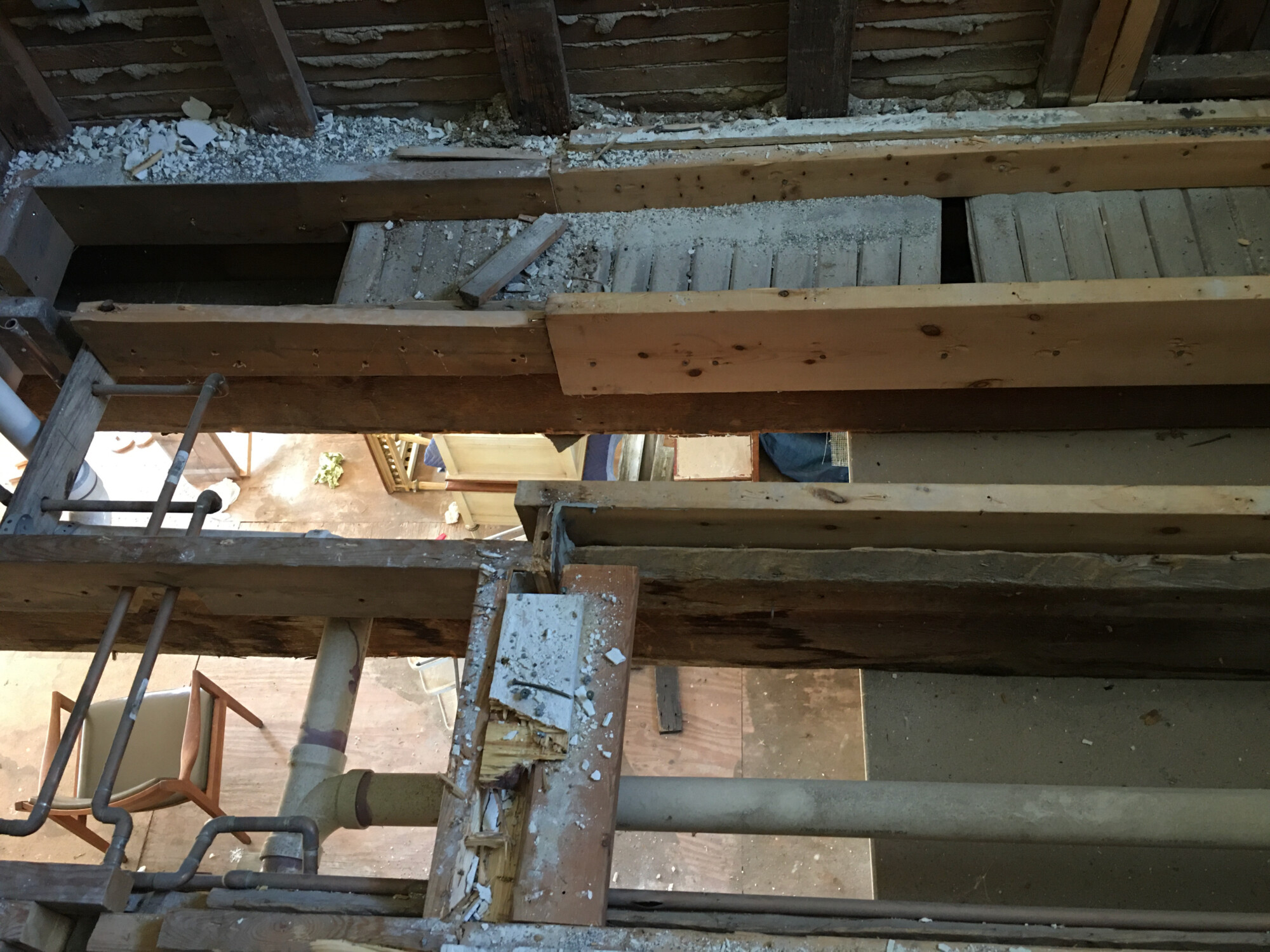
Today, in order to fix this old issue, Justin removed the bead-board, the plywood, and the bathroom floor:
.
The room will no longer be a bathroom, so as to avoid an old problem re-emerging long after I am gone. This is just no way to plumb the room without cutting through the 2×12 joists. Instead, a new bathroom will soon be created in the turret room facing west. A very nice bathroom! The plumbing for all this will drop below the ceiling joists, and the ceiling of the entry hall will be dropped by 6-inches to cover the new plumbing.
I cannot wait.
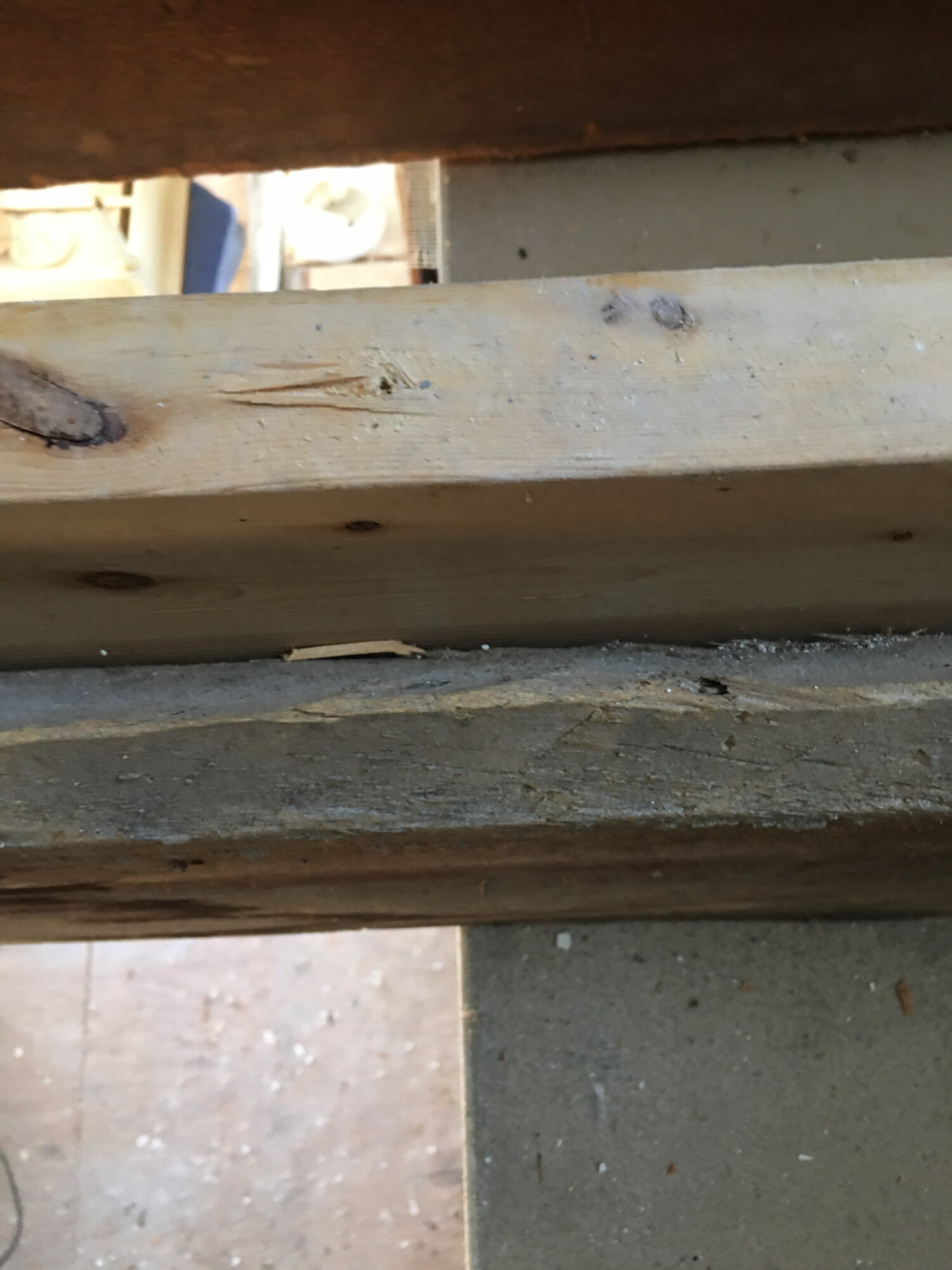
You are looking down. You are also looking at a fabulous discovery and mystery. In the middle is an 1894 2×12 ceiling joist. Tacked onto it is a 2×6 from 2013. Now…note how the 1894 joist is…huh?…beveled on top. And all the exposed 1894 joists are like this.
HUH????????
I have never seen this before. WHY would the joists be beveled on top? Justin though has seen this before. “In buildings which store grain, structural joists are beveled on top so, when grain is pushed down to a lower level, the grain won’t pile up, as grain would atop a normal flat-topped joist.”
Well, the things one learns!
But, grain would not have been stored in the carriage house. Hay though likely was. And beveled joists would help hay fall down to horses below.
This is, of course, just conjecture.
My mind though is just blown by this strange discovery.
A second discovery…
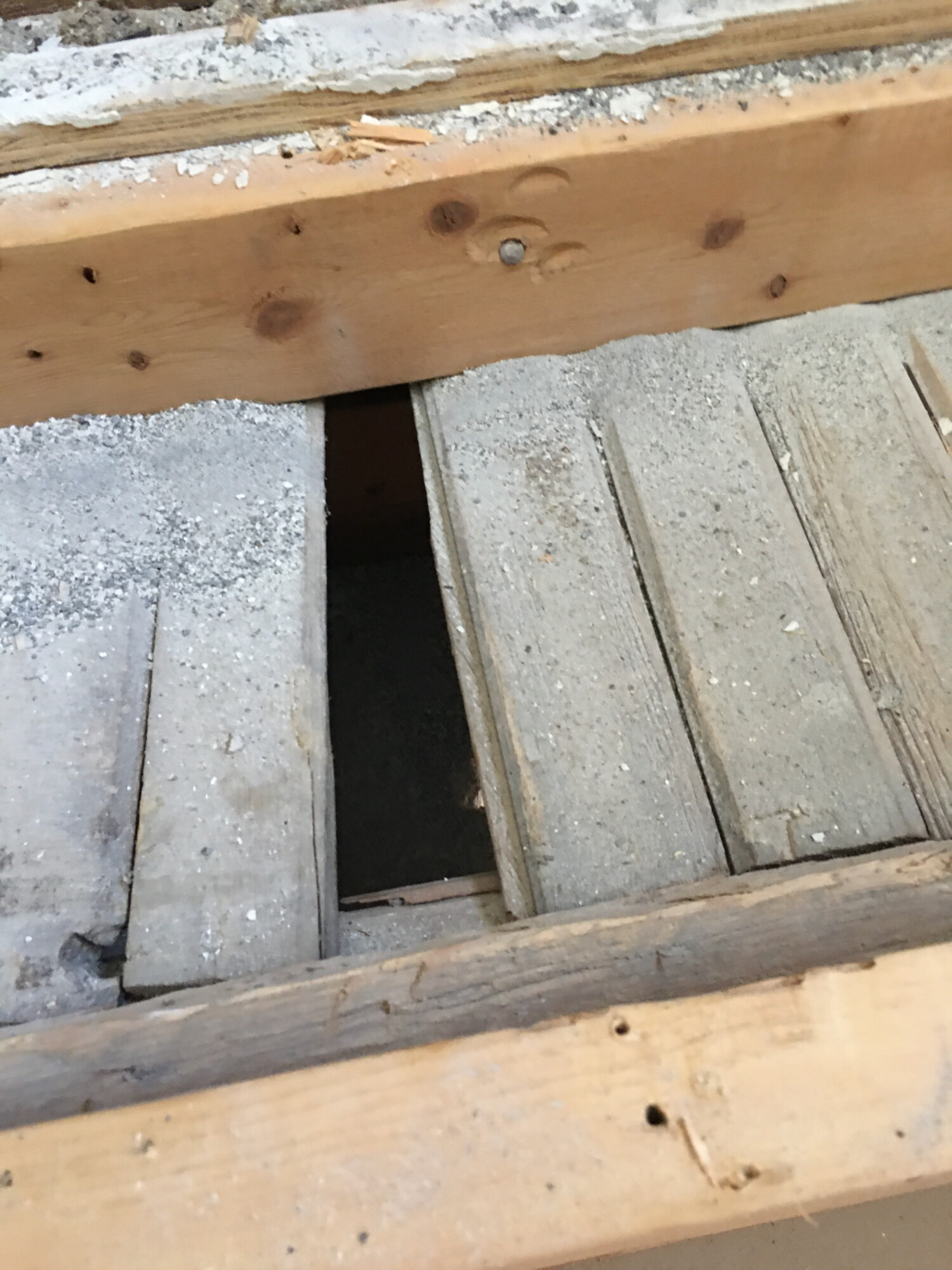
…was soon evident. WHAT are these tongue & grove boards? Ignore the new lumber, which has nothing to do with the old T&G boards.
Are these boards…Gasp! Gasp!…the 1894 ceiling of the first-floor?
I do not yet know. But I am desperate to discover What Is Going On. Is there more of this hidden by 1921 plaster and lath, and then sheetrock?
This is the first possible evidence of the original carriage house interior. It may though prove to be nothing.
Stay tuned!

11 Comments
Leave a Reply Cancel Reply
Your email address will NEVER be made public or shared, and you may use a screen name if you wish.
Interesting information about beveled joists. Thank you for sharing.
As for the tongue and groove boards, onward with the sleuthing! The place will soon be habitable, without the need to fetch water from the well during wintertime.
I put in a hex tile floor like that one in my garage bathroom. Even though the garage was part of the 1949 remodel the house dates from 1922. I love hex tile. I also replaced the cheap vanity sink and faucet with a nice pedestal and new fixtures. I tiled part way up the wall so that I could use the garden hose to wash it out. the garage bathroom is just a toilet and sink and is designed to allow me to clean up from working in the garden so I don’t have to track mud in the house and can wash up a bit. There is also a double laundry sink close by. I suppose the garage could be converted to living space or I could even put a second story on with some foundation work. Both the bathroom and the garage have double hung windows. A nice one over the washer dryer. There’s a gas hookup there too so I could put in a small kitchen.
I had never heard of the beveled joists but that is a fascinating tidbit of info.
Relocating the bathroom is probably the best plan. The sag can be repaired and a bathroom in the turret could be so awesome. I will have to go back to the beginning of the blog to read up on the carriage house and how you discovered all of those modifications and purposes. My neighbor told me the house was built in 1919 but the tax records say 1922 so I’m wondering if it took them three years to complete it. I do know it was remodeled in 1949 and at some point there was a septic tank in the middle of the back yard before the area was annexed by the city and all of the houses hooked up to the municipal sewer lines. I have the 1949 blueprints, two pages. They didn’t follow them exactly but they’re still very interesting. I’ve been meaning to mat and frame them with the intention of leaving them as a permanent part of the house. My neighbor Bob told me that John Bishop and his wife had the house built and lived in it until they died, sometime in the 70s I think. A nephew inherited it and rented it out until he decided to sell. Only one set of renters, a husband and wife. And that the counters in the kitchen are higher than normal because Mrs. Bishop was 6 feet tall. Supposedly John Bishop was the first car dealer in the area but I haven’t been able to confirm that. I suppose I should try doing some research on my house but I wouldn’t really know where to start.
I am surprised you did not restore the carriage house first as you were working on the Cross House so that you could move into the carriage house and be on site, making it easier to work on the Cross house.
Interesting about the beveled joints. Might the horse have been fed grain, too? I also love hex tile and installed it in my 1909 bathroom renovation.
I’m glad to read a new post, Ross!
Ross “Holmes” has another mystery! I can hear your head gears turning! Waiting for the next chapter! 🙂
I have seen “peaked” joists under historic poured concrete and ceramic tiled floors–the upper surfaces of the joists were not just beveled, they came to ridges. I’ve read this treatment was to minimize cracking. I’ve also seen T&G boards nailed between those joists to create a bottom for a mortar bed. This is described as if it is characteristic of the whole second floor joist system, so it is unlikely as an explanation for these Carriage House joists, but see https://www.finehomebuilding.com/forum/peaked-floor-joists
Yes, if they turned this space into a bathroom in 1921, they very likely hacked the tops off those floor joists in preparation for the tile floor and underlying concrete (cement mortar) bed.
Coming soon to a gutted carriage house bathroom near you…a WIC!
Super excited to fill it up! I’ve never had one before!
NOTE TO READERS:
I called Cody, and asked: “What the Hell is a WIC?”
He calmly replied: “Ahh, a walk-in closet.”
Oh. Carry on.
Hahaha you will be fluent in text-lingo in no time, Ross. Cody has lots in store.
Don’t feel alone there! I didn’t get it either! :/
Excitement! I read every blog post and comment but I must have missed the confirmation that Cody is coming! I am so happy that you, Ross, will have someone reliable on site and I am so glad that you, Cody, will have a WIC!