
Small Excitements
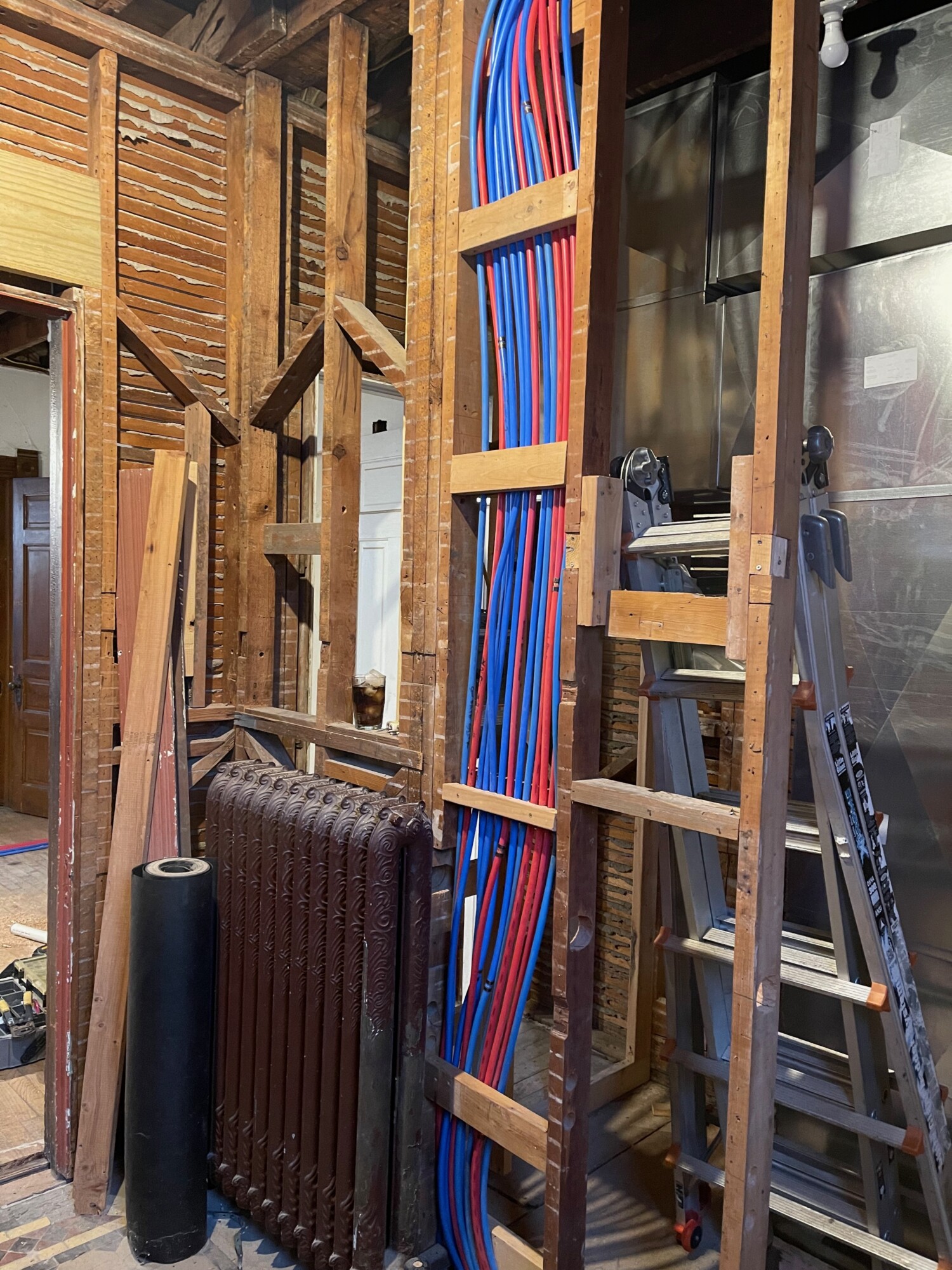
In order to proceed with the GRTFITH Plan (Get Ross The Fuck Into The House), all the plumbing to the third floor needs to be finished so the second-floor ceilings can be closed in. Otherwise, the house is not really heatable. This is bad. You are looking at the north wall of the original second-floor bathroom (off the Sewing Room).
In 2014, a bunch of PEX lines were run from the two west bathrooms on the second floor (servicing the Round Bedroom and Octagon Bedroom), and to the new utility closet adjacent to the original bathroom. This new utility closet though (which will offer access to the newly heightened dumbwaiter) is narrow and I was concerned about adding a manifold for all the PEX lines.
A solution was to install the manifold into a spacious closet above, on the third floor. So, Justin and Scott have extended the PEX lines up up up.
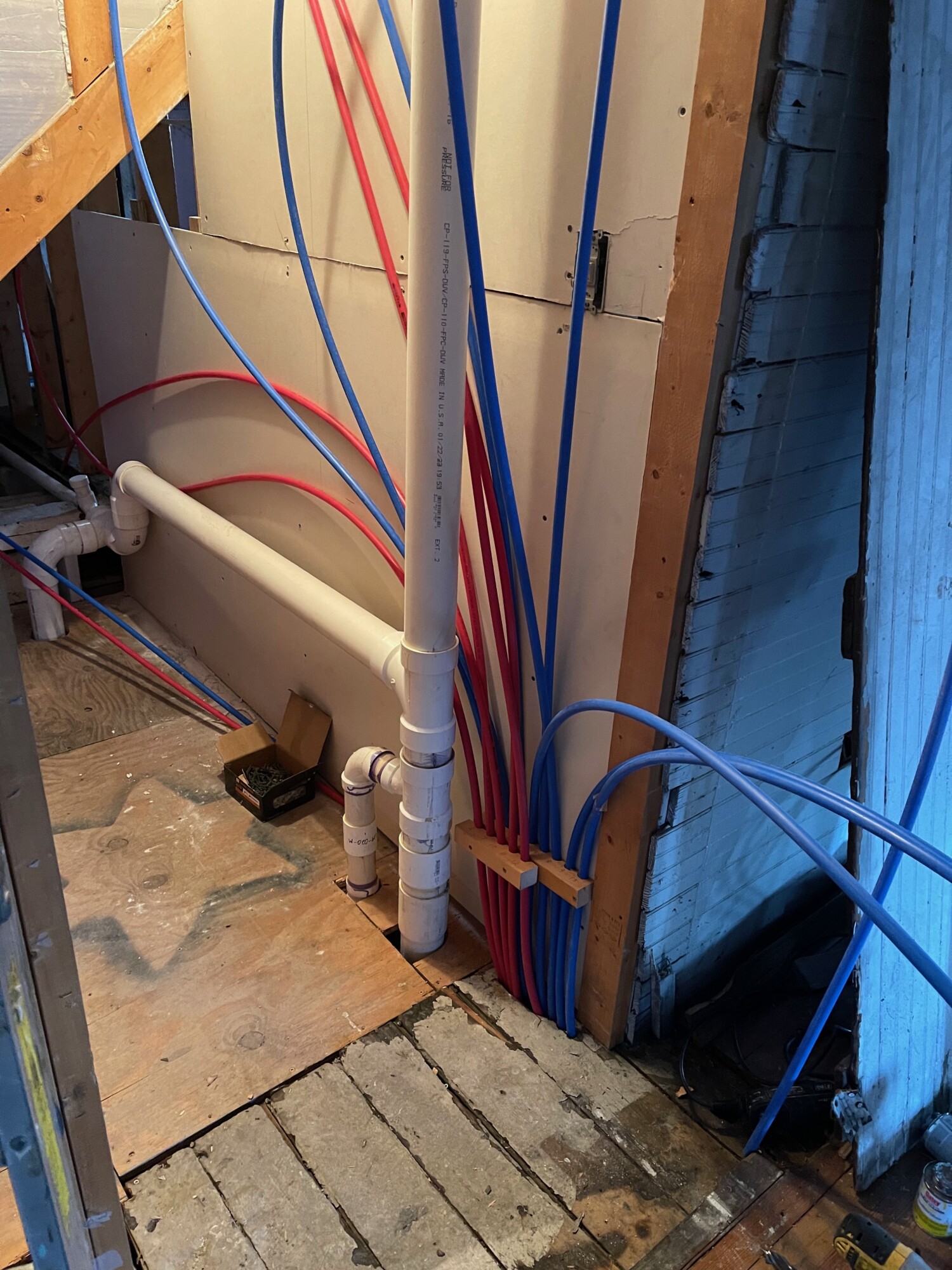
The third-floor closet. I came by today, late, after Scott and Justin had left. I texted Justin this image and wrote: “I think you’re drinking too much while working!”
The lines will soon connect to a new manifold on the newly sheetrocked wall.
All the PVC pipes are new. Soon, I will have a bathroom on the third-floor. Ross excited!
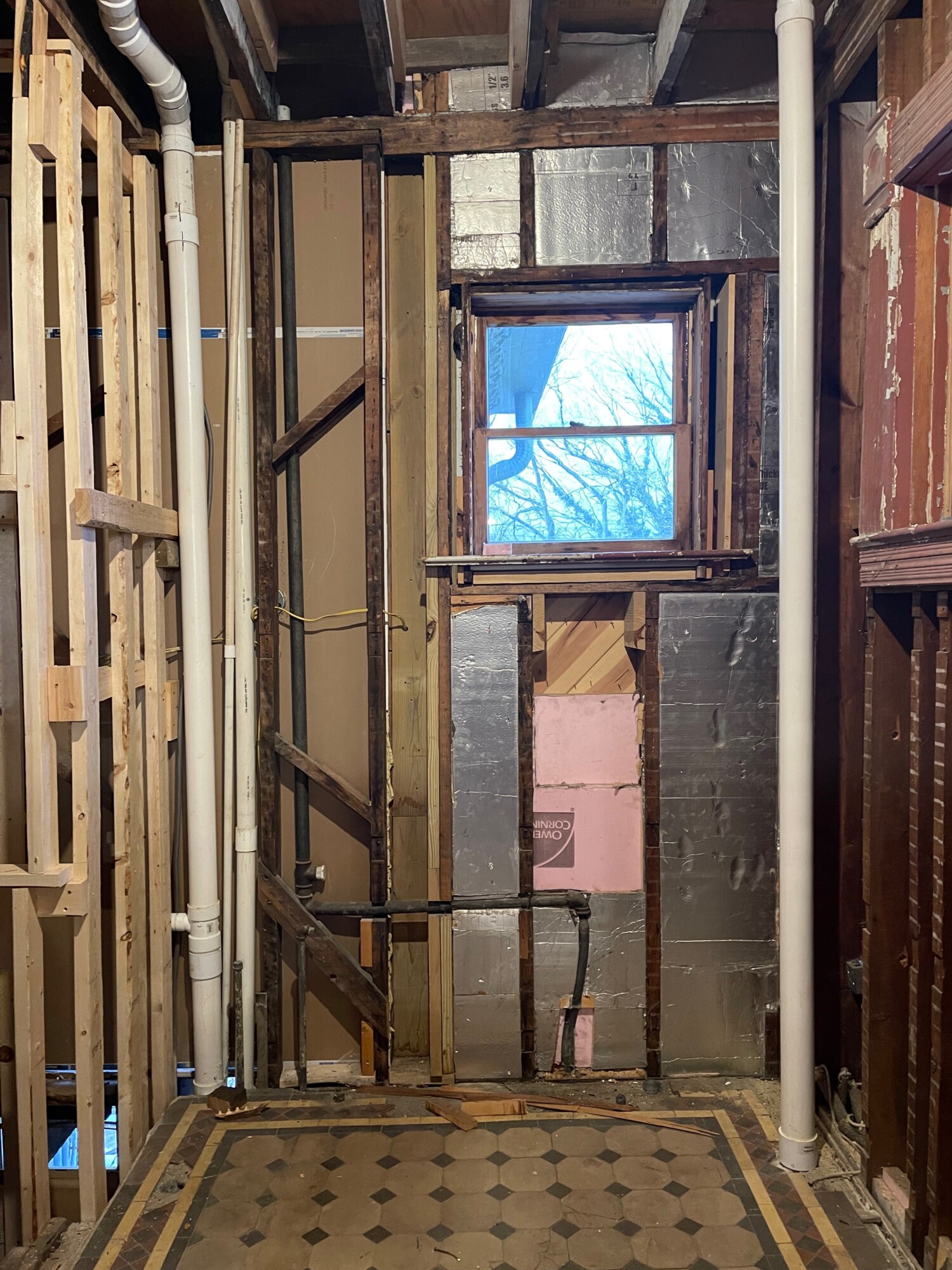
Back to the second-floor original bathroom. This is looking east. The floor is, of course, original. A claw-foot tub was originally against this wall. Such tubs from the 189s, restored, are about ten grand. So, nooooooooo, I will not be buying a restored 1890s tub. Instead, I plan to install a new tub. Tubs are normally 5-foot-wide but the room is 7-feet wide (the 10-foot ceiling makes the room appear narrower than it is). This means that I need to build out walls to each side of the tub for it to ‘fit’. Bump-outs. This though allows for plumbing and vent lines to be installed, as seen above.
The original flooring (porcelain geometric tiles) will be taken up under the new tub. This means I will have enough tiles to replace missing tiles. The border will be relaid in front of the new tub. Extra tiles will be left inside the new bump outs, to be discovered by a later owner if they decide to rip out my work. The floor tiles could, down the road, be relaid in their original configuration.
Finishing the bathroom is not on the 2023 GRTFITH Plan, save getting its ceiling in.

This is a Before/After image of what a porcelain geometric tile floor looks like after restoring. Incredible. I have five such floors. Image by London Mosaic.

7 Comments
Leave a Reply Cancel Reply
Your email address will NEVER be made public or shared, and you may use a screen name if you wish.
My new cast iron, porcelain slipper tub was about $1,000 five years ago, and I love it. In my previous house (1909 Portland cottage) my contractor found an original clawfoot tub for $500.
Our 1860’s house in Michigan never had a bathroom on the second floor so we added one. Found our clawfoot tub serving as a horse trough in a field. We traded the farmer a new galvanized watering trough for the tub and had the clawfoot tub reglazed. I think it cost us $250 total.
I’ve always wondered why US baths are so small in comparison! Standard European baths are 170×70 cm on the outside (67″x27 1/2″), clawfoot ones were often slightly longer. And it’s not like European bathrooms are usually huge, especially old ones. I’ve seen enough bathrooms where the bath was squeezed in lengthwise with barely enough room to walk past to the toilet or sink. Recently I saw an apartment where the owners turned the original bathroom into a utility closet and sacrificed the kitchen for a larger bathroom because the original one was so narrow.
I fully agree with the others, vintage baths should be easy to find and fairly affordable to restore.
CLARIFICATION:
Old tubs are, yes, easy to find and relatively inexpensive.
But tubs from the 1890s are not. I’ve updated my post to include “1890s”. Tubs from this decade are quite different than later tubs. Ditto for early 1890s toilets.
1890s tubs in higher-end homes were offered in (mostly) three versions:
ONE: Porcelain. These weighed a ton. I’ve never come across one.
TWO: The top edge is finished in wood, like walnut or mahogany. The legs, if exposed, were distinctive and different from, say, 1920s tubs.
I’ve been looking since 2014 for a restored 1890s wood-topped tub with no luck. Even when I rarely find one they are like $10K.
Here’s a simple one that sold.
But I think this would have been in a more modest home than the Cross House. You get the idea though.
THREE: A tub fully enclosed with wood paneling. I’ve been pondering this option. You can see such a tub here (as with option ONE).
Just gotta say those geometric tiled floors floors are to die for!!!! I have serious floor envy.
Do you still plan on using one of the 50s tubs as you mentioned in your old post? Or would “new” mean brand new?
Seems like a good plan, and I can see how it fits with your philosophy of “if I cannot get it exactly period correct, make it obviously period incorrect and newer”.
You can actually get tubs that are wider than 5 ft. They do cost more. I wouldn’t build out the walls (unless you need the storage space) but instead just build a platform on each side. They can be very handy for sitting on or laying a towel or bottles of stuff. It would also give you a spacious feeling while in the tub instead of being enclosed in an alcove. If you do porcelain on cast iron you’re looking at $2,000-$4,000. That’s what I’ve been looking at for a fantasy bathroom remodel that will never happen.
But I could swear I’ve seen reproduction free standing tubs that look similar to those illustrations in the link.
There is nothing I would like better than to remodel the bathroom in my parent’s house to not only install a tub but also move the doorway to make it an ensuite and then enlarge the doorway. The doorway is not wide enough for a walker or wheelchair and there are no handicap accessible bathrooms in the entire downstairs. The bathroom is about 5 feet by 8 feet. It currently has a small shower (that I’ve just installed a pressure balancing valve in to make it useable) but it just isn’t very practical. If I sealed up the door I could remove the shower and put a tub/shower combo across that and then move the door to the wall by the sink, facing the toilet straight on. Much more practical. But it would cost money. It would also raise the property values.
I love the tile and I hope you have a way to save it, restore it and reuse it. I really envy you the high ceilings. Truly. I love them. It’s the thing that really sold me on my house. The only reason I can tolerate moving back into my parent’s house is that the bedroom has a chapel ceiling so at least part of it is as tall as the ceilings in my house. I love my house but it just won’t be practical to stay here once I’m not mobile enough to walk on my own. That’s where I’ll be in 15-20 years. Maybe 10.