
Tearing The House Apart
In a previous post today, I wrote about how the new infra-red stripper did not really perform well at removing the paint of the bead-board covering the walls of the third floor.
The ceiling of the huge room is covered with sheetrock, which I loathe, and this, presumably, is covering over more bead-board.
Since 2014 I have wanted to pull down the bead-board. At the time I had no idea WHY it was installed. Since then, I have learned that there were two attic fires in the 1960s. The evidence of this is obvious in the attic, which charred roof joists everywhere. Yikes!
My thought was that the fires would have, it seems, damaged the wood ceiling. As such, it seems reasonable to think that the horrid sheetrock ceiling was installed to cover fire damage. But this was all guesswork.
Until…today.
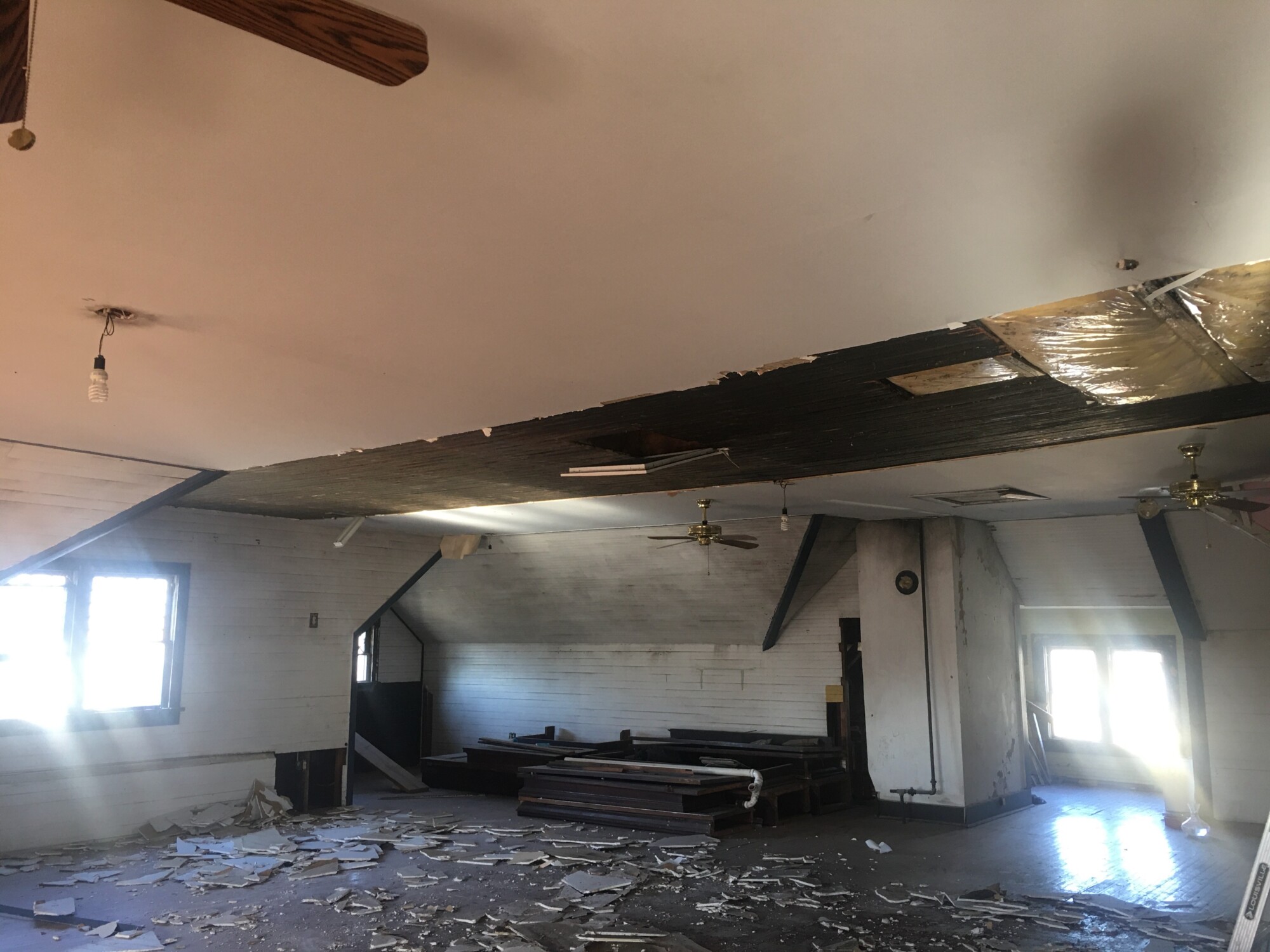
Because Ross tore down an eight-foot-wide section of the horrid material, revealing…
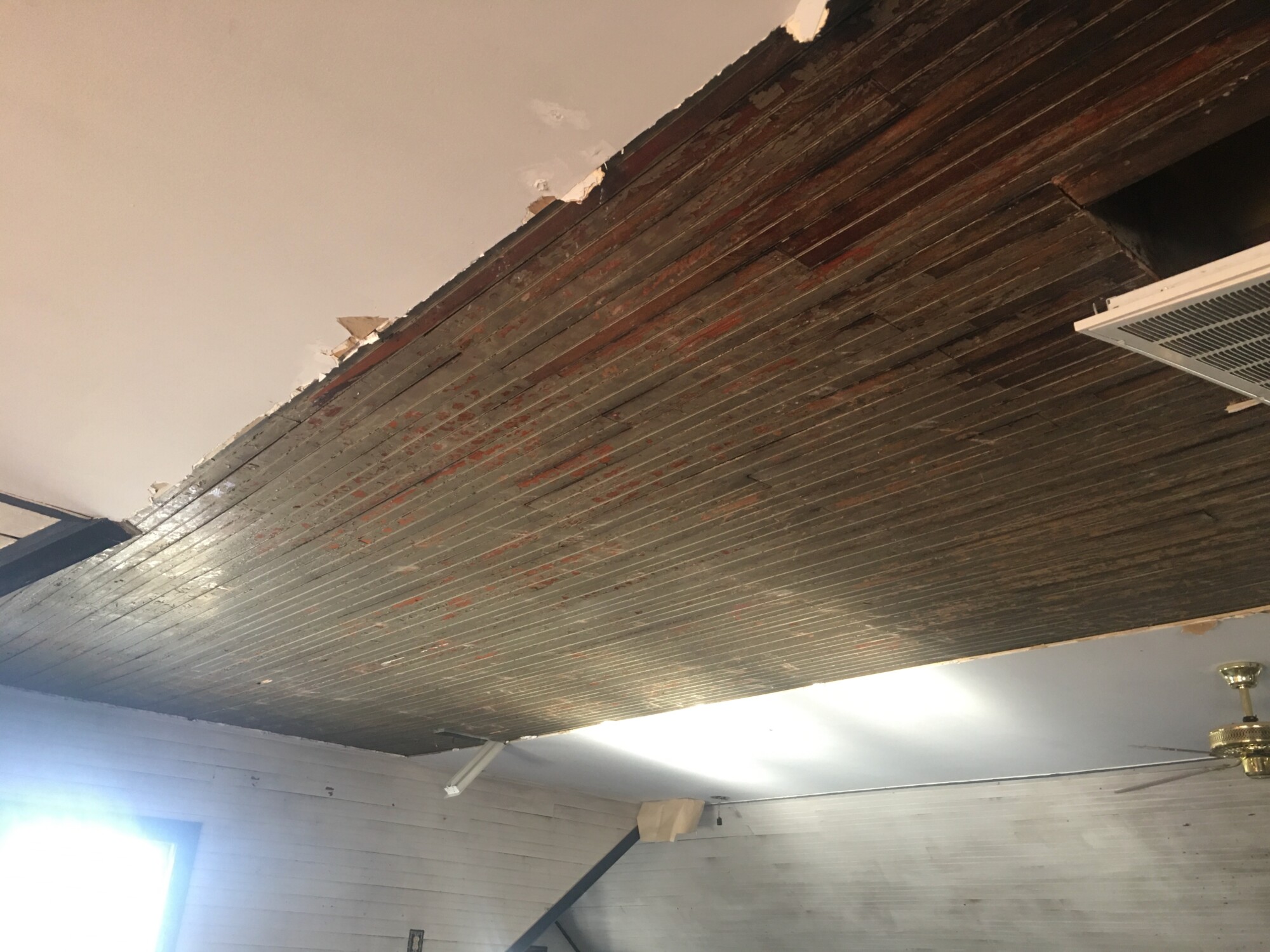
…bead-board!!!!!!!! Looking north.
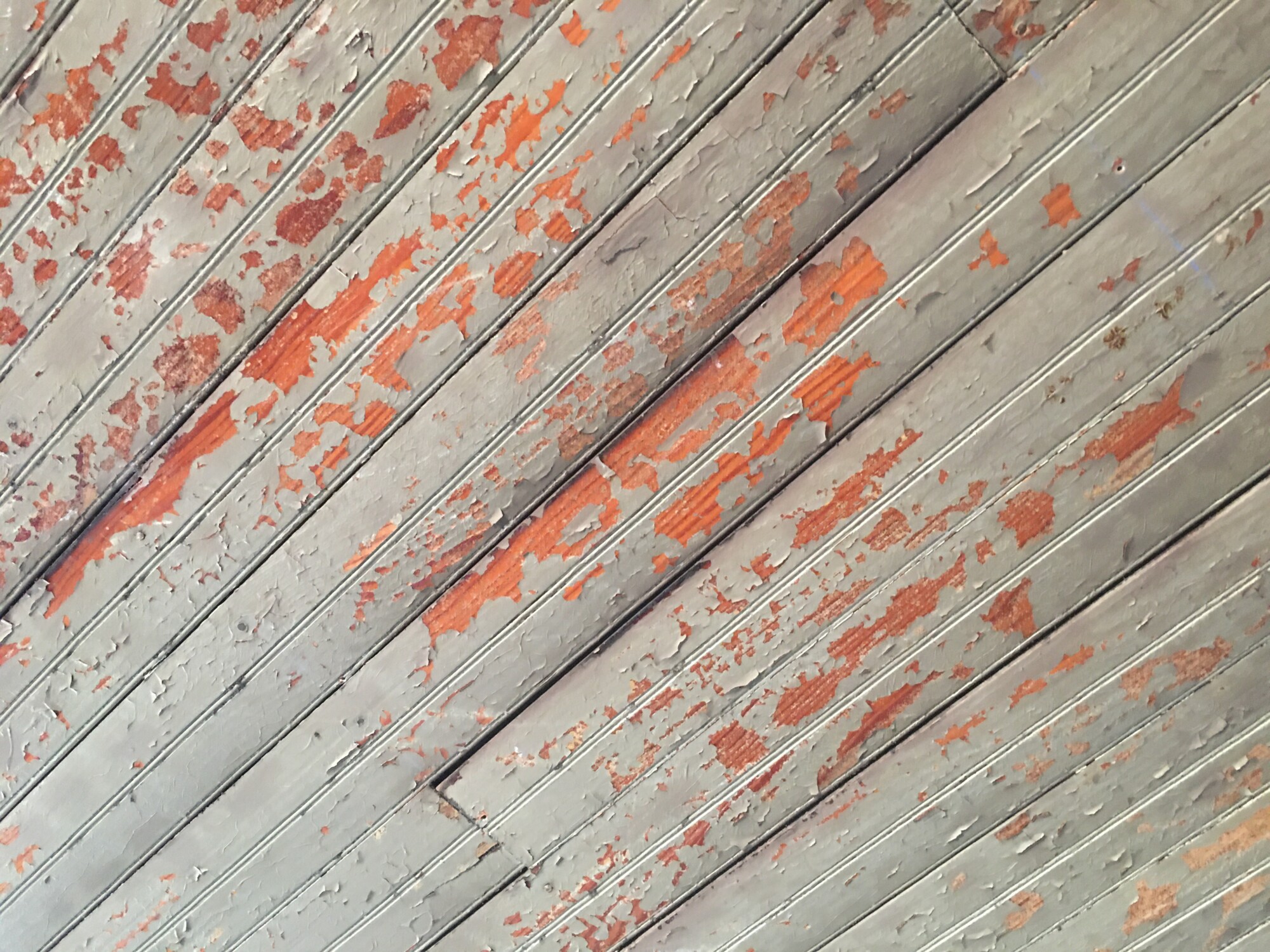
The bead-board though, to my great surprise, was painted! This single layer of paint is covering over the 1894 shellac finish.
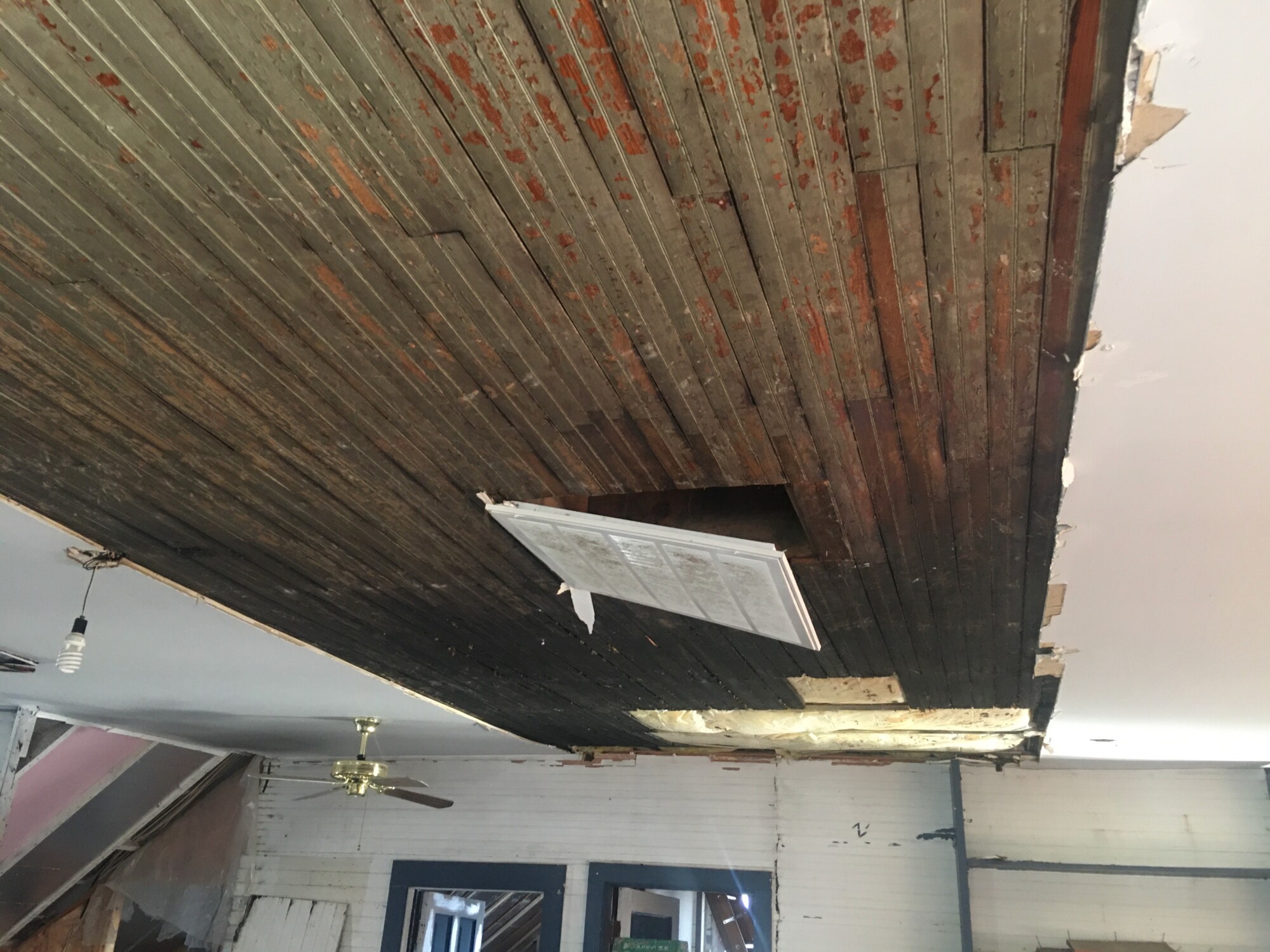
Turning, and looking south, an ominous story is revealed. Note how the bead-board turns black.
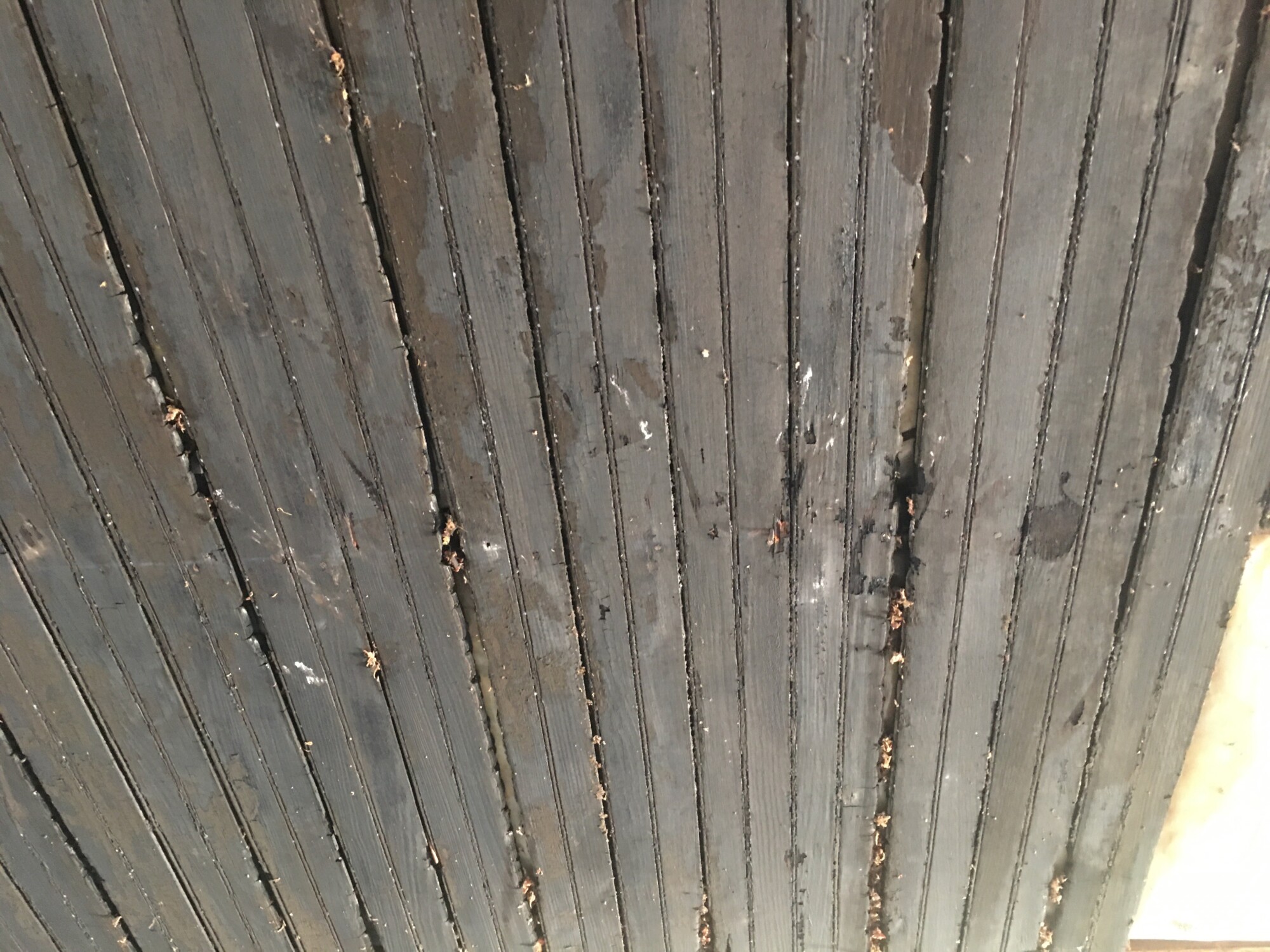
Very black. And with charring along the edges. Yikes!
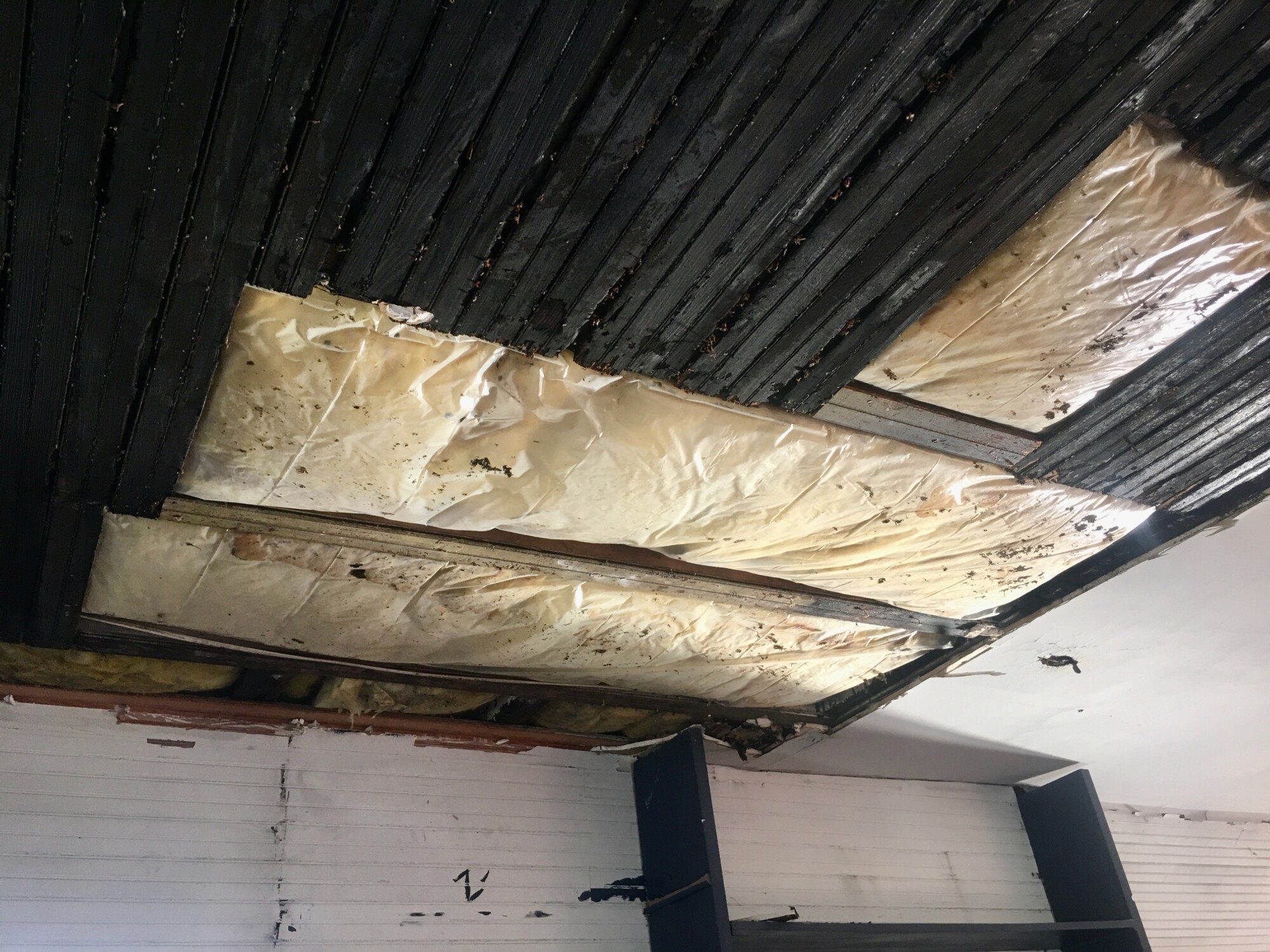
Geez. Were these sections removed after the fires? Or was the charred ceiling cut through to allow for HVAC equipment to be hauled up to the attic, directly above the insulated sections?
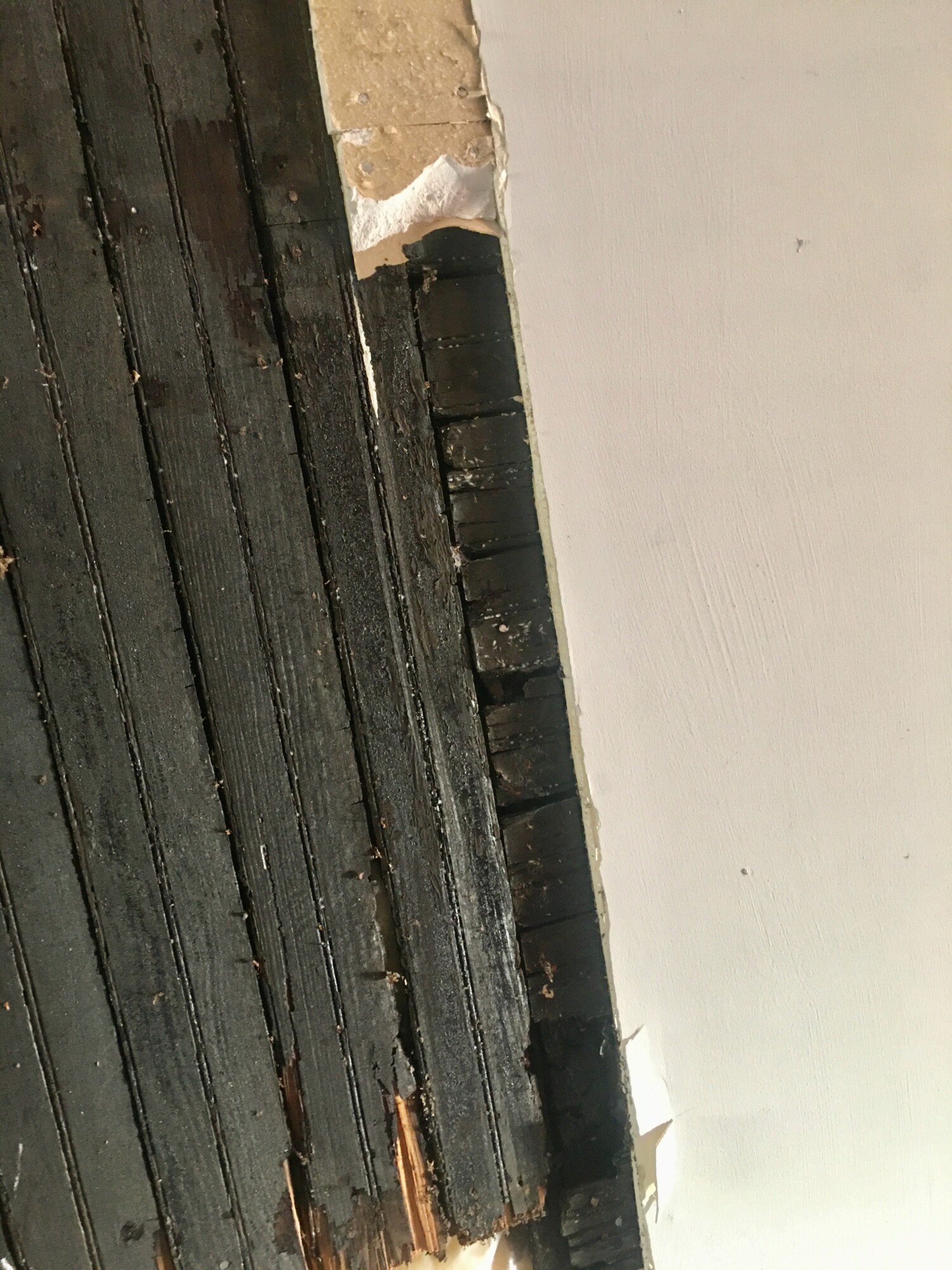
This discovery startled and intrigued me. Look close. The bead-board I exposed was installed north/south. But…you can see see the ends of the adjacent bead-board are installed east/west. WTF? This offered the tantalizing possibility that the huge room had originally been divided!

And this possibility is supported, perhaps, by the original drawing.
See the double-dashed lines? Those indicate walls. Indicate being the operative word. Drawings normally show solid double lines to indicate walls. So, these dashed lines indicate, to me, that the architect was unsure if there should be walls on the third floor. Or unsure where such walls should be.
The directional change I discovered today is roughly where a wall is indicated, running left/right. The dashed double lines running top/bottom show walls that were actually built.
So, was the left/right wall built?
I have wondered about this since 2014. And soon, with more sheetrock being pulled down, an answer may be revealed.

My third floor currently looks about like dance hall of the Armour-Stiner House did, before its spectacular…

…restoration. This image has been my inspiration to restore my third floor. These last two images are from the Armour-Stiner House.
My plan is to bit-by-bit remove all the sheetrock, so as to ascertain the condition of the wood ceiling.
The burned sections cannot be restored. They will have to cut out and replaced with new headboard (which is still made today). The new wood will have to be feathered in, just like new flooring is feathered into old flooring.
All the original bead-board will have to be taken down to bare wood. Then, both new and old wood will be shellacked.
The amount of work this will entail scares me profoundly. But, with Baby Steps…

18 Comments
Leave a Reply Cancel Reply
Your email address will NEVER be made public or shared, and you may use a screen name if you wish.
Ross, my darling….
I’ve looked at this print several times over the years of being a reader/badger here. It just now hit me that this isn’t exactly a floor plan…it’s a ceiling print! Notice how the chevrons are carefully intersected, and the small bit of boarding facing the direction to make the pattern that would be most effective. Yes, the “floor plan” is exactly what’s built, but it could be that the “ceiling plan” is the more important bit of work that has been overlooked, given your discovery today. I’m on pins and needles to discover what is under all that blasted sheet rock. Could it be a fabulous beadboard ceiling design? OOOHHH…I certainly hope so!
Alas, Dodi, no.
The plan shows the third floor, but overlaid upon this is the roofing plan. Those are all the single-dash lines. And the lines all close together represent how the roof shingles should be laid out (either east/west or north/south).
This is common to top-floor plans.
But I like your idea!
Oh boo hiss! At least I was thinking outside the box. Wouldn’t it have been wonderful after all? Mr. Squires would certainly have been the one to come up with this innovation, though.
Ross is this part of your plan for moving in by 2021 or are you procrastinating with a distraction?
It was obviously Ross’s day off and he was having a bit of fun playing “demolition of drywall and discovery” at his house. For myself, I was tearing out hated wire shelving in the laundry of my cabin! Pry bars and hammers aloft!
I’ve been drawing house plans for over forty years and yes, I am still old school, drawing by hand. Those dashed lines are exactly as you say they are. It is my opinion that the architect wasn’t sure of what the owner wanted, as far as layout in the attic. It might have been that the owner wasn’t sure themselves. The architect showed the walls solid that were necessary to build the house (outside walls, knee walls and windows) and showed the dashed walls which are typically the way future walls would be shown on a plan! It is my contention he was suggesting a possible future layout with the dashed walls. The only curious thing is that he didn’t indicate any interior doors to those spaces. As to if the owners ever followed his suggestions is anybody’s guess.
Now I really want another look at the third floor to see what the bead board looks like! I love that big open space. And I’m looking forward to seeing what you learn as you pull the drywall down. Were walls originally built? Were they built later during one of the house’s many incarnations? Can’t wait for you to put on your deerstalker again to figure it out.
I just saw this house for sale listing in Minnesota and was so struck by the similarity of the mantels to the Cross House- and of course the rounded porch and turret design too! Thought you might enjoy seeing it: https://www.startribune.com/2m-victorian-home-near-lake-of-the-isles-is-renovated-jewel/600038516/#1
Thx for the info – what a great house. 🙂
Wow. Is this going to be a someday job After you move in? lol 🙂
Yes, Laurie. I plan to remove one more piece of sheetrock to see if a wall was very built across the room, and then stop.
Restoring the room will take years.
The attic is quite a big job, but I can see where your curiosity got the best of you. The Arthur-Stiner house is magnificent. Someday your attic will look like that. When you move in and the rest of the house is restored and furnished, then you can start on the attic. It’s a shame about those charred bead boards though. You’ll find a way to get it done. So many things to look forward to.
Hi, Cindy!
Replacing the damaged bead-board will not be that difficult.
Spatially, I think the room makes a lot more sense with the addition of the double dashed north-south wall, especially if you want to turn this floor into more Airbnb space like you’ve mentioned previously. If you ran another short east-west wall from the “indicated” wall down to the exterior west wall facing Union, just south of the Union-facing dormer, you could split the “new” space in two and create two tower bedroom spaces with sitting areas for guests, and a large living space with the eastern portion of the rest of the floor.
Just a thought.
Cody. Are you mad? You suggest chopping up the fabulousness of the GREAT THIRD FLOOR ROOM?
There’s a rumor that you will be visiting the Cross House in May.
If so, you will see the error of your suggestion!!!!!!!!
If it was on the table in 1894, it certainly warrants discussion in 2021.
It would bug the SHIT out of me that the beadboard changes direction at the location where a wall was proposed to be built, but never finished. Things were obviously set in motion to make it happen, but then stopped (for whatever reason).
And also like I mentioned, more private bedrooms on the third floor would be more conducive to use as Airbnb space. More beds = more money. They would be quirky, kickass bedrooms.
Love seeing your new discoveries. I may be wrong, but I believe those dashed lines represent something “above”. I think this blog excerpt bears this out…
“The first and most basic rule of lines in design drawings is that solid lines indicate visible or “real” objects or surfaces, while anything drawing with dots and/or dashes indicates something that is unseen or “hidden” from view.”
Source: https://www.boardandvellum.com/blog/what-different-line-types-in-architecture-and-design-drawings-mean/