
Inching Along
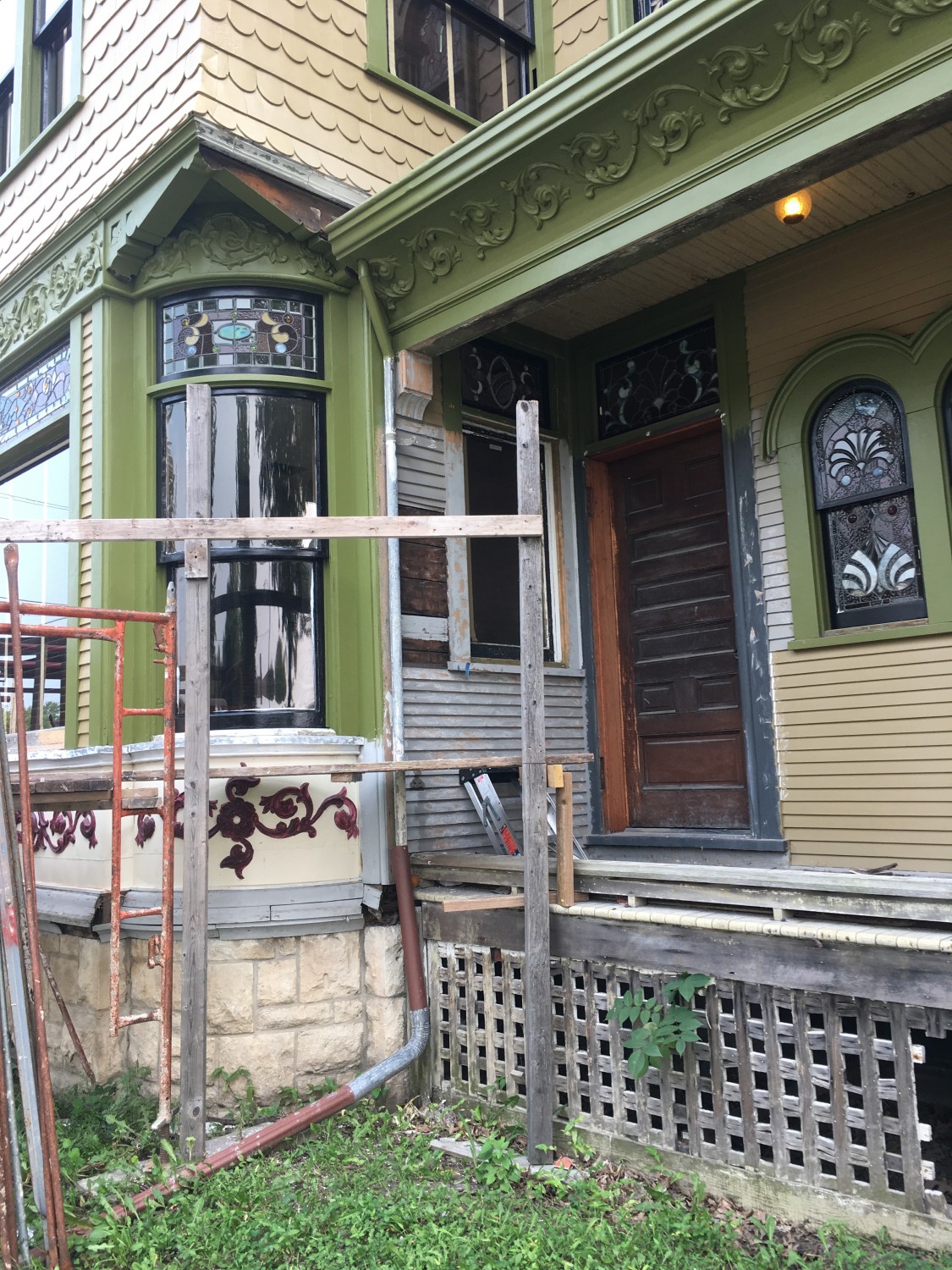
While waiting for the window glazing to dry on the big dining room window, and the east curved window, I have shifted attention to the inside corner of the porch, which requires some…attention. Like the DARK door, which I have been eager to make pretty. Eager!
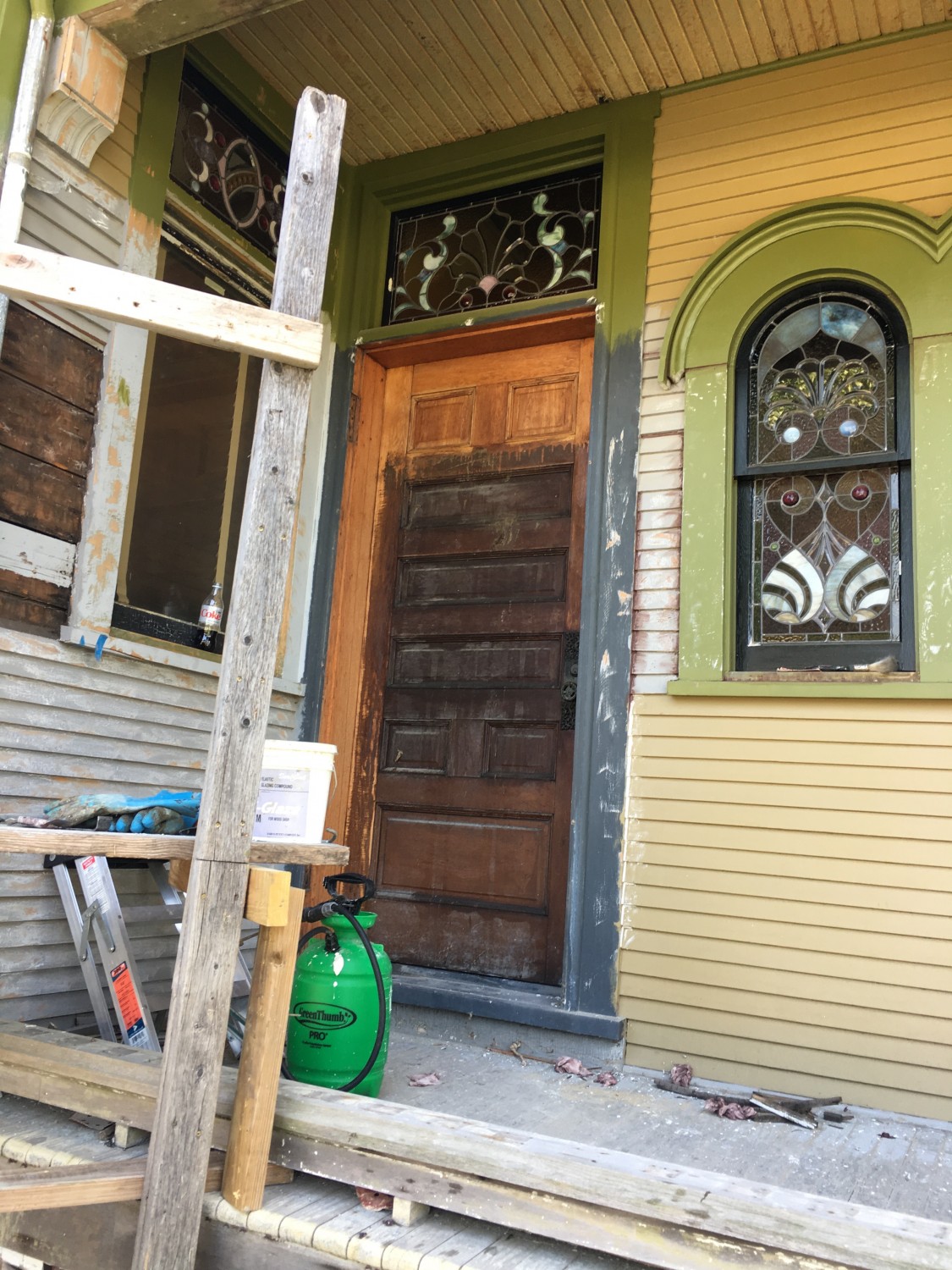
And so, today, pretty began!
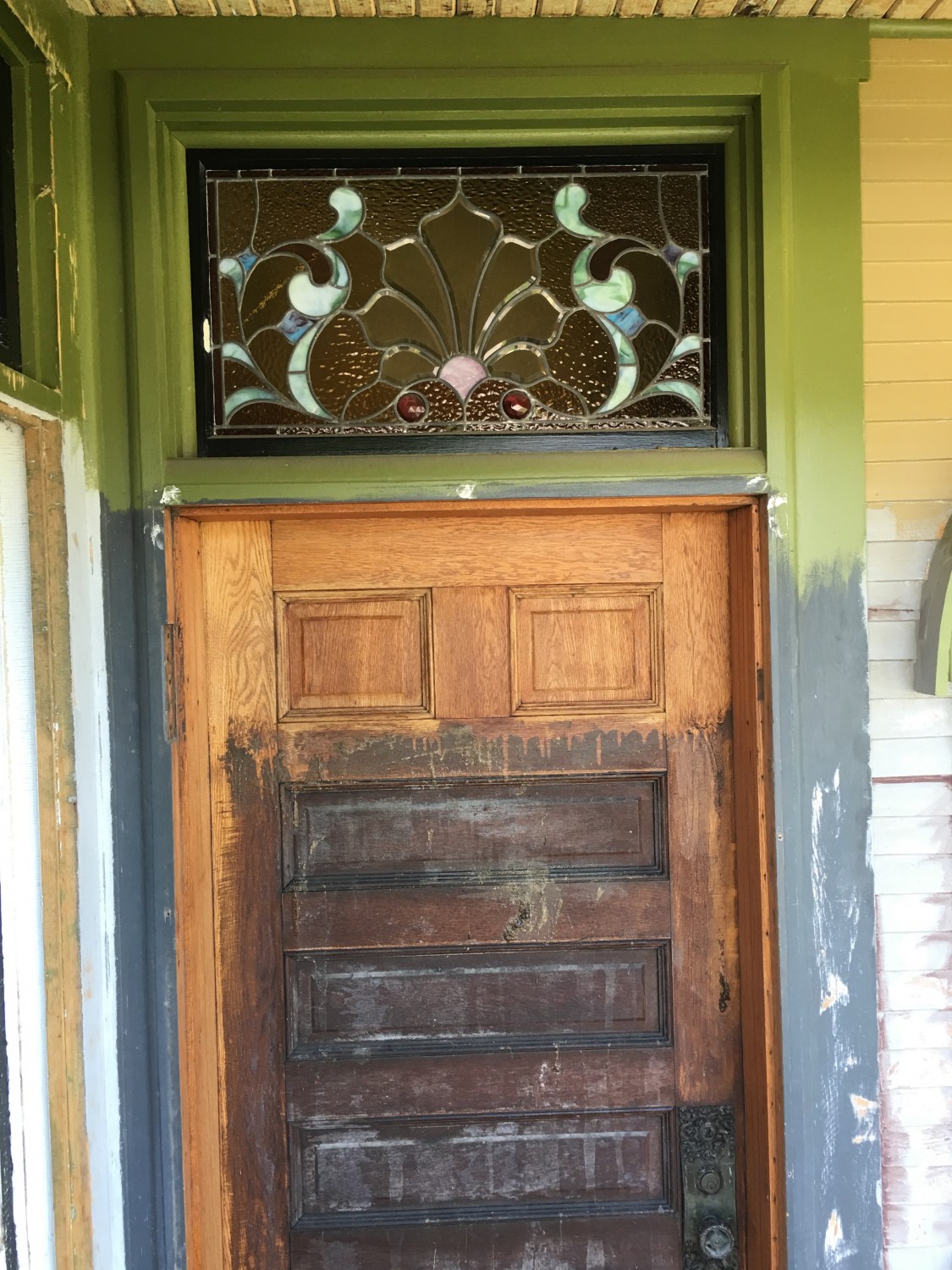
MUCH better!
On the front of the house, I restored the double set of entry doors by using denatured alcohol. The process was more tedious than difficult, and the old shellac had come off easily.
To my surprise though, and distress, denatured alcohol had no effect on the ancient cracked dark finish on the north door.
So I switched to paint stripper. This did the trick but whatever the finish is, it is unlike anything I have experienced previously. It took a LOT of work to accomplish the above. Geez. The stripper transformed the old finish into a kinda…glue. Ugh. Ugh!
My plan is to do a panel a day so I don’t lose my mind.
The dark & scary door really kills the look of the inside corner of the porch, so having it all pretty is going to make a huge difference.

26 Comments
Leave a Reply Cancel Reply
Your email address will NEVER be made public or shared, and you may use a screen name if you wish.
Just want to note that you should take the door off its hinges, lay it on sawhorses and use THIN BODIED STRIPPER. I use Kutzit brand by Savogran, which I just searched and one can buy from Amazon. Here is a link:
https://www.amazon.com/s/?ie=UTF8&keywords=kutzit+paint+and+varnish+remover&tag=googhydr-20&index=aps&hvadid=182060539810&hvpos=1t1&hvnetw=g&hvrand=364379756843937116&hvpone=&hvptwo=&hvqmt=b&hvdev=c&hvdvcmdl=&hvlocint=&hvlocphy=9007903&hvtargid=kwd-64525438394&ref=pd_sl_2mw3hz87e_b_p20
Heavy bodied stripper is more expensive and creates gelatinous glop. The original purpose of the heavy bodied was to make it stay on vertical surfaces. Anything that you can place so its surface is horizontal should be stripped with a thin bodied stripper. It is easier, less expensive, and and uses less. With thin bodied stripper, you just keep it wet. Don’t wipe off each coat, but use your cheap brush as a scraper and push it around to the areas that it hasn’t worked on yet. If you rub the side of the bristles on the surface, you can feel the old finish giving up its grip. At first it drags along. That is when you add more on top without trying to wipe any off. Often you can just move some from elsewhere on your project.
–
On a door such as yours, I use the paneled areas as reservoirs, pouring some stripper in and dipping my brush from there. Remember not to follow the instructions and wipe until rubbing with the side of your brush exposes an all clear surface even if the surrounding stripper is running back over what you have exposed. The brush should glide across easily when the varnish is gone. I believe that the manufacturers of these products advise wiping off between coats in order to have you use a lot more product. Wipe only when you think that you have lifted all of the finish. You will still miss some, but that is when you wipe with paper towels. I literally throw these towels on an old piece of plywood on the ground in the sun so they dry out pretty quickly. This can be followed with your traditional burning of the rags if you care to, but I have not had a problem with spontaneous combustion since they are in open air and dried before I dispose of them. Finally I do a new coat of clean stripper to get the last bits.
–
Hope this is helpful to someone even if you don’t use this method.
I stated that heavy bodied stripper creates gelatinous glop. It actually starts that way and gets worse as it absorbs finish and your surface needs to have it cleaned off after use.
Beautiful oak door by the way.
It will be!
And the fabulous kelp hardware will also be gorgeous with the dark old varnish off it!
What glorious wood in that door! I don’t envy you the process but I applaud the results!
Totally concur with Stewart. This how I refinished the door on my Victorian many years ago. Very caustic stuff though, but much more efficient. Wear heavy duty chemical gloves!! The door is looking awesome nonetheless BTW!!
The Kutzit brand that I use is not nearly as caustic as the heavy bodied stuff. I would still follow all typical safety procedures. I forgot to put them in making assumptions that anyone would know to follow them. Be sure to do this work in a shady spot. The sun dries the stripper right up and it won’t work unless wet.
I enjoy these inching along posts so much, Ross.
I have used denatured alcohol with some straight toluene mixed in, which makes it cut better. However, I don’t remember what the best proportion is.
Looks beautiful Ross.
The bit of the door that you’ve done makes the window above just gleam. Lovely.
I echo Barb Sanford–the small bit of beauty makes the gorgeous stained glass above stand out!
Where the hell do you get the energy? I sure could use some of it. Oh, and I love the way people send info your way. It is so nice to see people being engaged by something positive!
Oh how I long to have my own home like this that I can spend my time fixing up and restoring.
Wow, it looks sooo much better! It seems like, whenever I see old houses, the wood is really dark. I just assumed they used dark wood or stained it very dark. Do you know whether that was common or did most people just shellac their wood and then it turned dark over time? I always try to picture what old houses looked like when they were new, and I always pictured Victorian homes being really dark, but maybe they were actually relatively “light and breezy.” (I know that’s a weird question, but I was just curious)
I may be wrong, but I think Victorians usually had lighter wood in their homes, but tons of dark wallpaper and paint, though it was usually still pretty colourful.
Hi Jonathan! I’m sure the wallpaper was beautiful in person, but that combined with the patterned “wall to wall” carpet and all that Victorian “clutter” seems crazy and would have given me a headache!
Very true, I distaste wall to wall carpet, hard to clean, gets dirty easily, and holds in odors! What were they thinking when they started the trend that has now lasted over a century?
Dear Kerri,
The agencies that are trying to get you to buy fake wood products have made people confuse two issues. There is wood that is stained and finished, and wood that is just finished. There is also a lot of”wood” today that is not wood at all. Now you hear that furniture has a “cherry finish” which I take to mean it has been stained to look like antique cherry would look if it was refinished with no stain. These meaningless phrases are designed to convince you that what you are looking at is special in some way.
–
On antique furniture, the finished wood is regularly dusted and supposed to be waxed every once in a while. The old woodwork in a house doesn’t get nearly the same attention although it should. Over the years, a finish such as shellac or varnish is exposed to pollutants in the air, dust and dirt, and who knows what depending on the use of the rooms. If it is not getting the regular care, this becomes what you think of as the dark wood or dark stained wood. This does not mean that wood was never stained very dark. It just means that wood that wasn’t stained dark can become dark with time and neglect. The finish can also fail, which makes it opaque instead of clear. The reason for the finish is to protect the wood and bring out the grain, no matter how it is colored. It seems that stain was usually an earth tone that was used to bring out the grain and beauty of a particular wood, but you can also stain wood any color without hiding the grain of the wood. Some were even painted to look like good wood.
–
In the case of the Cross House, very good quality woods are among the many quality materials used in building the house. There are many houses that the same type of work that Ross is doing would reveal poor quality woods for which stain may have been used to hide the lack of quality. The builders of these places may have intentionally obscured the grain and the wood, to achieve a “look”.
–
I hope this is helpful even if it doesn’t exactly answer your question.
Thank you Stewart. That was really helpful. When I hear about stain,varnish,shellac,wax,and “painting” on a grain, it’s all very confusing. By making the distinction between what is staining versus finishing really helps to clarify it all in my mind. Thank you!
Hi, Kerri!
Almost all the wood in the Cross House has been repeatedly shellacked over the last century.
In time, shellac darkens.
When I purchased the house all the wood was very dark. I have refinished the parlor wood, which is now restored to its original light brown, and the library, which is now restored to its original cherry-like finish. The entry doors are now restored to their original golden oak.
Thank you Ross! I usual don’t ask a lot of questions because if it’s about something I don’t know anything about, like wood for example, I don’t want to sound like an idiot. When I first heard you mention shellac, I thought it was used as an alternative to wax, but now I’ve learned that it can also be used as the actual finish itself. Once again, I’ve learned something from reading your blog and got to see more pictures of all your progress!
Marine varnish maybe?
I know you wanted a green one, but here’s a pink one.
https://asheville.craigslist.org/zip/d/50s-pink-cast-iron-double/6261485667.html
How’s the door stripping going, Ross?
Morning Ross, I stripped an oak ice box years ago, out side in the shade. Turned out great, sent hardware to have nickel removed from brass. One of my favorite pieces. You and the Cross House are amazing, beautiful job, would love to be your neighbor. My Maltese Guster and I are planning a road this spring would love to visit. Keep inching along BEAUTIFUL 💝